✅ Oswaal Class 10 SST — Topper's Choice
✅ Together With SST — Best for Practice
✅ Oswaal Science Class 10 — Chapter Wise
✅ RD Sharma Maths — Most Popular
Print Culture and the Modern World Class 10 Notes
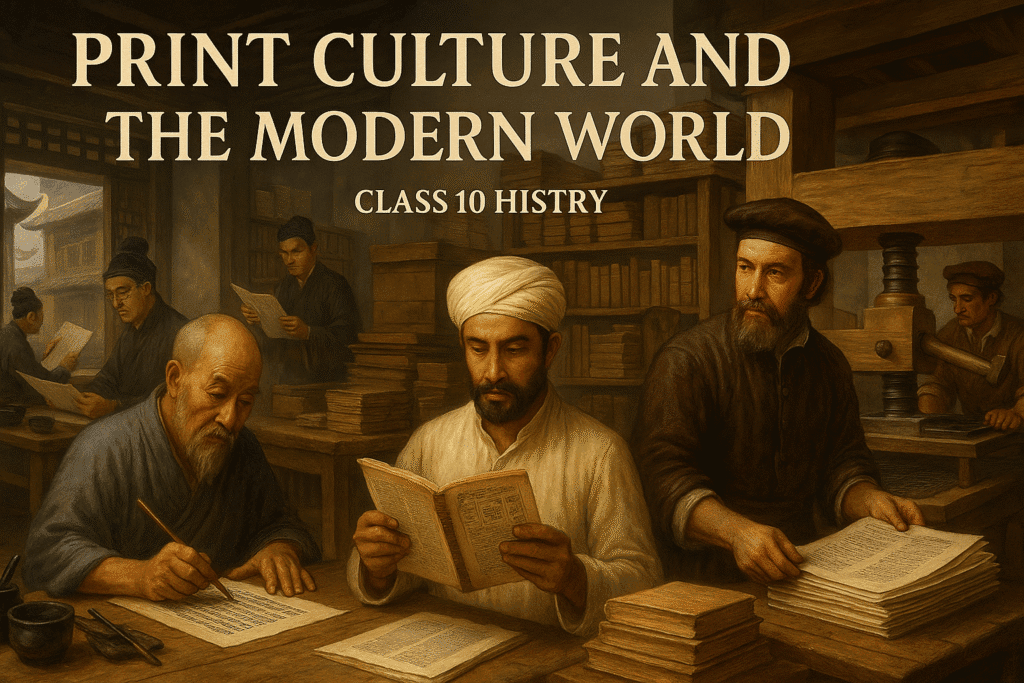
Print Culture and the Modern World
Today, it is almost impossible to imagine life without printed material. We are surrounded by print in every part of our daily lives. Books, magazines, newspapers, school textbooks, advertisements, calendars, posters, cinema tickets, official notices, and even product packaging are all examples of printed matter. We read printed stories and articles, look at printed images, and learn about current events through newspapers and magazines. Because print is so common, we often take it for granted and rarely think about how revolutionary this invention was.
However, there was a time when printed books and newspapers did not exist. Knowledge was transmitted mainly through handwritten manuscripts, oral traditions, and personal teaching. Producing a single book required copying every page by hand, which was a slow, expensive, and laborious process. As a result, books were rare and available only to a small number of people such as scholars, religious leaders, and wealthy individuals.
The invention and spread of printing changed this situation completely. It made it possible to produce large numbers of books and other materials quickly and at a much lower cost. This meant that information, ideas, and knowledge could reach a much wider audience than ever before.
The history of print is therefore not merely the story of a technological invention. It is also the story of profound social and cultural change. As printed material became more widely available:
- Literacy increased.
- Education expanded.
- New ideas spread rapidly.
- Public debate became possible.
- Social and political movements gained strength.
Print played a crucial role in shaping the modern world. It helped spread scientific discoveries, religious reforms, political ideas, and nationalist movements. Newspapers connected people to events happening across the world, while books and pamphlets influenced public opinion and inspired change.
In this chapter, we study how print developed from its earliest beginnings in East Asia, how it spread to Europe, and how it eventually transformed Indian society. We also examine how print affected people’s lives, altered social relationships, and contributed to the making of the modern world.
The First Printed Books
Print Culture and the Modern World Class 10 Notes
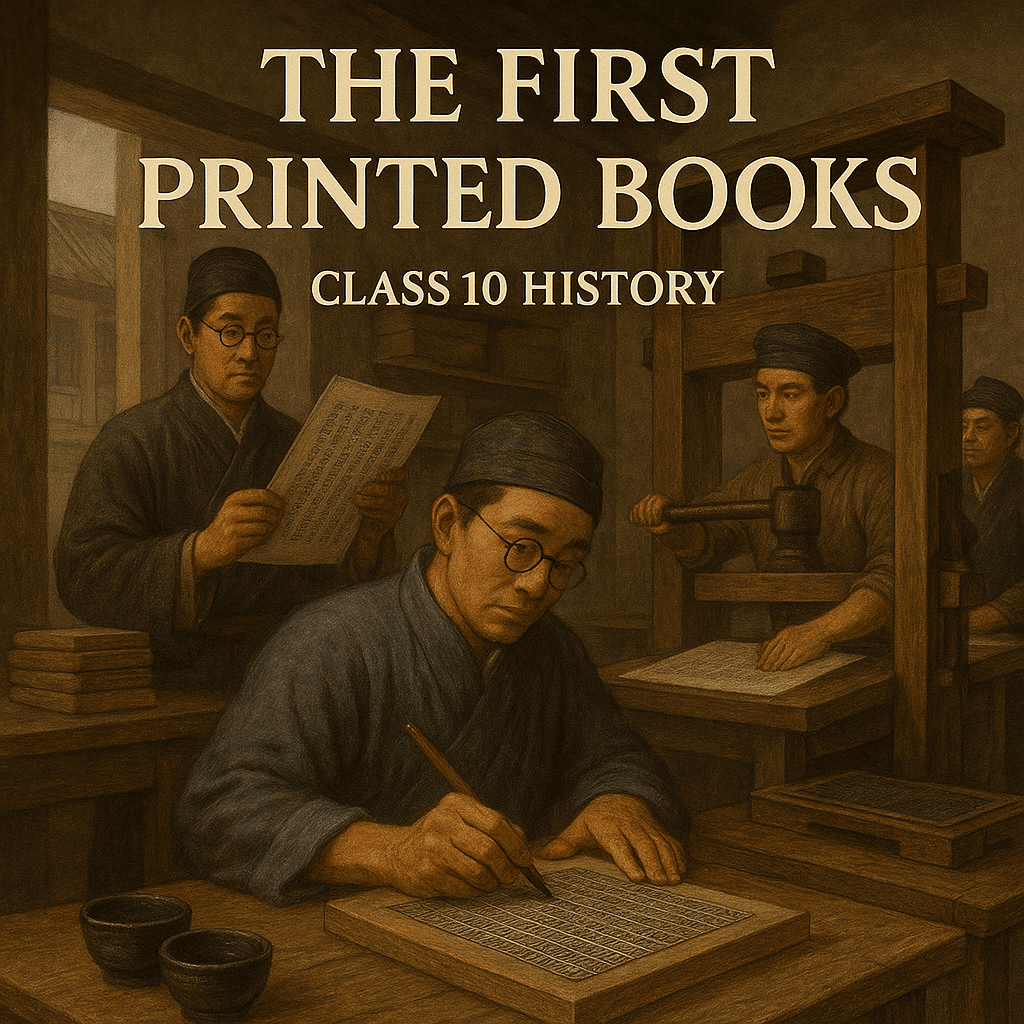
The earliest printing technology was developed in East Asia, especially in China, Japan, and Korea. This was a method of hand printing, in which texts and images were carved on wooden blocks, inked, and then transferred onto paper. This invention marked the beginning of print culture and laid the foundation for the spread of knowledge throughout the world.
In China, printing using woodblocks began around AD 594. China had already invented paper, which made this technology practical and effective. In this method, craftsmen carved the text in reverse on a wooden block. Ink was applied to the block, and paper was rubbed against it to produce a printed page.
Because Chinese paper was thin and porous, printing could be done only on one side of the sheet. To make books, the sheets were folded and stitched at the edges. This gave rise to the traditional Chinese “accordion book” format. Chinese craftsmen were highly skilled, and they were able to reproduce the beauty and elegance of handwritten calligraphy with great accuracy.
For a long time, the imperial government of China was the largest producer of printed material. China had a vast bureaucratic system, and officials were selected through civil service examinations. To prepare candidates for these examinations, the state printed enormous numbers of textbooks and study materials.
From the sixteenth century onward, the number of examination candidates increased significantly, leading to a rapid growth in printing.
By the seventeenth century, urban culture in China had expanded, and the uses of print became much more diverse. Printing was no longer limited to government officials and scholars.
Different groups began using printed material for different purposes:
- Merchants used printed books to gather commercial information.
- General readers enjoyed fiction, poetry, autobiographies, and plays.
- Wealthy women began reading literary works.
- Many women started writing and publishing poetry and dramas.
- Courtesans wrote accounts of their own lives.
This development created a vibrant reading culture in China.
In the late nineteenth century, Western printing techniques and mechanical presses were introduced as European powers established trading and political centers in China. Shanghai became the most important center of this new print culture, especially serving Western-style schools and institutions. Gradually, hand printing was replaced by mechanical printing.
Print in Japan
Printing technology was introduced to Japan by Buddhist missionaries from China around AD 768–770. These missionaries brought with them the technique of hand printing using wooden blocks.
The oldest known Japanese printed book is the Diamond Sutra. Printed in AD 868, this Buddhist text contains six sheets of text along with woodcut illustrations. It is one of the earliest surviving examples of printed books in the world.
In Japan, printing was used not only for religious books but also for many everyday objects such as:
- Textiles
- Playing cards
- Paper money
During medieval times, printed books became increasingly common. Poetry and prose were regularly published, and books became both affordable and widely available.
By the late eighteenth century, print culture had flourished in the city of Edo (modern-day Tokyo). Illustrated books and paintings depicted urban life, including artists, courtesans, and gatherings in teahouses.
Libraries and bookstores in Japan offered a wide variety of printed material on subjects such as:
- Women’s lives
- Musical instruments
- Mathematics and calculations
- Tea ceremony
- Flower arrangement
- Etiquette
- Cooking
- Travel and famous places
This rich and varied print culture made books accessible to a broad section of society and played an important role in shaping Japanese cultural life.
Print Comes to Europe
For many centuries, Europe maintained trade links with Asia through the Silk Route. Along this route, luxury goods such as silk and spices were brought from China and other Asian regions to European markets. In the eleventh century, one of the most important inventions of China—paper—also reached Europe through these trade connections.
The arrival of paper transformed the production of books in Europe. Before paper became widely available, books were written on parchment or vellum, which were made from animal skin and were very expensive. Paper was much cheaper and easier to produce, making manuscript writing more practical and less costly.
Books in medieval Europe were copied by hand by skilled scribes. These manuscripts were carefully written and often decorated with elaborate illustrations. However, preparing manuscripts was extremely slow, expensive, and labor-intensive.
In 1295, the famous Venetian traveler Marco Polo returned to Italy after spending many years in China. During his travels, he observed Chinese woodblock printing technology and brought this knowledge back to Europe.
Inspired by this technology, Italian printers began producing books using wooden blocks. The method gradually spread to other parts of Europe.
At first, printed books were not universally admired. Wealthy aristocrats and monastic libraries often preferred beautifully handwritten books on vellum and regarded printed books as cheap and inferior. In contrast, merchants and university students welcomed printed books because they were more affordable and accessible.
As literacy increased and the demand for books grew, booksellers across Europe began exporting books to different countries. Book fairs were organized where books were bought and sold in large quantities.
To meet the growing demand, manuscript production was also expanded. Scribes increasingly worked for booksellers rather than solely for wealthy patrons, and some booksellers employed more than fifty scribes at a time.
Despite these efforts, handwritten manuscripts could not satisfy the rising demand for books because they:
- Took a long time to produce.
- Were expensive.
- Were fragile.
- Were difficult to carry and use.
As a result, woodblock printing became increasingly popular. By the early fifteenth century, Europeans were widely using woodblocks to print:
- Textiles
- Playing cards
- Religious pictures with short texts
However, even woodblock printing had limitations. Each page had to be carved on a separate block, making the process slow and costly.
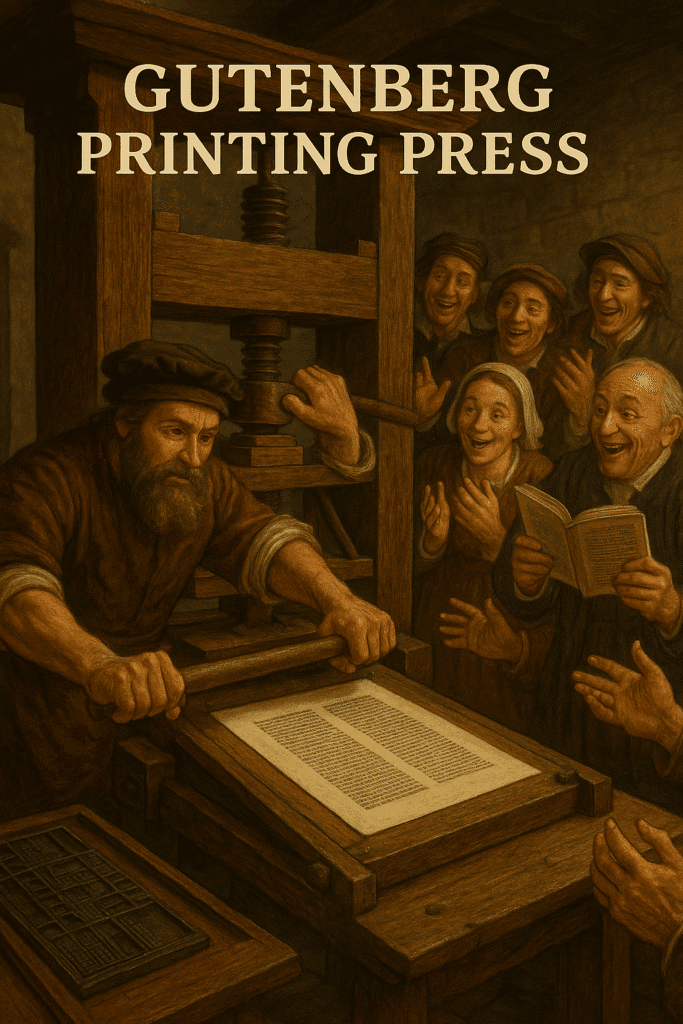
A major breakthrough came in the 1430s in Strasbourg, Germany, when Johann Gutenberg developed the first known printing press using movable metal type.
Gutenberg and the Printing Press
Johann Gutenberg was the son of a merchant and grew up on a large agricultural estate. From a young age, he was familiar with wine and olive presses, which later inspired his invention.
He trained as:
- A stone polisher.
- A master goldsmith.
- A maker of lead moulds used for casting metal objects.
Using this knowledge, Gutenberg combined existing technologies to create the printing press.
The key elements of his invention were:
- The screw mechanism of the olive press, used to apply pressure.
- Metal moulds, used to cast individual letters.
- Movable metal type, which allowed letters to be arranged and reused.
By 1448, Gutenberg had perfected this revolutionary system.
The first major book printed using this press was the Gutenberg Bible. About 180 copies were produced, and the entire process took approximately three years. Compared with hand-copying manuscripts, this was extraordinarily fast.
Initially, printed books were designed to resemble handwritten manuscripts. Printers used ornate typefaces that imitated calligraphy. Decorative borders and illustrations were often added by hand. Wealthy buyers could leave blank spaces in the printed book and later have artists decorate them according to their preferences.
Between 1450 and 1550, printing presses were established in most European countries. German printers traveled widely, helping to set up presses in new regions.
As the number of presses increased, book production expanded dramatically:
- About 20 million books were printed in Europe during the second half of the fifteenth century.
- By the sixteenth century, this number had risen to approximately 200 million copies.
This enormous increase in the production of books marked the beginning of the Print Revolution.
The Print Revolution transformed Europe by making books cheaper, more widely available, and accessible to a much larger audience. It accelerated the spread of knowledge, ideas, and information, and played a crucial role in shaping the modern world.
The Print Revolution and Its Impact
The Print Revolution refers to the far-reaching changes brought about by the invention and spread of printing technology in Europe. It was much more than a new method of producing books. It transformed the way people acquired knowledge, shared information, and interacted with religious, political, and social authorities. Printing changed popular thinking and opened entirely new ways of understanding the world.
A New Reading Public
One of the most important outcomes of the printing press was the emergence of a new reading public. Before printing, books were copied by hand, making them scarce and very expensive. Only wealthy people, monasteries, and educational institutions could afford them. As a result, reading was largely confined to the educated elite.
The printing press dramatically reduced the cost of producing books. Multiple copies could be printed quickly and efficiently, making books cheaper and more widely available. As books flooded the market, they reached an ever-growing number of readers.
Before the age of print, most ordinary people lived in an oral culture. They gained knowledge by listening to sacred texts, folk tales, ballads, and public performances. Information was shared collectively, and people often heard stories rather than reading them individually.
With the spread of print, this situation began to change. A reading public emerged—people who could directly access books and printed materials. However, literacy rates remained low in most European countries until the twentieth century, so the transition was gradual.
Printers and publishers understood this limitation. To attract common people, they published popular ballads, folk tales, and religious stories with numerous illustrations. These printed works were read aloud in villages, marketplaces, and taverns, allowing even illiterate people to enjoy them.
Thus, print did not replace oral culture immediately. Instead, oral and print cultures blended together. Printed texts were read aloud, and oral traditions were preserved in printed form. The hearing public and the reading public became closely connected.
Print Culture and the Modern World Class 10 Notes
Religious Debates and the Fear of Print
The printing press made it possible for ideas to circulate widely and rapidly. This created a new world of debate and discussion. People who disagreed with established authorities could now publish their views and influence large audiences.
This development was revolutionary, but it also caused fear. Religious leaders, monarchs, writers, and artists worried that unrestricted printing might spread rebellious, immoral, or irreligious ideas. They feared that established beliefs and respected literature would lose their authority.
These concerns became particularly significant in religion.
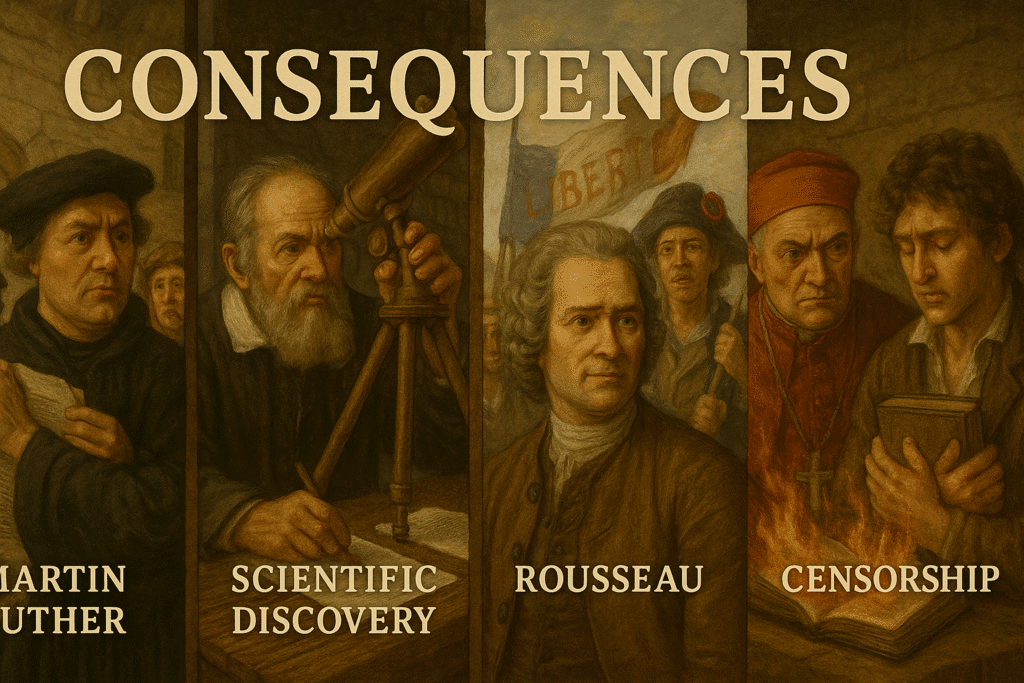
In 1517, Martin Luther wrote his famous Ninety-Five Theses, criticizing several practices of the Roman Catholic Church, especially the sale of indulgences. A printed copy was posted on a church door in Wittenberg, Germany.
Luther’s ideas spread rapidly because of print. Thousands of copies were reproduced and distributed across Europe. His writings challenged Church authority and inspired the Protestant Reformation, which led to a major division in Christianity.
Luther also translated the New Testament into German so ordinary people could read it themselves. About 5,000 copies were sold within a few weeks, and a second edition appeared within three months.
Recognizing the importance of printing, Luther declared:
“Printing is the ultimate gift of God and the greatest one.”
Many historians believe that print helped create a new intellectual climate that encouraged questioning, debate, and religious reform.
Print and Dissent
Print Culture and the Modern World Class 10 Notes
The spread of printed books enabled ordinary people to interpret religious texts independently. This sometimes led to ideas that challenged the authority of the Church.
One famous example is Menocchio, a miller from Italy in the sixteenth century. Menocchio read books available in his locality and developed his own unusual interpretations of the Bible and the creation of the universe.
His views angered the Roman Catholic Church. During the Inquisition—a system established to suppress heresy—Menocchio was tried twice and eventually executed.
Disturbed by such independent interpretations, the Roman Catholic Church imposed strict controls over printing.
In 1558, the Church introduced the Index of Prohibited Books, a list of books considered dangerous or heretical. Catholics were forbidden from reading these works without permission.
This shows that print became a powerful tool not only for spreading knowledge but also for challenging authority and encouraging dissent. Governments and religious institutions recognized its influence and sought to regulate what people could read.
Summary
The Print Revolution had a profound impact on European society:
- It reduced the cost of books and made them widely available.
- It created a new reading public beyond the educated elite.
- It blended oral and written traditions.
- It encouraged debate, discussion, and the questioning of authority.
- It played a crucial role in the Protestant Reformation.
- It enabled ordinary people to form independent opinions.
- It led to censorship and stricter control over books.
In short, the Print Revolution changed the intellectual and cultural life of Europe and laid the foundation for the modern world of information and mass communication.
The Reading Mania
During the seventeenth and eighteenth centuries, literacy rates increased significantly across Europe. Churches belonging to different Christian denominations established schools in villages, helping peasants and artisans learn to read and write. By the end of the eighteenth century, literacy rates in some parts of Europe had reached 60 to 80 percent. As more people became literate and schools spread, Europe experienced what historians describe as a “reading mania.” People developed a strong desire to read, and printers responded by producing books in ever-growing numbers.
This expanding readership created a demand for new forms of popular literature. Booksellers employed pedlars who travelled from village to village carrying small and inexpensive books. These included almanacs, which were ritual calendars containing practical information, along with ballads and folktales. Entertainment literature also became widely available.
In England, cheap booklets known as penny chapbooks were sold by chapmen for just one penny, making them affordable even for poor readers. In France, low-priced books called the Bibliothèque Bleue were printed on poor-quality paper and bound in simple blue covers. Romances, which were short love stories, and longer “histories” about the past also gained popularity. Books were produced in different sizes and formats to meet the varied interests of readers.
The periodical press also developed in the early eighteenth century. Newspapers and journals combined current affairs with entertainment, reporting on wars, trade, and events taking place in distant parts of the world.
Print also made scientific and philosophical ideas accessible to ordinary people. Ancient and medieval scientific works were compiled and published, and maps and diagrams were printed widely. When scientists such as Isaac Newton published their discoveries, they were able to influence a much larger audience. The writings of thinkers like Thomas Paine, Voltaire, and Jean-Jacques Rousseau were also widely printed and read. Their ideas about science, reason, and rationality reached ordinary readers and shaped popular thought.
‘Tremble, therefore, tyrants of the world!’
By the mid-eighteenth century, many people believed that books were powerful tools for spreading progress and enlightenment. They thought that books could transform society, challenge despotism, and create a world governed by reason and intellect.
The French novelist Louis-Sébastien Mercier strongly expressed this belief. He declared:
“The printing press is the most powerful engine of progress and public opinion is the force that will sweep despotism away.”
In Mercier’s novels, characters are often transformed through reading. They immerse themselves in books, gain new understanding, and become enlightened.
Convinced of the power of print to destroy tyranny, Mercier proclaimed:
“Tremble, therefore, tyrants of the world! Tremble before the virtual writer!”
This statement reflects the growing confidence that print could challenge rulers and empower ordinary people.
Print Culture and the French Revolution
Many historians argue that print culture created the conditions that made the French Revolution possible.
First Argument: Spread of Enlightenment Ideas
Print popularised the ideas of Enlightenment thinkers. Their writings criticized tradition, superstition, and despotism. They promoted reason over custom and argued that all institutions should be judged through logic and rational thought.
Writers such as Voltaire and Rousseau attacked the authority of the Church and the absolute power of monarchs. Their works encouraged readers to question established institutions and think critically about society.
Second Argument: Creation of a Public Sphere
Print created a new culture of dialogue and debate. Readers discussed books, pamphlets, and newspapers, reevaluating accepted beliefs and social norms.
This culture of discussion helped generate new ideas about liberty, equality, and social revolution.
Third Argument: Criticism of the Monarchy
By the 1780s, large amounts of literature openly mocked the French monarchy and criticized the moral conduct of the royal family.
Cartoons and caricatures portrayed the king and queen as selfish and indulgent, while ordinary people suffered poverty and hunger. Such underground literature increased hostility toward the monarchy and weakened respect for the existing social order.
A Balanced View
Although print helped spread revolutionary ideas, its influence was not automatic. People read a variety of materials, including works supporting the monarchy and the Church. Readers interpreted texts in different ways, accepting some ideas and rejecting others.
Print did not directly determine people’s opinions, but it created the possibility for them to think differently, question authority, and imagine a new social and political order.
The Nineteenth Century
The nineteenth century witnessed a remarkable expansion in mass literacy across Europe. As more schools were established and education spread, large sections of society who had previously been excluded from reading—especially children, women, and workers—became active readers. This transformation greatly increased the demand for books, magazines, newspapers, and educational material, and it significantly expanded the publishing industry.
Children, Women and Workers
As primary education became compulsory in many European countries during the late nineteenth century, children emerged as an important new category of readers. This led to a rapid growth in the production of school textbooks and children’s literature. In 1857, a special children’s press was established in France, devoted entirely to books for young readers. It published both new stories and traditional fairy tales and folk tales.
In Germany, the Brothers Grimm spent years collecting folk tales from peasants. These stories were carefully edited before publication in 1812. Any material considered unsuitable for children or offensive to elite sensibilities was removed. As a result, print not only preserved old oral stories but also transformed them into new literary forms suitable for modern readers.
Women also became an increasingly important reading public. Publishers produced penny magazines and manuals on housekeeping and proper conduct specifically for women. With the rise of the novel in the nineteenth century, women were recognized as a major audience. Some of the most celebrated novelists of the era were women, including Jane Austen, the Brontë sisters, and George Eliot. Their works portrayed women as intelligent, determined, and capable of independent thought, helping redefine the image of women in society.
Workers also entered the world of print. Lending libraries, which had existed since the seventeenth century, became especially important in nineteenth-century England. They provided affordable access to books for white-collar workers, artisans, and lower-middle-class readers.
As working hours gradually decreased from the mid-nineteenth century, workers gained some leisure time. Many used this time for self-education and self-expression. Some taught themselves to read and write and began producing political tracts and autobiographies. Through print, workers found a voice and a means to share their ideas and experiences.
Further Innovations
The nineteenth century also saw major technological innovations that transformed printing and publishing.
By the late eighteenth century, printing presses were made of metal, making them stronger and more efficient. During the nineteenth century, several new inventions improved printing speed and quality.
One major innovation was the power-driven cylindrical press developed by Richard March Hoe of New York. By the mid-nineteenth century, his machine could print 8,000 sheets per hour, making it particularly useful for newspapers.
In the late nineteenth century, the offset press was introduced, allowing printers to print up to six colours at once. From the early twentieth century, electrically operated presses further accelerated the printing process.
Additional improvements included:
- Better methods of feeding paper.
- Higher-quality printing plates.
- Automatic paper reels.
- Photoelectric controls for colour registration.
Together, these innovations greatly improved the appearance and efficiency of printed materials.
Publishers also developed new marketing strategies to increase sales. Important novels were often serialized in magazines and periodicals, creating excitement and encouraging readers to purchase each issue.
In 1920s England, inexpensive books were published in the popular Shilling Series, making literature affordable to a broader audience.
Another innovation was the dust cover or book jacket, introduced in the twentieth century.
During the Great Depression of the 1930s, publishers feared declining sales and responded by producing cheap paperback editions, ensuring that books remained accessible even during difficult economic times.
India and the World of Print
The history of print in India began much later than in China and Europe, but India already possessed a rich tradition of handwritten manuscripts. The arrival of the printing press transformed the way ideas, information, and literature were produced and circulated. It helped spread knowledge more widely and laid the foundation for the growth of newspapers, journals, and modern public debate in India.
Print Culture and the Modern World Class 10 Notes
Manuscripts Before the Age of Print
Before the introduction of printing, India had a long and highly developed tradition of handwritten manuscripts. These manuscripts were written in languages such as Sanskrit, Arabic, Persian, and many regional vernacular languages.
They were copied by hand on palm leaves or handmade paper. The pages were sometimes decorated with beautiful illustrations. To preserve them, the leaves were either pressed between wooden covers or sewn together.
Even after the printing press was introduced, manuscripts continued to be produced until the late nineteenth century.
However, manuscripts had several limitations:
- They were expensive to prepare.
- They were fragile and easily damaged.
- They required careful handling.
- Different styles of handwriting made them difficult to read.
Because of these difficulties, manuscripts were not widely used in everyday life.
In pre-colonial Bengal, for example, there was an extensive network of village primary schools. Yet students often did not read books. Instead, teachers recited passages from memory and students copied them down. As a result, many people became literate in writing without actually reading texts themselves.
Print Comes to India
The printing press was introduced to India by Portuguese missionaries in the mid-sixteenth century.
The first printing press was established in Goa. Jesuit priests learned the Konkani language and printed several religious tracts. By 1674, around 50 books had been printed in Konkani and Kanara languages.
Catholic missionaries also played a pioneering role in printing books in Indian languages:
- The first Tamil book was printed in 1579 at Cochin.
- The first Malayalam book was printed in 1713.
- By 1710, Dutch Protestant missionaries had printed 32 Tamil texts, many of them translations of older works.
Although the English East India Company imported printing presses from the late seventeenth century, the English-language press developed much later.
A major milestone came in 1780 when James Augustus Hicky began publishing the Bengal Gazette (also known as Hicky’s Bengal Gazette). It was a weekly newspaper that described itself as:
“A commercial paper open to all, but influenced by none.”
This was the first printed English newspaper in India.
Hicky published advertisements, including those related to the sale of slaves, but he also criticized senior officials of the East India Company.
Angered by these attacks, Warren Hastings persecuted Hicky and supported the publication of government-friendly newspapers to counter criticism.
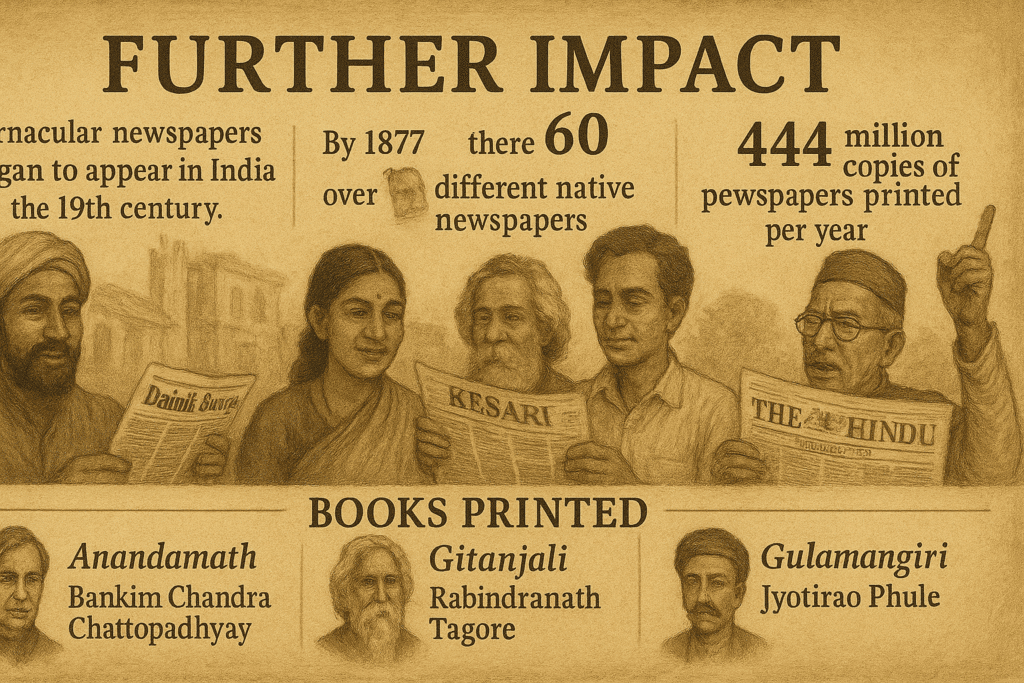
By the end of the eighteenth century, several newspapers and journals were being published in India.
Indians also entered the field of journalism. The first Indian-owned newspaper was the Bengal Gazette, published by Gangadhar Bhattacharya, who was associated with Raja Rammohun Roy.
Thus, the coming of print to India marked the beginning of a new era in communication, journalism, and the spread of ideas.
Print Culture and the Modern World Class 10 Notes
Print Culture and the Modern World Class 10 Notes
Religious Reform and Public Debates
From the early nineteenth century, India witnessed intense debates on religious and social issues. Different groups responded to the changes taking place under colonial rule in different ways. Some reformers criticized existing customs and campaigned for change, while others defended traditional beliefs and practices. These debates were carried out publicly through books, pamphlets, newspapers, and printed tracts.
Printed material played a crucial role in spreading new ideas and shaping the nature of public discussion. For the first time, a much wider public could read arguments, respond to them, and express their own views. As different opinions clashed, new ideas and interpretations emerged.
This period saw sharp controversies between social and religious reformers and orthodox Hindu groups over practices such as sati (widow immolation), monotheism, Brahmanical priesthood, and idol worship.
In Bengal, a large number of newspapers and tracts were published to present different viewpoints. To reach ordinary people, these publications used everyday spoken language rather than difficult classical forms.
Raja Rammohun Roy began publishing the Sambad Kaumudi in 1821 to promote his reformist ideas. In response, orthodox Hindus published the Samachar Chandrika to oppose his views.
From 1822, two Persian newspapers—Jam-i-Jahan Nama and Shamsul Akhbar—began publication. In the same year, the Gujarati newspaper Bombay Samachar was launched. It later became one of the longest-running newspapers in India.
In North India, Muslim scholars or ulama were deeply concerned about the decline of Muslim dynasties and feared that British rule would encourage religious conversion and interfere with Muslim personal laws.
To counter this, they made extensive use of cheap lithographic printing presses. They published Persian and Urdu translations of religious texts, as well as newspapers and pamphlets explaining Islamic teachings.
The Darul Uloom Deoband, established in 1867, published thousands of fatwas (religious rulings) to guide Muslims in their daily lives and explain Islamic doctrines.
Throughout the nineteenth century, many Muslim sects and seminaries emerged. Each promoted its own interpretation of Islam and used Urdu print to spread its ideas and respond to rivals.
Among Hindus as well, print encouraged the reading of religious texts in regional languages.
The first printed edition of Ramcharitmanas by Tulsidas was published in Calcutta in 1810.
By the mid-nineteenth century, cheap lithographic editions of religious books were widely available in North India.
From the 1880s, the Naval Kishore Press and the Shri Venkateshwar Press published large numbers of religious texts in vernacular languages.
Because these printed books were portable and inexpensive, people could read them anywhere and at any time. They were also read aloud to groups of illiterate men and women, allowing even non-readers to access religious ideas.
As a result, religious texts reached a vast audience and stimulated discussion, debate, and controversy both within and between different religious communities.
Print did more than spread conflicting opinions. It also connected people across different regions of India. Newspapers carried news from one place to another, helping create a broader sense of shared identity and contributing to the growth of pan-Indian consciousness.
New Forms of Publication
The spread of printing created a strong demand for new kinds of writing. As more people learned to read, they wanted books and magazines that reflected their own lives, emotions, experiences, and relationships. Readers were no longer satisfied with only religious texts or scholarly works. They wanted literature that described ordinary human life in a realistic and engaging way.
One of the most important new literary forms to emerge was the novel. Originating in Europe, the novel soon developed distinct Indian forms and styles. Novels opened up entirely new worlds for readers. They presented vivid stories about family life, social customs, love, conflict, and moral dilemmas. Through novels, readers gained a deeper understanding of the diversity and complexity of human lives.
Along with novels, many other literary forms became popular, including lyrics, short stories, and essays on social and political issues. These forms explored personal feelings and social realities, while also discussing the political and cultural rules that shaped people’s lives. Print culture therefore encouraged both entertainment and thoughtful reflection.
By the end of the nineteenth century, print also gave rise to a powerful visual culture. As printing presses multiplied, images could be reproduced in large numbers and distributed widely.
Raja Ravi Varma played a major role in this transformation. He created paintings of Hindu gods, goddesses, and mythological scenes, which were then printed and sold cheaply to the public. This allowed ordinary people to own beautiful religious images that had previously been available only to the wealthy.
Wood engravers who carved illustrations on wooden blocks often set up shops near printing presses and worked for publishers. Cheap prints and calendars became common in bazaars and were affordable even to poor households. These images decorated homes, shops, and workplaces, and shaped popular ideas about religion, tradition, modernity, politics, and society.
From the 1870s onward, journals and newspapers increasingly published cartoons and caricatures. These visual forms commented on social and political issues in a humorous but critical manner. Some mocked educated Indians who blindly imitated Western fashions and manners. Others reflected anxieties about changing social values. Imperial cartoons ridiculed Indian nationalists, while nationalist cartoons attacked British rule and exposed colonial injustice.
Women and Print
Print Culture and the Modern World Class 10 Notes
Print culture had a profound impact on women’s lives. For the first time, the experiences, emotions, and struggles of women were described vividly in books and magazines. As a result, women’s reading increased greatly, especially in middle-class families.
Many progressive fathers and husbands began educating women at home and sending them to newly established girls’ schools in towns and cities. Journals for women explained why female education was important. They also provided reading material and lessons for home-based education.
However, not all families supported women’s education. Conservative Hindus believed that an educated girl would become widowed, while some Muslims feared that reading novels and romances would corrupt women’s morals.
Despite these restrictions, many determined women secretly learned to read and write.
Rassundari Devi, a young married woman in an orthodox Bengali household, secretly learned to read in her kitchen. Later, she wrote Amar Jiban (My Life), published in 1876, which became the first full-length autobiography written in Bengali by a woman.
As social reform movements generated interest in women’s condition, women began writing about their own experiences.
Kailashbashini Debi described how women were confined to the home, denied education, and burdened with hard domestic work.
In Maharashtra, Tarabai Shinde and Pandita Ramabai wrote passionately about the suffering of upper-caste Hindu widows and the injustices faced by women.
While Bengali, Marathi, Tamil, and Urdu print cultures developed early, Hindi printing expanded significantly after the 1870s. A large portion of Hindi publications focused on women’s education.
In the early twentieth century, journals written for women—and sometimes edited by women—became extremely popular. They discussed women’s education, widow remarriage, widowhood, and the national movement. They also included household advice, fashion guidance, short stories, and serialized novels.
In Punjab, Ram Chaddha published Istri Dharm Vichar, a popular book teaching women the ideal qualities of obedient wives. The Khalsa Tract Society produced similar inexpensive booklets.
In Calcutta, the Battala printing area became famous for cheap popular publications. These included religious books, romances, and sensational literature. Pedlars carried Battala books from house to house, allowing women to read them during their leisure time.
Print and the Poor People
Print culture also reached poor and working-class people.
In nineteenth-century Madras, cheap small books were sold at marketplaces and crossroads. Even poor travellers could afford them.
From the early twentieth century, public libraries were established in towns and some prosperous villages. These libraries greatly expanded access to books. For wealthy patrons, founding a library was a source of prestige and public respect.
Print also became a powerful weapon against caste oppression.
Jyotirao Phule, a pioneering anti-caste thinker, wrote Gulamgiri (1871), exposing the injustices of the caste system.
In the twentieth century, B. R. Ambedkar and Periyar E. V. Ramasamy wrote extensively against caste discrimination. Their works were widely read across India and inspired oppressed communities.
Local protest movements and reform groups also published journals and pamphlets criticizing ancient social practices and imagining a more just society.
Factory workers had little time and limited education, but some still wrote about their lives.
Kashibaba published Chhote Aur Bade Ka Sawal in 1938, showing the connection between caste oppression and class exploitation.
Another Kanpur millworker, writing under the pen name Sudarshan Chakr, composed poems between 1935 and 1955 that were later collected as Sacchi Kavitayan.
By the 1930s, cotton mill workers in Bangalore established libraries to educate themselves. These were often supported by social reformers who aimed to promote literacy, reduce alcoholism, and spread nationalist ideas.
Through books, pamphlets, journals, and libraries, print gave women, workers, and marginalized communities new opportunities to educate themselves, express their experiences, and participate in social reform and national awakening.
Print and Censorship
Before 1798, the colonial government of the East India Company was not very concerned about controlling the press. At that time, censorship measures were mainly directed against Englishmen living in India who criticized Company officials and exposed corruption and misrule. The Company feared that such criticism, if circulated in England, could be used by its opponents to challenge its monopoly over trade in India.
By the 1820s, the colonial administration became more active in regulating the press. The Calcutta Supreme Court introduced regulations to restrict press freedom, while the government encouraged newspapers that praised British rule and supported colonial policies.
In 1835, after repeated petitions from editors of both English and vernacular newspapers, Governor-General Lord William Bentinck agreed to revise the press laws. The new rules were framed by Thomas Babington Macaulay, who was known for his liberal views. These regulations restored many of the freedoms that had previously been restricted and allowed newspapers to function with fewer controls.
The situation changed dramatically after the Revolt of 1857. British officials became suspicious of Indian-language newspapers, believing that they were encouraging resistance against colonial rule. Many Englishmen demanded strict control over what they called the “native press.”
As vernacular newspapers grew increasingly nationalist and outspoken, the colonial government introduced stricter laws. The most important of these was the Vernacular Press Act of 1878. This law specifically targeted newspapers published in Indian languages. It was modeled on the Irish Press Laws and gave the government wide powers to censor articles, editorials, and reports.
Under this Act, officials closely monitored vernacular newspapers across different provinces. If a newspaper published material considered “seditious” or anti-government, it received a warning. If the warning was ignored, the government could seize the printing press and confiscate its machinery. This was a powerful tool to silence nationalist voices.
Despite these repressive measures, nationalist newspapers continued to grow throughout India. They exposed colonial injustices, reported on political movements, and encouraged people to participate in the freedom struggle. Rather than stopping nationalist criticism, censorship often strengthened public resistance and increased sympathy for the cause of independence.
When Punjabi revolutionaries were deported in 1907, Bal Gangadhar Tilak expressed strong support for them in his newspaper Kesari. The British government charged him with sedition and imprisoned him in 1908. His arrest sparked widespread protests across India and further intensified nationalist sentiment.
Print and censorship therefore became closely linked during colonial rule. While the British government tried to suppress criticism through restrictive laws, newspapers continued to serve as powerful instruments of political awakening. They informed people, challenged colonial authority, and helped unite Indians in the struggle for freedom.
Summary
Print Culture and the Modern World Class 10 Notes
Print Culture and the Modern World Class 10 focuses on how printing transformed societies across Asia, Europe and India. The chapter begins with woodblock printing in China, followed by the spread of printing to Japan and Korea. The invention of the Gutenberg press in Europe triggered a major revolution—books became cheaper, literacy increased, and ideas spread quickly. Printing shaped the Reformation, Scientific Revolution, Enlightenment and political movements like the French Revolution.
In India, print arrived through missionaries in Goa. Newspapers, journals and vernacular printing played a major role in social reform and nationalism. The Vernacular Press Act tried to control Indian newspapers, but it failed to stop the growth of public opinion. Printing changed everyday life—new readers emerged, women accessed education, workers read political literature, and peasants mobilised. Ultimately, print became one of the strongest forces behind modern democracy, social reform and India’s freedom movement.
Other Resources
- Print Culture and the Modern World Quiz
- Print Culture and the Modern World Test
- Print Culture and the Modern World Flashcads
Similar Resources
Print Culture and the Modern World Class 10 — Important Questions, FAQs, MCQs
FAQs
Print Culture and the Modern World Class 10 Notes
1. Why was the Gutenberg printing press considered revolutionary?
The Gutenberg printing press allowed books to be printed quickly using movable metal type. Earlier, manuscripts had to be copied by hand, making them slow and expensive. With the press, books became cheaper, literacy spread, and ideas travelled across countries. It enabled the Reformation, scientific discoveries and political change. The press dramatically increased the speed at which knowledge could reach ordinary people.
2. How did print support Martin Luther’s Reformation movement?
Martin Luther wrote the “95 Theses” attacking the Church’s practices. Printing helped reproduce his ideas rapidly, allowing thousands of copies to reach people across Germany and Europe. For the first time, common people could read religious texts themselves. The Church could no longer control interpretation. Thus, print played a decisive role in weakening religious authority and spreading Protestant ideas widely.
3. What changes did printing bring to European society?
Printing created a new reading public. Books became cheaper, literacy increased, and people from different backgrounds could access knowledge. Scientific texts helped researchers share discoveries. Newspapers allowed political debates. Pamphlets criticised governments. People questioned old beliefs and demanded change. This print culture laid the foundation for modern democratic thinking.
4. How did print influence the French Revolution?
Printing spread Enlightenment ideas that criticised monarchy and inequality. Writers like Rousseau and Voltaire used printed books and pamphlets to explain ideas of liberty and rights. Cartoons mocked the nobility and exposed social injustice. Newspapers encouraged public discussions. This growing political awareness inspired people to revolt in 1789. Print made revolutionary ideas accessible to common citizens.
5. What were the fears about printing?
Rulers feared that printed books could spread rebellion. The Church believed people might interpret religious texts wrongly. Some thinkers argued that books made people lazy or rebellious. As a result, governments imposed censorship. Authors needed permission before publishing, and books could be banned. These fears proved how powerful the printed word had become.
6. What was the Vernacular Press Act of 1878?
The British passed the Vernacular Press Act to restrict Indian-language newspapers. It allowed the government to confiscate printing presses, demand security deposits and ban publications without trial. The Act targeted nationalist newspapers spreading anti-British ideas. Indians saw it as an attack on free speech. Despite repression, vernacular press continued to grow and played a major role in nationalism.
7. How did print shape everyday life in India?
Print introduced cheap books, calendars, almanacs, novels and newspapers. Women accessed magazines on education and household matters. Children read illustrated stories. Workers and peasants read political pamphlets that encouraged awareness. Print supported literacy, social reform and communication between people. By the early 20th century, reading became a common part of everyday life.
8. How did print support social reform in India?
Reformers like Ishwar Chandra Vidyasagar, Jyotirao Phule and Periyar used books and newspapers to oppose caste discrimination, child marriage and the treatment of widows. Women authors wrote about their experiences. Vernacular newspapers sparked debates on education, women’s rights and untouchability. This print culture created awareness and encouraged people to support modern reforms.
9. Why is print considered essential for nationalism in India?
Print spread anti-colonial ideas across regions and languages. Newspapers like Kesari, Amrita Bazar Patrika and Bengali journals inspired unity. Political cartoons exposed British cruelty. Leaders like Tilak, Gandhi and Nehru used print to communicate with masses. Without print, national movements could not have reached millions simultaneously.
10. How was print different in Asia and Europe?
Asia had early woodblock and movable type printing, especially in China and Korea. Europe developed mechanical printing, which allowed fast mass production. Europe’s print revolution spread rapidly due to high literacy, trade networks and demand for books. Asia’s print was older but less industrial, while Europe’s print became the foundation for modern global communication.
5 Long-Answer Questions
Print Culture and the Modern World Class 10 Notes
Q1. Explain the impact of print on the Reformation movement.
Printing played a crucial role in spreading Martin Luther’s ideas. His “95 Theses” challenging Catholic practices were printed and distributed across Germany within weeks. People read the Bible in their own languages instead of relying on priests. This weakened the Church’s authority. Pamphlets, debates and sermons spread rapidly. Common people began discussing religious issues openly. Printing enabled large-scale circulation of new ideas, making the Reformation one of the first mass movements in history.
Q2. Describe the spread of print culture in India.
Print was introduced in India by Portuguese missionaries in Goa during the 16th century. They printed religious literature, grammars and dictionaries. Over time, printing spread to Bengal, Madras, Bombay and Kerala. Newspapers and journals appeared in several languages like Bengali, Marathi, Urdu and Tamil. By the 19th century, printing became essential for social reform and nationalism. Indian authors published novels, poems, religious texts and political writings. Print transformed literacy, public opinion and awareness.
Q3. How did print influence modern politics in Europe?
Printing allowed Enlightenment thinkers such as Rousseau and Voltaire to publish ideas of liberty, equality and individual rights. These texts circulated widely and shaped public debates. Newspapers criticised monarchies. Pamphlets exposed corruption. Cartoons mocked rulers. The printing press created a space for informed citizens to question authority. This widespread political awareness contributed directly to revolutions and democratic movements in Europe, especially the French Revolution.
Q4. What role did print play in everyday life during the 19th century?
Print introduced new forms of reading. Cheap books, illustrated stories, newspapers, chapbooks, calendars and novels became widely accessible. Women read magazines, workers read political writings and children read storybooks. People discussed public issues and participated in social debates. This reading culture encouraged education and critical thinking, reshaping personal and social life. Print widened the world of information and connected different groups through shared knowledge.
Q5. Explain the importance of newspapers in the Indian national movement.
Newspapers became a powerful tool of nationalism. They spread anti-British ideas, exposed discrimination and united people. Leaders like Tilak used Kesari to criticise colonial policies. Newspapers informed people about protests, movements and injustices. They encouraged Swadeshi, Swaraj and public participation. Despite censorship and the Vernacular Press Act, newspapers reached millions. They linked different regions and helped transform nationalism into a mass movement.
MCQs
Print Culture and the Modern World Class 10 Notes
The earliest printing technology developed in:
a) Japan
b) China
c) Europe
d) India
Ans: b)Gutenberg’s press used:
a) Wooden type
b) Stone tablets
c) Movable metal type
d) Screen printing
Ans: c)The first printed Bible is known as the:
a) Roman Bible
b) Gutenberg Bible
c) European Bible
d) Christian Bible
Ans: b)Martin Luther started the:
a) Renaissance movement
b) Industrial Revolution
c) Protestant Reformation
d) Russian Revolution
Ans: c)The Vernacular Press Act was passed in:
a) 1905
b) 1780
c) 1878
d) 1885
Ans: c)The first English newspaper in India was:
a) Kesari
b) Dainik Jagran
c) Bengal Gazette
d) Amrita Bazar Patrika
Ans: c)Who invented the metal movable type in Europe?
a) James Hargreaves
b) Johannes Gutenberg
c) Isaac Newton
d) Voltaire
Ans: b)Ukiyo-e print culture developed in:
a) China
b) Korea
c) India
d) Japan
Ans: d)Which reformer printed “Gulamgiri”?
a) Dayanand Saraswati
b) Jyotiba Phule
c) Raja Ram Mohan Roy
d) Vivekananda
Ans: b)Printing helped spread:
a) Manuscripts
b) Scientific ideas
c) Wall paintings
d) Oral traditions
Ans: b)
5-Marker Questions
Print Culture and the Modern World Class 10 Notes
Explain how print culture developed in India and discuss the role of missionaries in spreading print.
“The print revolution transformed the lives of people and changed their relationship to information and knowledge.” Justify the statement.
Explain the impact of print on the spread of the Protestant Reformation in Europe.
Describe the role of print culture in the French Revolution.
How did print culture lead to the growth of nationalism in India? Explain with examples.
Supportive Study Material Class 10 Science
- Class 10 Science Quiz
- Class 10 Science tests
- Class 10 Science Worksheets
- Class 10 Science PYQs
- Class 10 Science NCERT Solution
CBSE Class 10 Complete Exam Preparation Materials
Rise of Nationalism in Europe Chapter 1 Notes
✅ Oswaal Class 10 SST — Topper's Choice
✅ Together With SST — Best for Practice
✅ Oswaal Science Class 10 — Chapter Wise
✅ RD Sharma Maths — Most Popular
✅ Oswaal Class 10 SST — Topper's Choice
✅ Together With SST — Best for Practice
✅ Oswaal Science Class 10 — Chapter Wise
✅ RD Sharma Maths — Most Popular