Rise of Nationalism in Europe Class 10 Notes
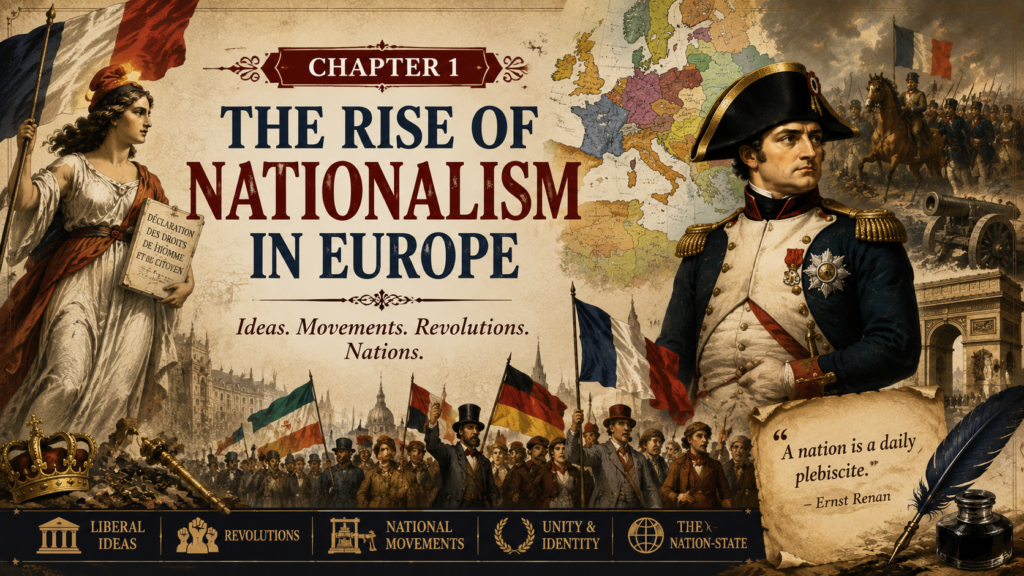
Rise of Nationalism in Europe Class 10 Notes – Introduction
The Rise of Nationalism in Europe Class 10 Notes help students understand how modern nations and nationalism developed in Europe between the late 18th and early 19th centuries. Before nationalism emerged, Europe consisted of kingdoms, empires, and dynasties. People did not identify as members of a nation; instead, they were subjects of a ruler.
This chapter explains how the French Revolution introduced the idea of a nation, how liberal ideas spread across Europe, how Germany and Italy were unified, and how nationalism later transformed into aggressive imperialism.
Frédéric Sorrieu’s Vision of a World of Free Nations (1848)
In the year 1848, a French artist named Frédéric Sorrieu created a remarkable series of four prints. These artworks were not simple paintings; they were a visual expression of his dream for the future of the world. Sorrieu imagined a world made up of what he called “democratic and social republics.” By this, he meant countries where people would govern themselves, enjoy equal rights, and live in peace and cooperation with one another.
At that time, many countries in Europe were ruled by kings and emperors who held absolute power. Ordinary people had little political freedom. Nationalism and liberalism were beginning to spread across Europe, inspiring people to demand representative governments and independent nation-states. Sorrieu’s prints captured these hopes in artistic form.
The Grand Procession of the Peoples of the World
In the first print of the series, Sorrieu depicts men and women from Europe and America marching together in a long and orderly procession. These people belong to different nations, social classes, and age groups. Rich and poor, young and old, men and women all appear together, showing that the struggle for freedom and national unity involved the entire population, not just rulers or elites.
As they march, they pass by the statue of Liberty and pay homage to it. This act symbolizes their respect for the ideals of freedom, equality, and democracy. The procession suggests that nations of the world are moving together toward a future based on liberty and mutual respect.
The Statue of Liberty as a Symbol of Freedom
At the center of the image stands the Statue of Liberty, represented as a female figure. During the French Revolution, artists commonly portrayed abstract ideas such as liberty and justice as women. This artistic tradition helped people visualize political ideals in human form.
In Sorrieu’s print, Liberty carries two important symbols:
The Torch of Enlightenment
In one hand, she holds a burning torch. This torch represents the ideas of the Enlightenment, an intellectual movement of the eighteenth century that emphasized reason, knowledge, and individual rights. The light of the torch symbolizes the spread of truth and the end of ignorance and oppression.
The Charter of the Rights of Man
In the other hand, Liberty carries the Charter of the Rights of Man, referring to the Declaration of the Rights of Man and of the Citizen issued in revolutionary France in 1789. This historic document proclaimed that all men are born free and equal and possess natural rights such as liberty, property, and security.
Together, the torch and the charter symbolize both the ideas and the legal principles on which modern democratic societies are built.
The Broken Symbols of Absolutist Rule
At the bottom of the print lie shattered crowns, chains, and other symbols of monarchical authority. These broken objects represent the destruction of old oppressive systems.
Meaning of Absolutist Rule
An absolutist government is a form of rule in which the monarch possesses unlimited power. Such governments are typically centralized, militarized, and repressive. The ruler controls the administration, army, and laws, and the people have little or no political participation.
Sorrieu’s image shows these symbols broken to indicate that the age of autocratic kings is ending and that the ideals of liberty and democracy are triumphing.
Meaning of the Word “Utopian”
Sorrieu’s artwork is described as a utopian vision.
A utopia is an ideal society in which there is peace, justice, equality, and harmony. It is a perfect world imagined by thinkers and artists, although such a world may not fully exist in reality.
Sorrieu’s vision is utopian because he imagines all nations as free and democratic, living together peacefully without oppression or war.
Nations Identified by Flags and Traditional Costumes
In the print, each group of people is shown carrying its national flag and wearing distinctive traditional clothing. This artistic choice emphasizes the uniqueness of each nation while also suggesting that all nations can coexist as equals.
The use of flags and costumes communicates the idea that a nation is a community with its own identity, history, and cultural traditions.
The Leading Nations: United States and Switzerland
At the front of the procession are United States and Switzerland.
These countries lead the march because, by 1848, they were already established nation-states where citizens enjoyed significant political rights. They served as examples of how a nation-state could function successfully.
France and the Revolutionary Tricolour
Following them is France, identified by its famous tricolour flag of blue, white, and red.
This flag emerged during the French Revolution and became a symbol of:
- Liberty
- Equality
- Fraternity
France occupies an important place in the procession because the French Revolution had spread modern political ideas throughout Europe.
Germany and the Black-Red-Gold Flag
Next comes the German people carrying the black, red, and gold flag.
In 1848, Germany did not yet exist as a unified country. Instead, the German-speaking population was divided among many independent kingdoms and principalities. The flag represented the hope that these separate states would unite into one democratic nation.
This hope was fulfilled later in 1871, when Germany was officially unified.
Other Peoples Included in the Procession
Behind Germany are groups representing:
- Austria
- The Kingdom of the Two Sicilies
- Lombardy
- Poland
- England
- Ireland
- Hungary
- Russia
Many of these peoples were under foreign domination or were part of large empires. Their presence in the print symbolizes their aspirations for freedom and national independence.
Christ, Saints, and Angels: Symbol of Fraternity
In the sky above the procession, Christ, saints, and angels watch over the scene.
These religious figures symbolize fraternity, meaning brotherhood among nations. Their presence suggests that unity, peace, and mutual respect among peoples are noble ideals blessed by divine approval.
The Main Message of Sorrieu’s Print
Sorrieu’s print conveys a powerful political message. It expresses the belief that:
- Absolute monarchies will disappear.
- People will gain liberty and equal rights.
- Different nationalities will form independent nation-states.
- Nations will cooperate peacefully.
- Democracy and social justice will spread across the world.
The artwork reflects the hopes of many Europeans in 1848, a year marked by revolutions and demands for constitutional government.
Nationalism as a Powerful Force in Nineteenth-Century Europe
The nineteenth century witnessed the rise of nationalism, one of the most influential forces in modern history.
Nationalism is the feeling of loyalty and devotion to one’s nation. It develops when people begin to see themselves as part of a larger community with a shared history, culture, traditions, and aspirations.
This new sense of national identity transformed the political map of Europe.
From Dynastic Empires to Nation-States
Before nationalism, Europe was dominated by large dynastic empires such as the Austrian Empire and the Russian Empire.
These empires contained many different ethnic groups and languages, but loyalty was directed toward the ruling dynasty rather than toward a shared national identity.
Nationalism challenged this system by asserting that each people with a common identity should have its own sovereign state.
Meaning of a Modern State
A modern state is a political system in which a central authority exercises sovereign control over a clearly defined territory.
Its features include:
- Fixed borders
- Centralized administration
- Uniform laws
- Organized taxation and military systems
This political structure had developed gradually in Europe over many centuries.
Meaning of a Nation-State
A nation-state is a modern state in which the majority of citizens feel united by a common identity and shared historical memory.
In a nation-state:
- People see themselves as belonging to one nation.
- Loyalty is directed toward the nation rather than a king.
- Citizens feel connected through common struggles and achievements.
This sense of unity is not ancient or automatic; it is created through historical experiences and collective efforts.
National Identity Is Historically Created
The feeling of belonging to a nation does not exist naturally from the beginning of history. It develops over time.
National identity is forged through:
- Shared memories
- Common sacrifices
- Political movements
- Cultural traditions
- Leadership and participation of ordinary people
Thus, nations are historical creations built through struggle and cooperation.
Ernst Renan and the Idea of a Nation
In 1882, French philosopher Ernst Renan delivered a famous lecture at the University of Sorbonne titled “What is a Nation?”
In this lecture, Renan explained that a nation cannot be defined solely by:
- Common language
- Race
- Religion
- Territory
Instead, he argued that a nation is based on a shared past and a collective desire to live together.
Renan’s Definition of a Nation
According to Renan, a nation is:
“The culmination of a long past of endeavours, sacrifice and devotion.”
This means that a nation is formed when people:
- Share memories of achievements and struggles.
- Take pride in their heroes and history.
- Make sacrifices together.
- Wish to continue building a common future.
For Renan, emotional solidarity and collective will are more important than language or ethnicity.
“A Nation Is a Daily Plebiscite”
One of Renan’s most famous statements was that:
“A nation is a daily plebiscite.”
A plebiscite is a vote by the people. Renan meant that a nation survives only because its people continue, day after day, to choose to remain united.
National unity must be based on consent, not force.
Why Renan Considered Nations Essential
Renan believed that nations were necessary for the protection of liberty.
If the world were ruled by only one authority, freedom would be threatened. Independent nations allow people to govern themselves according to their own will and preserve their unique historical traditions.
Thus, the existence of nations is a safeguard against tyranny.
Summary of Renan’s Ideas
According to Ernst Renan:
- A nation is based on shared memories, sacrifices, and aspirations.
- Language, religion, and race alone do not define a nation.
- People must willingly choose to live together.
- Nations are essential for preserving liberty and self-government.
The Message
Sorrieu imagined a world based on:
Democratic governments
Equality among nations
Fraternity among people
His paintings represent the growing desire to form nations based on common identity and political freedom.
The French Revolution and the Idea of the Nation
The French Revolution: Birth of Modern Nationalism
The first clear and powerful expression of nationalism in Europe emerged during the French Revolution. Before 1789, France was already a well-defined territorial state, but it was ruled by an absolute monarch, meaning that the king held complete authority and the people had little political power.
The French Revolution transformed this system completely. One of its most important achievements was the transfer of sovereignty from the king to the people. Sovereignty means the ultimate power to make laws and govern the country. After the revolution, it was declared that the nation was made up of its citizens, and the people themselves would determine the future of France.
To strengthen this new idea of nationhood, the revolutionaries introduced several measures to create a common identity among the French people. They popularized the ideas of la patrie (the fatherland) and le citoyen (the citizen). These concepts emphasized that all citizens were equal members of one united nation and enjoyed equal rights under a constitution.
Many national symbols and institutions were also created:
- The revolutionary tricolour flag replaced the old royal flag.
- The Estates General was renamed the National Assembly.
- Patriotic songs and hymns were composed.
- Public oaths were taken in the name of the nation.
- National heroes and martyrs were honored.
Administrative reforms also helped unite the country. A centralized government introduced uniform laws throughout France. Internal customs duties were abolished, and a common system of weights and measures was adopted. Regional dialects were discouraged, and standard French, as spoken in Paris, became the national language. These steps reduced regional differences and strengthened the feeling that all French people belonged to one nation.
The revolutionaries believed that France had a mission to spread these ideals across Europe. They declared that the French nation would help liberate other peoples from despotism and assist them in becoming free nations.
Spread of Nationalist Ideas and Napoleon’s Reforms
The revolutionary ideas of France inspired many educated people in Europe. Students and members of the middle class formed political groups such as the Jacobin clubs to support liberty and national unity. In the 1790s, French armies entered regions such as Holland, Belgium, Switzerland, and Italy, carrying the ideas of nationalism beyond France.
When Napoleon Bonaparte came to power, he ended democracy in France and crowned himself emperor. However, he preserved and spread many important reforms introduced by the revolution.
The most significant of these reforms was the Napoleonic Code or Civil Code of 1804. This code:
- Abolished privileges based on birth.
- Established equality before the law.
- Protected the right to property.
Napoleon introduced these reforms in territories under French control, including the Dutch Republic, Switzerland, Italy, and German states. He abolished feudalism, ended serfdom, and freed peasants from manorial dues. In towns, guild restrictions were removed, allowing artisans and businessmen to work more freely. Roads, transport, and communication systems were improved.
These reforms benefited peasants, artisans, workers, and especially businessmen. Uniform laws, standardized weights and measures, and common currencies made trade easier and encouraged economic growth across different regions.
Mixed Reactions to French Rule in Europe
In the beginning, many people in Europe welcomed the French armies. In places such as Holland, Switzerland, Brussels, Mainz, Milan, and Warsaw, the French were seen as liberators who would bring freedom and equality.
However, this enthusiasm gradually faded. People soon realized that French rule often brought control rather than genuine political freedom. Several policies created resentment:
- Heavy taxation
- Strict censorship
- Forced military conscription into Napoleon’s armies
Although Napoleon introduced useful administrative reforms, many conquered peoples felt exploited and dominated by France. As a result, admiration for revolutionary ideals turned into opposition to French rule.
This reaction was historically significant because it encouraged people in other parts of Europe to develop their own nationalist movements. They began to demand not only reforms but also independence from foreign domination. In this way, the French Revolution and Napoleonic rule played a central role in spreading the idea of nationalism throughout Europe.
The Making of Nationalism in Europe
The Aristocracy and the New Middle Class
In the middle of the eighteenth century, Europe was not divided into nation-states as we know them today. Modern countries such as Germany, Italy, and Switzerland were split into many small kingdoms, duchies, and cantons. Eastern and Central Europe were dominated by large autocratic empires that included many different peoples speaking different languages and following different customs.
The best example was the Habsburg Empire. It included Germans, Magyars, Poles, Bohemians, Slovaks, Slovenes, Croats, and Roumanians (Romanians). These groups did not share a common national identity. Their only unifying factor was loyalty to the emperor.
Socially and politically, the most powerful class in Europe was the landed aristocracy. Aristocrats owned large estates in rural areas and elegant houses in towns and cities. They shared a common lifestyle across Europe, spoke French in diplomatic circles, and were often linked through marriage. However, they formed only a small part of the population.
The majority of people were peasants. In Western Europe, many peasants were tenants or small landowners. In Central and Eastern Europe, large estates were cultivated by serfs, who were legally bound to the land and had very limited freedom.
The growth of trade and industrial production gradually changed this social structure. Industrialization began in England during the second half of the eighteenth century and later spread to France and the German states. As towns grew, new social groups emerged:
- A working class of laborers and factory workers.
- A middle class consisting of industrialists, businessmen, merchants, and professionals.
In Central and Eastern Europe, these groups were smaller until the late nineteenth century. It was among the educated and liberal middle classes that the idea of national unity became popular. They believed that aristocratic privileges should be abolished and that people sharing a common culture and history should form a united nation.
What Did Liberal Nationalism Stand For?
In early nineteenth-century Europe, nationalism was closely connected with liberalism. The word liberalism comes from the Latin word liber, meaning “free.” For the new middle classes, liberalism represented freedom of the individual and equality before the law.
Politically, liberalism stood for:
- Government based on the consent of the people.
- The end of autocracy and clerical privileges.
- A written constitution.
- Representative government through elected parliaments.
- Protection of private property.
However, equality before the law did not mean equal voting rights for everyone. In revolutionary France, only property-owning men could vote and contest elections. Men without property and all women were excluded from political rights. The Jacobins briefly introduced universal male suffrage, but this was later reversed by Napoleon. Women remained legally subordinate to fathers and husbands for much of the nineteenth century.
In the economic sphere, liberalism demanded freedom of markets and the removal of state restrictions on trade. This was particularly important in the German-speaking regions. After Napoleon’s reforms, these areas were organized into a confederation of 39 states. Each state had its own currency, customs duties, and systems of weights and measures.
These differences created serious obstacles for merchants. A trader traveling from Hamburg to Nuremberg had to pass through multiple customs barriers and pay duties at each one. Different units of measurement made trade slow and complicated.
To solve these problems, Prussia established the Zollverein in 1834. This customs union abolished tariff barriers among most German states and reduced the number of currencies. Railways were expanded to improve transport and communication. These developments promoted economic unity and strengthened the growing desire for political unification.
A New Conservatism after 1815
After the defeat of Napoleon Bonaparte in 1815, European rulers sought to restore the old order. This political approach is known as conservatism.
Conservatives believed that traditional institutions such as:
- Monarchy
- Church
- Social hierarchy
- Property
- Family
should be preserved. However, they did not reject all changes introduced during the Napoleonic period. Many conservatives accepted that modernization—such as an efficient bureaucracy, modern army, and the abolition of feudalism—could strengthen monarchies and make states more powerful.
In 1815, representatives of Britain, Russia, Prussia, and Austria met at the Congress of Vienna. The meeting was hosted by Austrian Chancellor Klemens von Metternich.
The resulting Treaty of Vienna (1815) aimed to reverse many of the changes introduced by Napoleon.
Key decisions included:
- Restoration of the Bourbon monarchy in France.
- Reduction of French territory.
- Creation of buffer states around France, such as the Kingdom of the Netherlands.
- Addition of Genoa to Piedmont in the south.
- Expansion of Prussia in the west.
- Austrian control over northern Italy.
- Russia receiving part of Poland.
- Prussia receiving part of Saxony.
The main goal was to restore monarchies and establish a stable conservative order in Europe.
These restored governments were autocratic and intolerant of criticism. They imposed censorship laws to control newspapers, books, plays, and songs that promoted ideas of liberty and nationalism. Despite this repression, the ideals of the French Revolution continued to inspire liberals. One of their major demands was freedom of the press.
The Revolutionaries
After 1815, many liberal-nationalists were forced to work secretly because governments suppressed political opposition. Secret societies were formed across Europe to train revolutionaries and spread ideas of liberty and national unity.
At this time, being a revolutionary meant:
- Opposing the monarchical order established after the Congress of Vienna.
- Fighting for political freedom and constitutional government.
- Supporting the creation of nation-states.
One of the most important revolutionaries was Giuseppe Mazzini.
Born in Genoa in 1805, Mazzini joined the secret society known as the Carbonari. In 1831, he was exiled for attempting a revolution in Liguria. During exile, he founded two important organizations:
- Young Italy in Marseilles.
- Young Europe in Berne.
These groups attracted young nationalists from Poland, France, Italy, and the German states.
Mazzini believed that nations were the natural units created by God. He argued that Italy should not remain divided into small states and kingdoms. Instead, it should become one unified democratic republic. He also hoped for a wider alliance of free nations across Europe.
Mazzini’s ideas inspired the formation of similar secret societies in Germany, France, Switzerland, and Poland. His strong opposition to monarchy and his vision of democratic republics alarmed conservative rulers. Metternich described him as “the most dangerous enemy of our social order.”
Mazzini played a crucial role in spreading nationalism and inspiring future movements for Italian and European unification.
The Age of Revolutions: 1830–1848
Revolutionary Movements and the Growth of Nationalism
Between 1830 and 1848, Europe witnessed a series of major revolutions that were inspired by the ideas of liberalism and nationalism. Conservative governments established after the Congress of Vienna tried to suppress political freedom and maintain the old monarchical order. However, these efforts only increased the desire for constitutional government, civil liberties, and national independence.
These revolutionary movements appeared in many parts of Europe, including the Italian and German states, Ireland, Poland, and provinces of the Ottoman Empire. The leadership of these movements came mainly from educated middle-class groups such as professors, schoolteachers, lawyers, clerks, and businessmen.
The first major uprising occurred in France in July 1830. The Bourbon monarchy, restored after Napoleon’s defeat, was overthrown. Liberal revolutionaries established a constitutional monarchy under Louis Philippe I. This event, known as the July Revolution, had a powerful influence on the rest of Europe. It inspired the people of Brussels to revolt, resulting in Belgium separating from the United Kingdom of the Netherlands.
Another important nationalist struggle was the Greek War of Independence. Greece had been under Ottoman rule since the fifteenth century. In 1821, Greeks launched a movement for independence. They received support from Greek communities living abroad and from many Europeans who admired ancient Greek civilization. The English poet Lord Byron raised funds and personally joined the struggle, dying in Greece in 1824. The movement succeeded when the Treaty of Constantinople in 1832 recognized Greece as an independent nation.
The Romantic Imagination and National Feeling
Nationalism developed not only through political revolutions and wars but also through cultural movements. Art, literature, poetry, and music played a crucial role in creating and spreading the idea of the nation.
One of the most important cultural movements of the nineteenth century was Romanticism. Romantic artists and thinkers rejected the excessive emphasis on reason and science associated with the Enlightenment. Instead, they celebrated emotions, imagination, intuition, and spiritual experience. Their goal was to awaken feelings of belonging by connecting people with a shared cultural heritage.
The German philosopher Johann Gottfried Herder argued that the true spirit of a nation, known as the Volksgeist, could be found among ordinary people, or das Volk. Folk songs, folk tales, poetry, and traditional dances reflected the authentic culture of the people. Collecting and preserving this folklore became an important part of nation-building.
The use of vernacular languages also helped spread nationalism. Speaking and writing in local languages enabled nationalist ideas to reach common people, many of whom were illiterate and deeply connected to their traditional culture.
The case of Poland is a powerful example. Poland had been partitioned by Russia, Prussia, and Austria and ceased to exist as an independent state. Yet national identity survived through language and music. Composer Karol Kurpiński transformed folk dances such as the polonaise and mazurka into symbols of patriotism.
After Russia imposed the Russian language in schools, the Polish language became a symbol of resistance. In 1831, a rebellion against Russian rule was crushed, but Polish priests continued to use Polish in church services and religious instruction. Many were imprisoned or exiled to Siberia. This transformed language into a powerful tool of national struggle.
Hunger, Hardship and Popular Revolt
The 1830s and 1840s were marked by severe economic hardship across Europe. Population increased rapidly, but employment opportunities did not grow at the same pace. Many rural people migrated to cities, where they lived in overcrowded and unhealthy slums.
Small producers and artisans faced intense competition from cheap machine-made goods imported from England, where industrialization was more advanced. This was especially damaging to textile workers who depended on hand production in homes and small workshops.
In regions where aristocrats retained power, peasants were burdened by feudal dues and obligations. Rising food prices and poor harvests worsened conditions, leading to widespread poverty in both rural and urban areas.
In 1845, the weavers of Silesia revolted against contractors who reduced their wages while demanding more work. The weavers marched to the contractor’s house, demanding fair payment. After being insulted and threatened, they attacked his property. The contractor returned with the army, and eleven weavers were killed. This incident revealed the deep social tensions created by industrial and economic change.
The crisis reached its peak in 1848. Food shortages and unemployment drove the people of Paris onto the streets. Barricades were erected, and King Louis Philippe fled. A republic was proclaimed, universal male suffrage was introduced, and national workshops were established to provide employment for the unemployed.
1848: The Revolution of the Liberals
Alongside the revolts of workers and peasants, 1848 also witnessed a major political movement led by the liberal middle classes. In countries where nation-states had not yet been formed—such as Germany, Italy, Poland, and the Austro-Hungarian Empire—liberals demanded constitutional government, civil liberties, and national unification.
In the German states, middle-class professionals, businessmen, and prosperous artisans formed political associations and called for an all-German National Assembly. On 18 May 1848, 831 elected representatives met in the Church of St. Paul in Frankfurt to draft a constitution for a united Germany.
The Frankfurt Parliament proposed a constitutional monarchy and offered the crown to Frederick William IV. He refused to accept a crown offered by an elected assembly and joined other monarchs in opposing the parliament.
The parliament also lost support because it was dominated by middle-class leaders who were unwilling to address the demands of workers and artisans. Without broad popular backing, the assembly was eventually dispersed by military force.
Women played an active role in the liberal movement. They formed political associations, published newspapers, and participated in demonstrations. Yet they were denied voting rights and were allowed only to observe the Frankfurt Parliament from the visitors’ gallery.
Although the revolutions of 1848 were suppressed, they had lasting consequences. Conservative rulers realized that they could not ignore demands for reform forever. In the years that followed:
- Serfdom and bonded labor were abolished in the Habsburg Empire and Russia.
- The Habsburg rulers granted greater autonomy to Hungary in 1867.
- Liberal and nationalist ideas continued to spread across Europe.
The revolutions of 1830–1848 were therefore a crucial stage in the development of modern nationalism. Even when immediate goals were not achieved, they weakened the old order and laid the foundation for the future unification of Germany, Italy, and other nation-states.
The Making of Germany and Italy
Germany – Can the Army Be the Architect of a Nation?
After the revolutions of 1848, nationalism in Europe changed significantly. Earlier, nationalism was closely linked with ideas of democracy, constitutional government, and popular participation. However, after 1848, conservative rulers began to use nationalist feelings to strengthen their own states and expand political power.
This change is clearly seen in the unification of Germany.
In 1848, middle-class liberals had attempted to unite the German states through the Frankfurt Parliament and create a nation-state governed by an elected assembly. This effort failed because the monarchy, military, and the powerful Prussian landowners known as the Junkers opposed it.
Who Were the Junkers?
The Junkers were wealthy landowning aristocrats of Prussia. They held great influence over the army and government and strongly supported the authority of the king.
After the failure of the liberal movement, Prussia assumed leadership of German unification.
Otto von Bismarck and the Policy of “Blood and Iron”
The most important figure in German unification was Otto von Bismarck, the Chief Minister of Prussia.
Bismarck was a conservative statesman who believed that great political questions were decided not by speeches and parliamentary debates, but by military strength and practical diplomacy. His strategy is often described as the policy of “blood and iron.”
He unified Germany through:
- Strong leadership
- Efficient bureaucracy
- Diplomatic alliances
- Military power
Three Wars That Unified Germany
Bismarck fought three major wars within seven years:
- War with Denmark
- Austro-Prussian War (against Austria)
- Franco-Prussian War (against France)
Prussia won all three wars, and these victories persuaded the German states to unite under Prussian leadership.
Proclamation of the German Empire (1871)
In January 1871, the rulers of the German states gathered in the Hall of Mirrors at the Palace of Versailles in France.
There, William I was proclaimed the German Emperor (Kaiser).
This event marked the birth of the German Empire.
Impact of German Unification
The unification of Germany showed that national unity had been achieved through military power rather than democratic revolution.
The new German state introduced major reforms:
- Unified currency
- Modern banking system
- Common legal and judicial systems
- Centralized administration
These measures helped transform Germany into one of the most powerful nations in Europe.
Italy Unified
Like Germany, Italy had long been divided into many states and territories.
In the mid-nineteenth century, Italy consisted of seven states:
- Sardinia-Piedmont (ruled by an Italian dynasty)
- Lombardy and Venetia (under Austrian control)
- Central Italy (ruled by the Pope)
- Southern Italy and Sicily (ruled by Bourbon kings)
Even the Italian language had many regional variations, and many people did not think of themselves as Italians.
Giuseppe Mazzini and Young Italy
In the 1830s, Giuseppe Mazzini developed a vision of a united democratic republic.
He founded the secret society Young Italy to spread nationalist ideas.
However, his revolutionary attempts in 1831 and 1848 failed.
Victor Emmanuel II and Count Cavour
After Mazzini’s failures, leadership passed to the kingdom of Sardinia-Piedmont under Victor Emmanuel II.
The key political strategist was Camillo Benso, Count of Cavour.
Cavour was neither a revolutionary nor a democrat. He was a practical statesman who used diplomacy and war to achieve unification.
In 1859, through an alliance with France, Sardinia-Piedmont defeated Austria and gained important territories.
Giuseppe Garibaldi and the Red Shirts
Another major leader was Giuseppe Garibaldi.
In 1860, Garibaldi and his volunteer army, known as the Red Shirts, marched into southern Italy and the Kingdom of the Two Sicilies.
He won support from local peasants and successfully overthrew the Bourbon rulers.
Garibaldi then handed over the conquered territories to Victor Emmanuel II.
Proclamation of United Italy
In 1861, Victor Emmanuel II was declared the King of united Italy.
However, many ordinary Italians, especially peasants, were unfamiliar with nationalist ideas. Some had never even heard the word “Italia.”
This shows that political unification often occurred before a strong national consciousness had fully developed among the people.
The Unification of Britain
he formation of the United Kingdom was different from the unification of Germany and Italy.
It was not achieved through a sudden revolution but through a gradual process extending over centuries.
England’s Dominance
Before the eighteenth century, there was no single British nation. People identified themselves as:
- English
- Scottish
- Welsh
- Irish
Each group had its own cultural and political traditions.
As England became wealthier and more powerful, it extended its influence over the rest of the British Isles.
Act of Union, 1707
The Act of Union (1707) united England and Scotland to form the United Kingdom of Great Britain.
Although presented as a union, it effectively placed Scotland under English dominance.
The British Parliament was dominated by English representatives.
Suppression of Scottish Culture
The Scottish Highlands experienced harsh repression.
Scottish Highlanders:
- Were forbidden to speak Gaelic.
- Were banned from wearing traditional dress.
- Were forcibly displaced from their lands.
Incorporation of Ireland
Ireland was divided between:
- Protestants, supported by England.
- Catholics, who formed the majority.
After the failed revolt of Wolfe Tone, Ireland was formally incorporated into the United Kingdom in 1801.
Creation of a British Identity
A common British identity was promoted through:
- The Union Jack
- The national anthem “God Save Our Noble King”
- The English language
The cultures of Scotland, Wales, and Ireland continued to exist, but in subordinate positions within a state dominated by England.
Visualising the Nation
Personification of the Nation
A king or queen can easily be represented through a portrait or statue because they are real individuals. But a nation is an abstract idea. It cannot be seen or touched. Artists of the eighteenth and nineteenth centuries solved this problem by representing the nation as a human figure. This method is called personification.
In most cases, nations were shown as female figures. These women were not portraits of real people. Instead, they were symbolic figures created to give a visible form to the idea of the nation. Such a symbolic representation is known as an allegory.
Meaning of Allegory
An allegory is a way of expressing an abstract idea through a person, object, or image. Ideas such as liberty, justice, greed, and nationalism cannot be physically seen, so artists represent them symbolically.
For example:
- Liberty is often shown as a woman holding a torch or wearing a red cap.
- Justice is represented as a blindfolded woman carrying weighing scales.
- The nation is represented as a female figure symbolizing unity and patriotism.
Thus, allegories helped ordinary people understand complex political ideas through familiar visual symbols.
Female Allegories in the French Revolution
During the French Revolution, artists used female allegories to represent ideals such as Liberty, Justice, and the Republic.
Each allegorical figure was identified by specific symbols:
- Liberty was shown with a red cap and broken chains, symbolizing freedom from oppression.
- Justice was shown blindfolded with a pair of weighing scales, representing fairness and equality before the law.
- The Republic was represented as a strong female figure embodying the sovereignty of the people.
These symbols made political ideas more meaningful and emotionally powerful.
Marianne: The National Symbol of France
In France, the female allegory of the nation was called Marianne.
The name Marianne was a common French name, chosen to emphasize that the nation belonged to ordinary citizens rather than to kings or aristocrats.
Marianne’s appearance combined symbols of Liberty and the Republic:
- The red Phrygian cap
- The tricolour flag
- The national cockade
Statues of Marianne were placed in public squares throughout France to remind people of national unity and republican values. Her image also appeared on coins, postage stamps, and official seals, making her a constant symbol of the French nation.
Germania: The National Symbol of Germany
In Germany, the female allegory of the nation was known as Germania.
Germania symbolized strength, unity, and patriotism. In paintings and sculptures, she was often shown wearing a crown made of oak leaves.
The oak tree had special significance in German culture because it represented:
- Heroism
- Courage
- Endurance
- National strength
Germania became a powerful symbol during the movement for German unification and helped inspire feelings of national pride among the German people
Importance of National Symbols
The creation of allegorical female figures such as Marianne and Germania played a crucial role in the rise of nationalism.
These symbols:
- Gave a visible form to the abstract idea of the nation.
- Helped ordinary people emotionally connect with their country.
- Promoted unity and patriotism.
- Appeared in art, monuments, stamps, coins, and public ceremonies.
By transforming the nation into a recognizable image, artists made nationalism more meaningful and accessible to the public.
Nationalism and Imperialism
Nationalism Becomes Aggressive in the Late Nineteenth Century
During the first half of the nineteenth century, nationalism was closely associated with liberal and democratic ideals. It inspired people to fight for freedom, constitutional government, equal rights, and national unity. Nationalism was seen as a positive force that helped create independent nation-states such as Germany and Italy.
However, by the last quarter of the nineteenth century, the nature of nationalism changed significantly. It gradually lost its idealistic and democratic character and became a much narrower and more aggressive ideology. Instead of promoting liberty and cooperation, many nationalist groups began to view their own nation as superior to others. They became increasingly intolerant and hostile toward neighboring countries and were often willing to go to war to expand their power.
At the same time, powerful European states began to exploit nationalist sentiments for their own imperial interests. They encouraged or manipulated the aspirations of smaller national groups in order to weaken rival empires and extend their own influence. Thus, nationalism became closely linked with imperialism.
The Balkans: The Most Explosive Region of Europe
The most dangerous center of nationalist conflict in Europe after 1871 was the region known as the Balkans.
The Balkans included many present-day countries:
- Romania
- Bulgaria
- Albania
- Greece
- North Macedonia
- Croatia
- Bosnia and Herzegovina
- Slovenia
- Serbia
- Montenegro
Most of the inhabitants of this region were Slavs and were collectively known as the Slavic peoples.
For centuries, a large part of the Balkans had been under the control of the Ottoman Empire. As the Ottoman Empire weakened during the nineteenth century, the subject peoples of the Balkans began to demand independence.
Inspired by romantic nationalism, these groups argued that they had once been free nations and were now struggling to recover their lost independence. They used history, language, and culture to justify their claims to nationhood.
Rivalries in the Balkans and the Road to the First World War
The Balkan region became highly unstable because many newly emerging states wanted to expand their territories. Countries in the region were deeply suspicious of one another and competed fiercely for land and influence.
The situation became even more dangerous because the great European powers also sought control over the Balkans. The main powers involved were:
- Russia
- Germany
- United Kingdom
- Austria-Hungary
Each power wanted to prevent its rivals from dominating the region and sought to increase its own influence. This competition led to repeated crises and wars in the Balkans.
Ultimately, the intense nationalism and imperial rivalry in this region contributed directly to the outbreak of the First World War in 1914.
Thus, nationalism, when combined with imperial ambitions, became a destructive force that pushed Europe toward a catastrophic war.
Nationalism Inspires Anti-Imperial Movements in Colonized Countries
While aggressive nationalism led Europe into conflict, the same idea inspired colonized peoples in Asia, Africa, and Latin America to resist foreign domination.
During the nineteenth and twentieth centuries, many countries under European colonial rule began to develop nationalist movements. These movements sought:
- Political freedom
- National unity
- Independence from colonial powers
- The creation of sovereign nation-states
These anti-imperial struggles were nationalist because they united people around a shared identity and a common desire for self-rule.
Although these movements were inspired by European ideas of nationalism, they did not simply copy the European model. Each country developed its own unique form of nationalism shaped by its history, culture, and social conditions.
By the twentieth century, the idea that people should organize themselves into independent nation-states had become widely accepted across the world.
15. Important Terms Table - Rise of Nationalism in Europe Class 10 Notes
| Term | Meaning |
|---|---|
| Nationalism | Feeling of unity among people sharing common identity |
| Liberalism | Idea of freedom, equality, and individual rights |
| Conservatism | Idea supporting tradition and monarchy |
| Romanticism | Cultural movement promoting emotions & folk culture |
| Imperialism | Policy of controlling other nations |
| Nation-State | Nation with its own government & territory |
16. Germany & Italy Unification – Comparison Table
| Feature | Germany | Italy |
|---|---|---|
| Key Leader | Bismarck | Cavour, Mazzini, Garibaldi |
| Method | Wars (“blood and iron”) | Diplomacy + revolts |
| Year | 1871 | 1871 |
| Nature | Military-driven | Mixed (popular + political) |
Other Resources of this chapter.
- Quiz Rise of Nationalism in Europe
- Test Rise of Nationalism in Europe
- Flashcards Rise of Nationalism in Europe
Other Chapters you want to learn
Nationalism in India Notes, Power Sharing Notes, Money and Credit Notes
FAQs : Rise of Nationalism in Europe Class 10 Notes
Q1. What is the Rise of Nationalism in Europe Class 10 about?
The Rise of Nationalism in Europe Class 10 chapter explains how modern nations emerged through revolutions, liberal ideas, and unification movements in countries like Germany and Italy.
Q2. What is the main idea of Class 10 History Chapter 1?
The main idea of Class 10 History Chapter 1 is that nationalism evolved from cultural unity, political changes, and revolutions starting with the French Revolution.
Q3. How did the French Revolution promote nationalism?
As explained in the Nationalism in Europe Summary, the French Revolution created national symbols, common laws, equal citizenship, and a national identity.
Q4. Who unified Germany according to the chapter?
The Rise of Nationalism in Europe Class 10 Notes highlight that Otto von Bismarck unified Germany through wars and military strategy.
Q5. Who were the important leaders in Italian unification?
According to Class 10 History Chapter 1 Notes, Mazzini (ideology), Cavour (diplomacy), and Garibaldi (military) played major roles.
MCQs: Rise of Nationalism in Europe Class 10
1. Who painted the 1848 series showing democratic nations?
a) Mazzini
b) Bismarck
c) Frédéric Sorrieu
d) Metternich
Answer: c
2. What replaced regional dialects in France after the Revolution?
a) Latin
b) German
c) French (national language)
d) English
Answer: c
3. What is the Napoleonic Code also called?
a) Civil Code of 1804
b) Code of Vienna
c) Code of Liberty
d) French Charter
Answer: a
4. Which ideology opposed liberalism?
a) Conservatism
b) Nationalism
c) Socialism
d) Romanticism
Answer: a
5. Unification of Germany was led by—
a) Cavour
b) Napoleon
c) Bismarck
d) Garibaldi
Answer: c
6. Who founded Young Italy?
a) Garibaldi
b) Mazzini
c) Metternich
d) Louis XVI
Answer: b
7. Who led the Red Shirts?
a) Cavour
b) Bismarck
c) Garibaldi
d) Kaiser William I
Answer: c
8. What symbolized liberty in French nationalism?
a) Germania
b) Oak crown
c) Marianne
d) Eagle
Answer: c
9. What caused hardship in 1830s Europe?
a) High wages
b) Low population
c) Food shortages
d) Cheap grain
Answer: c
10. Britain unified through—
a) Wars
b) Revolutions
c) Parliamentary laws
d) Dictatorship
Answer: c
3-Mark Questions: Rise of Nationalism in Europe Class 10 Notes
Q1. Explain the meaning of liberal nationalism in the context of the Rise of Nationalism in Europe Class 10.
Liberal nationalism, as explained in the Class 10 History Chapter 1
, refers to the belief in individual freedom, equality before law, and government based on consent. It supported free markets, end of aristocratic privileges, and elected parliaments. However, it was limited because only property-owning men could vote, excluding women and the poor.
Q2. How did culture play a role in strengthening nationalism in Europe?
According to Rise of Nationalism in Europe Class 10 Notes, culture strengthened nationalism through folk songs, folk dances, poetry, and local languages. Romantic artists revived traditional heritage to create emotional unity. Writers and musicians used cultural expression to develop a feeling of shared identity among people.
Q3. What were the main features of the Napoleonic Code?
The Napoleonic Code, highlighted in the Rise of Nationalism in Europe Class 10 Notes Summary, promoted equality before the law, abolished feudal privileges, protected property rights, and simplified administrative systems. Though Napoleon became authoritarian, the Code spread modern nationalism across Europe.
5-Mark Questions : Rise of Nationalism in Europe Class 10 Notes
Q1. Describe the process of German unification as explained in Rise of Nationalism in Europe Class 10 Notes.
The Rise of Nationalism in Europe Class 10 Notes mention that Germany was divided into 39 states. Otto von Bismarck, Prime Minister of Prussia, used military power to unify Germany. He strengthened the Prussian army and led three major wars:
1864 with Denmark,
1866 with Austria,
1870–71 with France.
Prussia won all wars, proving Bismarck’s “blood and iron” policy. In 1871, Kaiser William I was proclaimed Emperor of unified Germany. This shows how nationalism combined with militarism shaped the modern nation-state.
Q2. Explain the role of Mazzini, Cavour and Garibaldi in Italian unification (Class 10 History Chapter 1).
In Class 10 History Chapter 1 The Rise of Nationalism in Europe, Italy’s unification involved three key leaders:
Giuseppe Mazzini gave ideological foundation and founded Young Italy.
Count Cavour, Prime Minister of Sardinia-Piedmont, used diplomacy and alliances (especially with France) to weaken Austria.
Giuseppe Garibaldi led the “Red Shirts,” liberating southern Italy.
By 1871, all regions united under Victor Emmanuel II. The combined efforts of ideology, diplomacy, and military action created the modern Italian nation-state.