Complete CBSE Exam Ready Nationalism in India Class 10 Notes
Introduction to Nationalism in India
The idea of nationalism, which transformed Europe in the nineteenth century, also became a powerful force in India during British rule. In Europe, nationalism was closely connected with the formation of nation-states, where people developed a common identity based on shared history, culture, and political aspirations. In India, however, nationalism emerged under very different circumstances.
India was a colony of the British Raj. The growth of modern nationalism in India was deeply linked with the struggle against colonial rule. As Indians experienced political oppression, economic exploitation, and racial discrimination under British rule, they gradually began to develop a common sense of belonging. People from different regions, religions, languages, and social backgrounds started to realize that they were united by a shared experience of subjugation.
This growing awareness created the foundation of Indian nationalism.
Growth of Nationalism Through the Anti-Colonial Struggle
he development of nationalism in India did not happen suddenly. It evolved over many decades as Indians participated in movements against British rule.
Colonialism affected different groups in different ways:
- Peasants suffered from heavy taxes and oppressive land policies.
- Workers faced poor wages and harsh conditions.
- Businessmen were hurt by discriminatory economic policies.
- Students and professionals were frustrated by racial inequality.
- Women became increasingly involved in public and political life.
Although all these groups opposed British rule, their experiences and expectations were not identical. Each group had its own understanding of freedom and its own demands.
Despite these differences, the common experience of colonial exploitation brought people together and helped create a shared national consciousness. Thus, Indian nationalism was forged through the collective struggle against imperialism.
Role of the Indian National Congress and Mahatma Gandhi
The Indian National Congress played a central role in organizing the nationalist movement.
Under the leadership of Mahatma Gandhi, the Congress transformed from an organization of educated elites into a mass movement involving millions of ordinary Indians.
Gandhi attempted to unite various social groups within a single national movement. He emphasized:
- Non-violence (Ahimsa)
- Truth (Satyagraha)
- Hindu-Muslim unity
- Participation of peasants, workers, women, and students
However, creating unity was not always easy. Different groups often had conflicting interests, and disagreements sometimes emerged over goals and strategies. Even so, Gandhi’s leadership gave the nationalist movement a broad popular base and helped spread the idea of national unity across India.
Focus of This Chapter
This chapter of Nationalism in India Class 10 Notes continues the story of the Indian national movement from the 1920s onward.
It focuses on two major mass movements:
- The Non-Cooperation Movement
- The Civil Disobedience Movement
It also explains:
- How the Congress organized the national struggle.
- How different social groups participated.
- How nationalism inspired people in towns and villages.
- How symbols, songs, and ideas captured the imagination of the masses.
By studying this chapter, we understand that Indian nationalism was not merely a political movement. It was a broad and evolving process through which millions of Indians came to see themselves as members of one nation and united in the struggle for independence.
Nationalism in India Class 10 Notes
The First World War, Khilafat and Non-Cooperation
After 1919, the Indian national movement entered a new phase. It spread to new regions, attracted different social groups, and adopted new methods of protest. The years following the First World War were marked by economic hardship, political unrest, and growing dissatisfaction with British rule. These conditions created the background for mass movements led by Mahatma Gandhi.
The First World War had a deep impact on India. The British government increased defence expenditure and financed it through war loans and higher taxes. Customs duties were raised and income tax was introduced. At the same time, prices rose sharply; between 1913 and 1918, prices nearly doubled. This caused severe hardship for ordinary people. Villages were forced to supply soldiers, and compulsory recruitment in rural areas created widespread resentment.
The situation became worse in 1918–19 and 1920–21 when crop failures led to food shortages. An influenza epidemic also swept through the country. According to the 1921 Census, around 12 to 13 million people died due to famine and disease. People expected relief after the war, but their suffering continued. In this atmosphere of frustration and anger, Gandhi emerged as a new leader and introduced a new method of struggle.
The Idea of Satyagraha
Mahatma Gandhi returned to India from South Africa in January 1915. In South Africa, he had successfully fought racial discrimination using a new method called Satyagraha.
The word Satyagraha means “insistence on truth” or “holding firmly to truth.” Gandhi believed that if a cause was just and based on truth, there was no need to use violence. A satyagrahi should oppose injustice through non-violent means and seek to appeal to the conscience of the oppressor. The goal was not to punish the opponent, but to persuade them to recognize the truth.
Gandhi believed that non-violence was a moral force powerful enough to unite all Indians, regardless of caste, religion, or region.
After returning to India, Gandhi tested Satyagraha in several local struggles:
- In 1917, he led the Champaran movement in Bihar to help indigo farmers suffering under the plantation system.
- In 1918, he organized a strike of cotton mill workers in Ahmedabad.
- In the same year, he supported peasants in Kheda, Gujarat, who were unable to pay land revenue because of crop failure and plague.
These successes established Gandhi as a national leader.
The Rowlatt Act
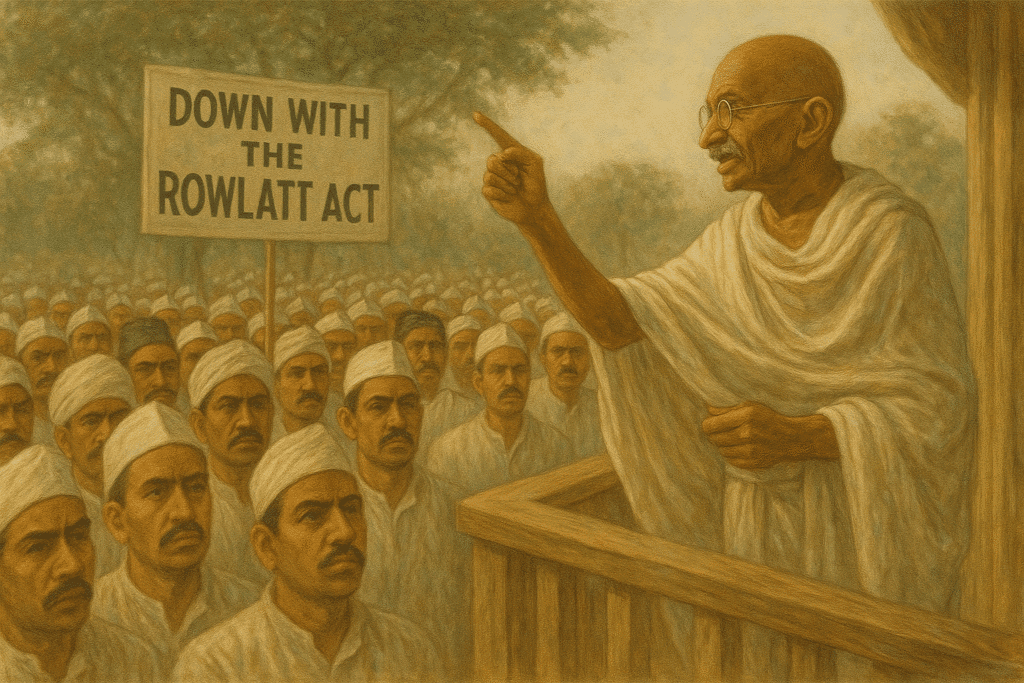
The Rowlatt Act gave the British government extraordinary powers:
- It allowed detention of political prisoners without trial for up to two years.
- It permitted the government to suppress political activities.
- It curtailed civil liberties and legal rights.
Indian members of the Imperial Legislative Council strongly opposed the Act, but the government passed it anyway.
Gandhi called for a nationwide hartal (strike) on 6 April 1919. Across India:
- Shops were closed.
- Workers went on strike.
- Peaceful rallies were organized.
The British authorities reacted with repression. Local leaders were arrested, and Gandhi was prevented from entering Delhi.
Jallianwala Bagh Massacre
On 10 April 1919, police fired on peaceful demonstrators in Amritsar, leading to unrest. Martial law was imposed, and Reginald Dyer took command.
On 13 April 1919, thousands of people gathered at Jallianwala Bagh massacre. Some had come to protest, while others were attending the Baisakhi fair. Dyer blocked the only exit and ordered his troops to fire on the unarmed crowd. Hundreds were killed and many more were injured.
The massacre shocked the entire country.
Repression and Withdrawal of the Movement
As news spread, protests erupted in many towns in northern India. The government responded with brutal punishments:
- Public floggings
- Forced humiliations
- Bombing of villages around Gujranwala
When violence spread, Gandhi called off the movement because he believed that satyagraha must remain strictly non-violent.
Although the Rowlatt Satyagraha was significant, it was mainly urban in character. Gandhi now sought a broader movement that could unite both Hindus and Muslims.
The Khilafat Issue
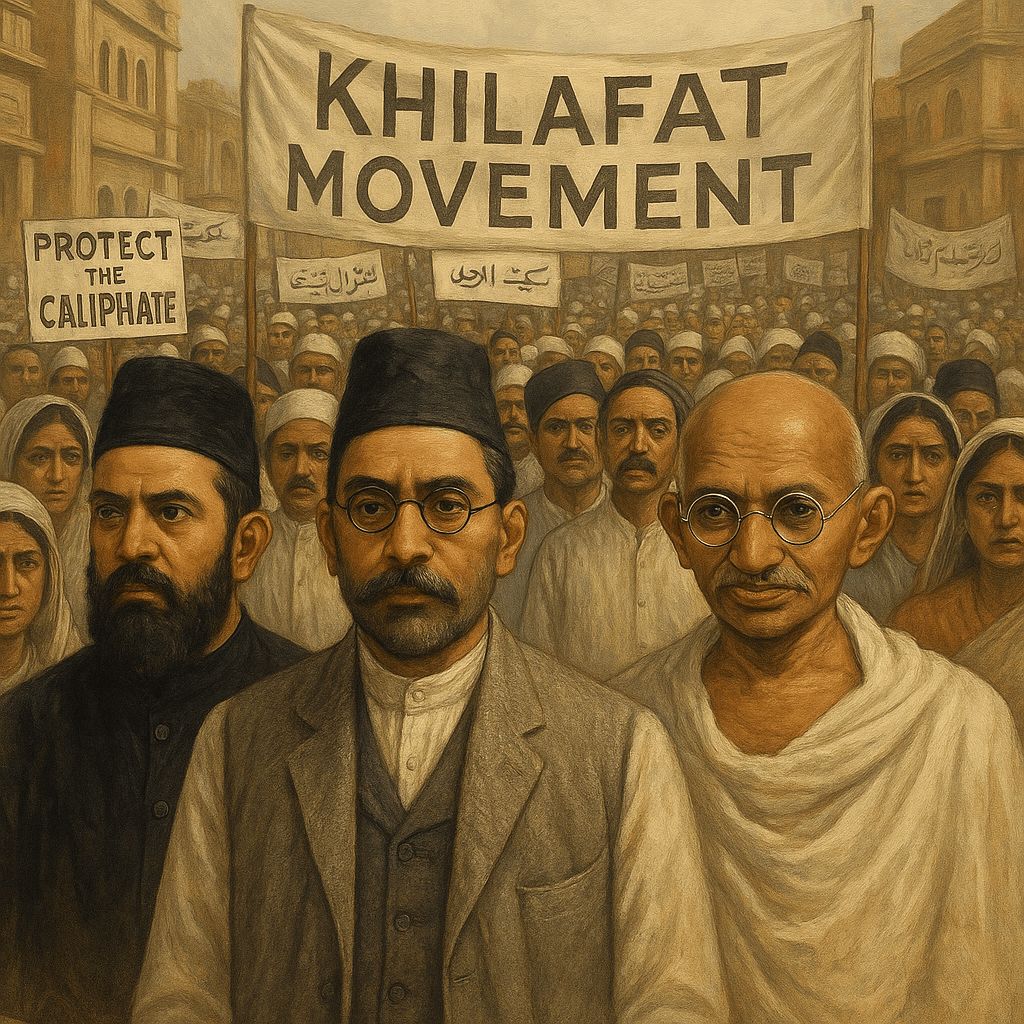
After the First World War, the Ottoman Empire was defeated. The Ottoman Sultan was regarded by many Muslims as the Khalifa, the spiritual head of the Islamic world. Indian Muslims feared that the British would weaken the Khalifa’s authority.
To defend his position, the Khilafat Committee was formed in Bombay in March 1919. Leaders such as Muhammad Ali Jauhar and Shaukat Ali worked closely with Gandhi.
Gandhi saw the Khilafat issue as an opportunity to strengthen Hindu-Muslim unity and expand the national movement.
At the Calcutta session of the Congress in September 1920, Gandhi persuaded Congress leaders to launch a Non-Cooperation Movement in support of both the Khilafat cause and the demand for Swaraj.
Why Non-Cooperation?
In his book Hind Swaraj, Gandhi argued that British rule in India survived only because Indians cooperated with it. If Indians withdrew their cooperation, British authority would collapse and self-rule (Swaraj) would be achieved.
Gandhi proposed that the Non-Cooperation Movement should begin in stages.
Proposed Programme of Non-Cooperation
The movement included:
- Surrender of government titles and honors
- Boycott of civil services, army, police, and law courts
- Boycott of legislative councils
- Boycott of government schools and colleges
- Boycott of foreign goods
If the government responded with repression, the movement would escalate into civil disobedience.
During the summer of 1920, Gandhi and Shaukat Ali toured across India to build support.
Debate Within the Congress
Some Congress leaders were hesitant:
- They opposed the boycott of council elections.
- They feared that the movement might lead to violence.
Intense discussions took place between September and December 1920.
Finally, at the Nagpur session of the Indian National Congress in December 1920, a compromise was reached, and the Non-Cooperation programme was officially adopted.
This marked the beginning of the first large-scale mass movement under Gandhi’s leadership, bringing millions of Indians into the struggle for freedom.
Differing Strands within the Movement
The Non-Cooperation-Khilafat Movement began in January 1921 and soon spread to different parts of India. People from towns, villages, tribal areas, and plantations joined the movement with great enthusiasm. However, each group understood the idea of Swaraj in its own way.
For some, Swaraj meant self-government and political freedom from British rule. For others, it meant relief from taxes, an end to exploitation by landlords, restoration of traditional rights, or the freedom to return to their villages. Thus, while all groups responded to Gandhi’s call, their hopes and expectations were often very different.
The Movement in the Towns
The Non-Cooperation Movement began in urban areas and was initially led by the middle classes.
Students left government schools and colleges. Teachers and headmasters resigned from their jobs. Lawyers gave up their legal practice in British courts. The council elections were boycotted in most provinces.
An important exception was Justice Party in Madras. It believed that participating in legislative councils would help non-Brahmans gain political power that had traditionally been dominated by Brahmans.
The economic impact of the movement was especially significant.
- Foreign cloth was boycotted and burned in public bonfires.
- Liquor shops were picketed.
- Merchants refused to deal in imported goods.
- Indian-made textiles and handloom products gained popularity.
The import of foreign cloth fell sharply from ₹102 crore in 1921 to ₹57 crore in 1922.
However, the movement in towns gradually slowed down.
Khadi was more expensive than mill-made cloth, making it difficult for poor people to buy. Also, Indian institutions that were supposed to replace British schools and courts were slow to develop. As a result, many students returned to government schools and many lawyers resumed their practice.
Rebellion in the Countryside
From the cities, the movement spread to rural areas, where peasants and tribals joined with their own local grievances.
Peasant Movement in Awadh
In Awadh, the movement was led by Baba Ramchandra, a sanyasi who had earlier worked as an indentured labourer in Fiji.
The peasants were protesting against:
- High rents imposed by talukdars and landlords.
- Numerous illegal cesses.
- Begar (forced labor without payment).
- Frequent eviction and insecurity of tenure.
Their demands included:
- Reduction of land revenue.
- Abolition of begar.
- Social boycott of oppressive landlords.
In many villages, panchayats organized nai-dhobi bandhs, in which barbers and washermen stopped providing services to landlords.
In June 1920, Jawaharlal Nehru toured villages in Awadh to understand the peasants’ problems. In October 1920, the Oudh Kisan Sabha was formed under the leadership of Jawaharlal Nehru, Baba Ramchandra, and others. Within a month, it established more than 300 branches.
When the Non-Cooperation Movement began, the Congress tried to incorporate the peasant struggle into the national movement. However, the movement sometimes turned violent. Houses of landlords and merchants were attacked, bazaars were looted, and grain stocks were seized.
Local leaders often told peasants that Gandhiji had ordered them not to pay taxes and that land would be distributed among the poor. Gandhi’s name was used to justify many local actions and aspirations.
Tribal Movement in the Gudem Hills
In the Gudem Hills of Andhra Pradesh, tribal peasants interpreted Swaraj differently.
The colonial government had:
- Closed forest areas.
- Restricted grazing.
- Prevented collection of fuelwood and forest produce.
- Forced people to provide begar for road construction.
These measures disrupted tribal livelihoods and provoked resistance.
The movement was led by Alluri Sitarama Raju.
Raju was regarded as a charismatic figure with special powers. People believed he could predict the future, heal the sick, and survive bullets.
He admired Gandhi and encouraged:
- Wearing khadi.
- Giving up alcohol.
But unlike Gandhi, he believed that freedom could be achieved only through armed struggle.
The Gudem rebels attacked police stations, attempted to kill British officials, and used guerrilla warfare. Raju was captured and executed in 1924, but he became a legendary folk hero.
Swaraj in the Plantations
Plantation workers in Assam also interpreted Swaraj according to their own experiences.
Most tea plantation workers were bound by the Inland Emigration Act of 1859, which prevented them from leaving the plantations without permission. In practice, such permission was rarely granted.
For these workers, freedom meant:
- The right to move freely.
- The ability to return to their home villages.
- Escape from oppressive plantation conditions.
When they heard about the Non-Cooperation Movement, thousands left the plantations and began walking toward their villages. They believed that Gandhi Raj was coming and that they would receive land in their native places.
However, many never reached home. Railway and steamer strikes stranded them on the way, and the police captured and brutally beat them.
Different Meanings of Swaraj
The hopes and goals of peasants, tribals, and workers were not always the same as those of the Congress leadership. Each group understood Swaraj in its own way—as a future in which suffering, exploitation, and injustice would end.
Yet, when these groups raised slogans such as “Swatantra Bharat” and invoked the name of Gandhi, they connected their local struggles to the broader national movement.
In this way, the Non-Cooperation Movement united people across India, even though their expectations and interpretations of freedom differed significantly.
Towards Civil Disobedience
In February 1922, Mahatma Gandhi decided to withdraw the Non-Cooperation Movement. He believed that the movement was becoming violent in many places and that satyagrahis needed better training in non-violence before launching another mass struggle.
Within the Indian National Congress, differences of opinion began to emerge. Some leaders believed that mass movements should be suspended and that nationalists should contest elections to the provincial councils established under the Government of India Act of 1919. They hoped to oppose British policies from within these councils and expose their undemocratic nature.
Leaders such as C. R. Das and Motilal Nehru formed the Swaraj Party within the Congress to pursue this strategy. In contrast, younger leaders such as Jawaharlal Nehru and Subhas Chandra Bose wanted more vigorous mass movements and complete independence.
During the late 1920s, two important developments changed the political situation.
The first was the worldwide economic depression. Agricultural prices began to decline from 1926 and collapsed after 1930. Peasants found it increasingly difficult to sell their crops and pay land revenue. By 1930, rural India was deeply disturbed.
The second development was the appointment of the Simon Commission under Sir John Simon. It was set up to review India’s constitutional system, but because it had no Indian members, it was greeted everywhere with the slogan “Go Back Simon.” The Congress and the Muslim League both participated in protests against it.
In October 1929, Viceroy Lord Irwin announced a vague promise of dominion status and a Round Table Conference to discuss constitutional reforms. Congress leaders were dissatisfied.
At the Lahore session of the Congress in December 1929, presided over by Jawaharlal Nehru, the Congress adopted the historic demand for Purna Swaraj (Complete Independence). It declared that 26 January 1930 would be observed as Independence Day, and people were asked to pledge themselves to the struggle for complete freedom.
However, this declaration did not create the desired public response. Gandhi therefore sought an issue that would connect the idea of independence to the everyday lives of ordinary Indians.
The Salt March and the Civil Disobedience Movement
Gandhi chose salt as the symbol of resistance because it was used by every Indian, rich and poor alike. The British government imposed a tax on salt and maintained a monopoly over its production. Gandhi argued that this tax represented the most oppressive aspect of British rule.
On 31 January 1930, Gandhi wrote a letter to Lord Irwin listing eleven demands. These included issues affecting industrialists, peasants, and the general public. The aim was to unite all sections of Indian society.
He warned that if the demands were not accepted by 11 March, the Congress would launch a civil disobedience campaign.
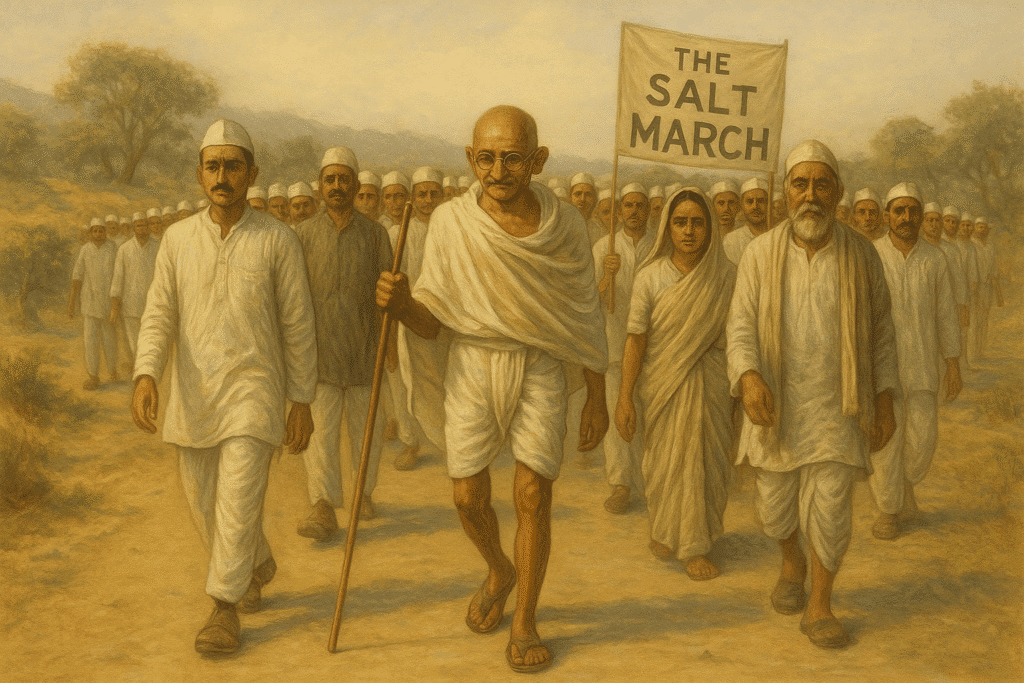
When the government ignored his demands, Gandhi began the historic Dandi March on 12 March 1930. Accompanied by 78 volunteers, he marched about 240 miles from Sabarmati Ashram to the coastal village of Dandi in Gujarat.
After 24 days, on 6 April 1930, Gandhi broke the salt law by making salt from seawater.
This act marked the beginning of the Civil Disobedience Movement.
Unlike the Non-Cooperation Movement, in which people only refused to cooperate with British institutions, Civil Disobedience required people to openly break colonial laws.
Across India:
- People manufactured salt illegally.
- Foreign cloth was boycotted.
- Liquor shops were picketed.
- Peasants refused to pay revenue and chaukidari taxes.
- Village officials resigned.
- Forest dwellers entered reserved forests to collect wood and graze cattle.
The British government responded by arresting Congress leaders.
When Khan Abdul Ghaffar Khan was arrested in Peshawar, large crowds protested and many were killed in police firing.
When Gandhi was arrested, workers in Sholapur attacked symbols of British authority such as police stations and railway buildings.
The government adopted harsh repression:
- Peaceful satyagrahis were beaten.
- Women and children were assaulted.
- About 100,000 people were arrested.
In this situation, Gandhi signed the Gandhi-Irwin Pact on 5 March 1931.
Under this pact:
- Gandhi agreed to suspend the movement.
- The Congress agreed to attend the Round Table Conference in London.
- The government agreed to release political prisoners.
Gandhi attended the Second Round Table Conference in December 1931, but the talks failed.
After returning to India, he found that repression had resumed. Congress was declared illegal, leaders such as Ghaffar Khan and Jawaharlal Nehru were jailed, and restrictions were imposed on meetings and demonstrations.
Gandhi relaunched the Civil Disobedience Movement, but by 1934 it gradually lost momentum.
How Participants Saw the Movement
Different social groups joined the Civil Disobedience Movement for their own reasons and interpreted the meaning of Swaraj according to their specific interests.
Rich Peasants
Rich peasant groups such as the Patidars of Gujarat and the Jats of Uttar Pradesh were among the most active participants.
They produced commercial crops and were severely affected by falling agricultural prices during the Great Depression. Their incomes declined sharply, making it difficult to pay land revenue.
They supported the movement because they hoped that Swaraj would lead to a reduction in revenue demands.
However, when Gandhi suspended the movement in 1931 without securing revenue concessions, many rich peasants were disappointed. When the movement resumed in 1932, many did not participate.
Poor Peasants
Poor peasants, especially tenants, faced difficulty in paying rent to landlords. They wanted unpaid rents to be cancelled.
Many joined radical movements led by socialists and communists.
The Congress was reluctant to support no-rent campaigns because it feared alienating landlords and rich peasants. As a result, the relationship between poor peasants and the Congress remained uncertain.
Business Classes
Indian industrialists and merchants had prospered during the First World War and wanted greater freedom to expand their businesses.
They demanded:
- Protection from foreign imports.
- A favorable rupee-sterling exchange rate.
To represent their interests, they formed organizations such as:
- The Indian Industrial and Commercial Congress (1920)
- FICCI (1927)
Prominent industrialists such as G. D. Birla and Purshottamdas Thakurdas supported the movement financially and boycotted imported goods.
However, after the failure of the Round Table Conference, some business groups became cautious. They feared prolonged unrest and the growing influence of socialist ideas within Congress.
Industrial Workers
Industrial workers did not participate in large numbers, except in places such as Nagpur.
Some workers joined strikes and boycott campaigns, but the Congress did not include their demands for higher wages and better conditions because it did not want to alienate industrialists.
Women
Women participated on an unprecedented scale.
They:
- Joined protest marches.
- Made salt.
- Picketed foreign cloth and liquor shops.
- Went to jail.
In urban areas, many women came from high-caste families. In rural areas, they often belonged to rich peasant households.
Gandhi viewed participation in the national movement as a sacred duty for women. However, the Congress was reluctant to give women positions of authority and largely valued their symbolic presence.
The Limits of Civil Disobedience
Despite its broad appeal, the Civil Disobedience Movement did not attract all sections of Indian society equally.
Dalits and the Question of Untouchability
The so-called untouchables, who later came to call themselves Dalits, were not fully integrated into the movement.
Gandhi believed that Swaraj would be meaningless unless untouchability was abolished. He called Dalits Harijans (children of God) and worked for:
- Temple entry
- Access to wells, roads, and schools
- Social reform among upper castes
However, many Dalit leaders wanted political safeguards rather than moral reform.
The most prominent leader was B. R. Ambedkar.
He formed the Depressed Classes Association in 1930 and demanded:
- Reserved seats in educational institutions
- Separate electorates for Dalits
At the Second Round Table Conference, Ambedkar and Gandhi disagreed sharply over this issue.
When the British government accepted Ambedkar’s demand, Gandhi began a fast unto death in prison.
The dispute was resolved through the Poona Pact.
The pact granted reserved seats for the Depressed Classes in provincial and central legislatures, but they would be elected by the general electorate.
Although an agreement was reached, many Dalits remained skeptical of the Congress-led movement.
Muslims and Political Differences
Many Muslim political organizations were also hesitant to participate fully in the Civil Disobedience Movement.
After the decline of the Non-Cooperation-Khilafat Movement, many Muslims felt alienated from the Congress.
They were concerned that:
- Congress was becoming too closely associated with Hindu organizations such as the Hindu Mahasabha.
- Muslim identity and interests might be dominated by the Hindu majority.
Efforts to rebuild Congress-Muslim League cooperation failed.
Muhammad Ali Jinnah was willing to compromise if Muslims received reserved seats and adequate representation, especially in Muslim-majority provinces.
However, disagreements over representation remained unresolved.
As communal tensions increased, large sections of Muslims stayed away from the Civil Disobedience Movement.
This showed that although the movement united millions, it could not bring all communities and social groups together under a single political vision.
Nationalism in India Class 10 Notes
The Sense of Collective Belonging
Nationalism becomes powerful when people begin to feel that they are part of one larger community. In a country as vast and diverse as India, where people spoke different languages, followed different religions, and belonged to different regions and communities, creating this sense of unity was a difficult task.
This feeling of collective belonging developed partly through common struggles against British rule. When people participated together in movements such as Non-Cooperation and Civil Disobedience, they began to recognize that they shared similar hopes and grievances. At the same time, several cultural processes also helped nationalism take root in the minds of the people.
History, literature, folklore, songs, symbols, and popular images all played an important role in creating a common national identity.
Bharat Mata and the Visual Image of the Nation
One of the most powerful symbols of Indian nationalism was the image of Bharat Mata (Mother India).
The idea of representing India as a mother figure gave the nation a human and emotional form with which people could identify. Loving and serving the motherland came to be seen as a sacred duty.
The concept was first developed by Bankim Chandra Chattopadhyay.
In the 1870s, he wrote the song Vande Mataram as a hymn to the motherland. Later, it was included in his novel Anandamath and became widely popular during the Swadeshi Movement in Bengal.
Inspired by the nationalist movement, Abanindranath Tagore created a famous painting of Bharat Mata.
In this painting, Bharat Mata is shown as:
- Calm and composed
- Spiritual and divine
- Dressed like an ascetic woman
- Holding symbolic objects associated with learning, food, and clothing
As this image circulated through posters and prints, devotion to Bharat Mata became a symbol of patriotism and national pride.
Revival of Indian Folklore
Nationalists believed that India’s true identity was preserved in its folk traditions.
In the late nineteenth century, scholars and writers traveled to villages to collect:
- Folk songs
- Ballads
- Nursery rhymes
- Legends
- Myths
They believed that these traditions reflected the authentic culture of the people, which had remained alive despite foreign rule.
Rabindranath Tagore played an important role in Bengal by gathering folk literature and encouraging pride in indigenous culture.
In Madras, Natesa Sastri published a four-volume collection titled The Folklore of Southern India.
He described folklore as the true national literature and the most reliable expression of the thoughts and character of the people.
By preserving folk traditions, nationalists sought to reconnect Indians with their cultural roots and strengthen their sense of national identity.
National Flags and Symbols
National leaders recognized the importance of symbols in inspiring unity.
During the Swadeshi Movement, a tricolour flag of red, green, and yellow was designed.
This flag included:
- Eight lotuses representing the eight provinces of British India
- A crescent moon symbolizing Hindu-Muslim unity
In 1921, Gandhi introduced the Swaraj Flag.
It was a tricolour of red, green, and white, with a spinning wheel (charkha) at the center.
The charkha represented:
- Self-reliance
- Economic independence
- The dignity of labor
Carrying the national flag in processions became a powerful act of resistance and a visible expression of patriotism.
Reinterpretation of Indian History
Nationalism also grew through a new interpretation of India’s past.
British historians often described Indians as backward and incapable of self-government. In response, Indian scholars emphasized the achievements of ancient India.
They highlighted India’s accomplishments in:
- Art and architecture
- Science and mathematics
- Religion and philosophy
- Law and literature
- Crafts and trade
According to nationalist writers, India had once been a great civilization but later declined under foreign rule and colonial domination.
These historical writings encouraged Indians to take pride in their heritage and inspired them to fight to restore the nation’s dignity and freedom.
Nationalism in India Class 10 Notes
Limitations of These Symbols and Ideas
The attempt to create unity was not without difficulties.
Many nationalist symbols and images, such as Bharat Mata and Vande Mataram, were based on Hindu cultural traditions. While they inspired many people, some members of other religious communities felt excluded.
This revealed an important challenge of Indian nationalism: how to create a shared identity that included all communities.
Conclusion
The growth of Indian nationalism was the result of both political struggle and cultural awakening.
Common opposition to British rule brought together people from different backgrounds. At the same time, symbols such as Bharat Mata, patriotic songs, folk traditions, national flags, and reinterpretations of history helped Indians imagine themselves as members of one nation.
However, different groups had different aspirations and understood freedom in different ways. The Congress, under Gandhi’s leadership, constantly tried to maintain unity while balancing these varied interests.
As a result, Indian nationalism developed as a broad and complex movement—a nation with many voices, united by the common goal of freedom from colonial rule.
Other Resources of this chapter
Other Resources
Rise of Nationalism in Europe Notes, Development Notes, Federalism Notes
FAQs
Nationalism in India Class 10 Notes
1. What is the meaning of Nationalism in India Class 10?
Nationalism in India Class 10 refers to the process through which Indians developed a shared identity and collective desire for freedom. It shows how political events, economic hardships, and Gandhian methods united different groups—peasants, students, workers, women, tribals, and plantation labourers—under one goal: ending British rule. The chapter explains how a common national consciousness gradually replaced regional and social divisions.
2. How did World War I help in the growth of Indian nationalism?
World War I created widespread inflation, food shortages, crop failures, and forced recruitment. Indian families suffered without adequate support from the British government. The influenza epidemic worsened the situation, killing lakhs. These difficulties made people realise that colonial rule was neither helpful nor protective. This shared suffering encouraged Indians to unite, question British authority, and support national leaders like Gandhi, who promised dignity and justice.
3. What is Satyagraha as explained in Class 10 History?
Satyagraha, introduced by Gandhi, means insisting on truth through non-violent methods. Instead of using force, Satyagraha encourages peaceful resistance, moral courage, and self-suffering. Gandhi believed that a just cause becomes stronger when people refuse to harm others. Through movements like Champaran, Kheda and Ahmedabad, he proved that truth combined with discipline could pressure even the most powerful government.
4. Why was the Rowlatt Act opposed across India?
The Rowlatt Act allowed the British to arrest people without trial or legal rights. Indians felt betrayed because they expected reforms after supporting Britain in World War I. The Act took away basic freedoms, leading to strikes, hartals, and public meetings. The widespread anger and the unfair nature of the Act united Indians across religions and regions, increasing distrust toward the colonial government.
5. What was the significance of the Jallianwala Bagh massacre?
The Jallianwala Bagh massacre was a turning point in the Indian freedom struggle. General Dyer ordered firing on an unarmed gathering trapped inside a closed garden. The brutality shocked Indians and destroyed any remaining trust in British rule. Many moderates who once believed in constitutional methods turned toward mass movements. The incident strengthened the call for complete independence, not just reforms.
6. What was the Non-Cooperation Movement and why was it started?
The Non-Cooperation Movement aimed to withdraw Indian support from British institutions—schools, courts, titles, government jobs and foreign goods. Gandhi launched it because of the Rowlatt Act, Jallianwala Bagh massacre, the Khilafat injustice and growing economic suffering. The idea was simple: if Indians refused cooperation, British rule would collapse morally and administratively. It became India’s first nationwide movement.
7. Why did peasants join the national movement?
Peasants joined the national movement because they faced high rents, illegal taxes, unpaid labour demands, and constant harassment by landlords and officials. Gandhi’s call for Swaraj raised hopes of relief and justice. Movements in Awadh and other regions reflected rural frustration. Although their expectations were sometimes different from Congress leadership, their participation made the movement reach India’s deepest rural areas.
8. How did the Salt March unite the nation?
The Salt March became a national symbol because salt was essential for every household. Gandhi walked 240 km to break the salt law, proving that an ordinary act could challenge an empire. People across India began making salt illegally, refusing taxes, and boycotting foreign goods. Women, students, tribals and farmers participated in large numbers. The movement gained global attention and transformed the struggle into a mass uprising.ulvinar dapibus leo.
9. Why did the Civil Disobedience Movement face limitations?
Despite widespread participation, the Civil Disobedience Movement struggled with internal divisions. Rich peasants, poor peasants, business classes and workers had different expectations. Dalits wanted stronger support for social rights, while Muslims feared political marginalisation. The British used repression to weaken the movement. These differences reduced unity, but the movement still strengthened national consciousness across the country.
10. What is the sense of collective belonging described in the chapter?
The sense of collective belonging refers to the emotional unity that developed among Indians. National symbols like the tricolour, patriotic songs like Vande Mataram, images of Bharat Mata, and rediscovery of folk traditions helped people imagine India as one nation. This cultural unity supported political movements by strengthening the feeling that India was not just a landmass but a shared homeland.
5 Long-Answer Questions
Nationalism in India Class 10 Notes
1. Explain how World War I created the foundation for Indian nationalism.
World War I placed enormous economic and social pressure on Indian society. Rising prices, shortages of essential items and forced recruitment created widespread frustration. The devastating influenza epidemic worsened living conditions. People realised that British rule demanded sacrifices but offered little support during crises. This shared experience of hardship connected Indians emotionally. It became easier for leaders like Gandhi to unite people under common issues, transforming scattered protests into organised national movements.
2. Describe the importance of the Non-Cooperation Movement in uniting India.
The Non-Cooperation Movement brought together students, teachers, lawyers, peasants, workers and women across India. It encouraged Indians to withdraw support from British schools, courts and goods, weakening the colonial system. For the first time, ordinary people felt they could challenge British authority. National schools grew, Khadi spread widely and local institutions gained importance. Although it had limitations, the movement strengthened unity and confidence, laying the groundwork for future mass struggles like Civil Disobedience.
3. Why was the Salt March considered a turning point in the freedom struggle?
The Salt March united India in a way no earlier movement had. Salt was an essential commodity for everyone, so the tax felt deeply unjust. Gandhi’s 240 km march brought national attention to simple, everyday oppression. People from all social groups participated by making salt, boycotting foreign goods and refusing taxes. International media covered the event, exposing British injustice. The movement broke fear, increased courage and transformed the struggle into a genuine national uprising.
4. How did different social groups experience the idea of Swaraj?
Different groups interpreted Swaraj according to their everyday struggles. Rich peasants wanted lower taxes; poor peasants wanted reduced rents. Plantation workers hoped Swaraj meant freedom to return home. Business classes expected fewer trade restrictions, while women viewed Swaraj as a chance for dignity and participation. These variations sometimes caused misunderstandings with Congress leadership. However, they also showed how deeply the idea of independence had travelled into India’s diverse social fabric.
5. Explain the cultural forms that helped develop nationalism in India.
Nationalism was strengthened not only through movements but also through cultural expression. The tricolour flag symbolised unity and swadeshi. Songs like Vande Mataram created emotional energy during protests. Images of Bharat Mata helped people imagine the nation as a mother figure. Folk tales, traditional stories and rediscovered histories promoted pride in India’s cultural heritage. These cultural tools made nationalism accessible to people who might not participate directly in political movements.
MCQs
Nationalism in India Class 10 Notes
Who introduced the idea of Satyagraha?
a) Nehru
b) Gandhi
c) Patel
d) Tilak
Answer: bThe Rowlatt Act allowed:
a) Free speech
b) No tax
c) Arrest without trial
d) Land reforms
Answer: cJallianwala Bagh incident took place in:
a) Lahore
b) Amritsar
c) Kolkata
d) Surat
Answer: bThe Khilafat leaders were:
a) Ali brothers
b) Nehru brothers
c) Gandhi and Patel
d) Tilak and Lajpat Rai
Answer: aGandhi began the Salt March from:
a) Porbandar
b) Dandi
c) Sabarmati Ashram
d) Wardha
Answer: cSimon Commission arrived in India in:
a) 1928
b) 1930
c) 1919
d) 1942
Answer: aPurna Swaraj was declared in:
a) Delhi
b) Lahore
c) Bombay
d) Madras
Answer: bInland Emigration Act affected:
a) Lawyers
b) Plantation workers
c) Peasants
d) Women
Answer: bVande Mataram was written by:
a) Rabindranath Tagore
b) Bankim Chandra Chattopadhyay
c) Aurobindo
d) Sarojini Naidu
Answer: bCivil Disobedience began with:
a) Boycott of schools
b) Salt March
c) Swadeshi
d) Quit India
Answer: b
5-Marker Questions
Analyse the reasons behind the rise of nationalism in India after World War I.
Examine how Gandhian methods transformed Indian politics and motivated mass participation.
Describe the phases of the Non-Cooperation Movement and explain why it eventually slowed down.
Discuss the Civil Disobedience Movement and evaluate the participation of different social groups.
How did cultural nationalism—symbols, songs, folk tales and Bharat Mata—strengthen the idea of India as a nation?
Supportive Study Material Class 10 Science
- Class 10 Science Quiz
- Class 10 Science tests
- Class 10 Science Worksheets
- Class 10 Science PYQs
- Class 10 Science NCERT Solution