✅ Oswaal Class 10 SST — Topper's Choice
✅ Together With SST — Best for Practice
✅ Oswaal Science Class 10 — Chapter Wise
✅ RD Sharma Maths — Most Popular
The Age of Industrialisation Class 10 Notes (Avoid Common Mistakes) Complete CBSE Exam-Ready
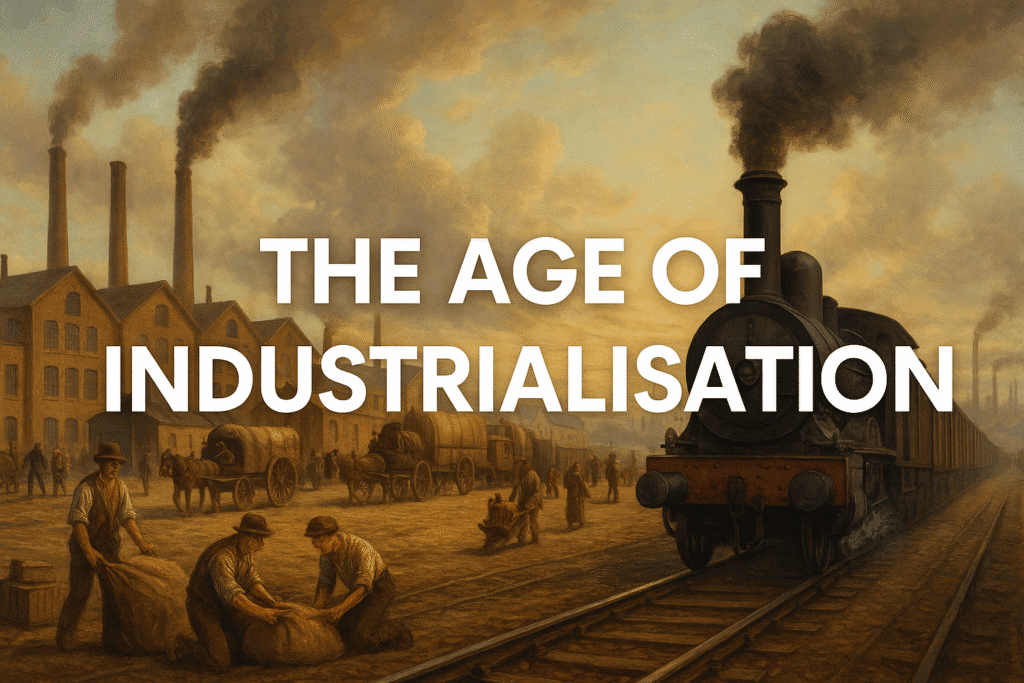
Introduction to the Age of Industrialisation
The modern world is often associated with machines, factories, railways, and new technologies. These inventions are usually seen as symbols of progress and development. In the early twentieth century, this idea was widely celebrated in books, magazines, and popular images.
In 1900, music publisher E. T. Paull released a music book titled “Dawn of the Century.” The cover showed a goddess-like figure representing the angel of progress. She carried the flag of the new century and stood on a winged wheel symbolizing time.
Around her appeared images of modern inventions:
- Railways
- Cameras
- Machines
- Printing presses
- Factories
This illustration presented the twentieth century as an age of scientific advancement and industrial progress.
The Symbolism of Aladdin and the Modern Mechanic
Another image published in a trade magazine over a hundred years ago showed two magicians.
The first was Aladdin, representing the East and the past. Using his magic lamp, he created a magnificent palace.
The second was the modern mechanic, representing the West and modernity. With tools and machines, he built:
- Bridges
- Ships
- Towers
- High-rise buildings
The message was clear: modern science and machinery had become the new magic of the industrial age.
This image reflected a common belief that industrialization and technological innovation were transforming the world in extraordinary ways.
Industrialisation and the Idea of Progress
These images helped create a powerful association between industrialization and progress.
The modern world came to be identified with:
- Rapid technological change
- Mechanized production
- Factory systems
- Railways and steamships
- Urban growth
As a result, industrialization was often presented as a success story of development and modernity.
Even today, many people see factories, infrastructure, and advanced technology as signs of national progress.
However, history raises important questions:
- Is industrialization always beneficial?
- Does mechanization improve life for everyone?
- How did industrialization affect workers and ordinary people?
- Was technological progress always rapid and smooth?
To answer these questions, we must study the actual history of industrialization.
Focus of This Chapter
This chapter examines the historical development of industrialization and its impact on society.
It focuses on:
- United Kingdom, the first industrial nation.
- India, where industrialization developed under colonial conditions.
By comparing Britain and India, we can understand that industrialization was a complex process. It brought economic growth and technological progress, but it also created new challenges and inequalities.
The Age of Industrialisation was therefore not just a story of machines and inventions. It was also a story of workers, entrepreneurs, colonialism, and the profound changes that transformed the modern world.
Before the Industrial Revolution
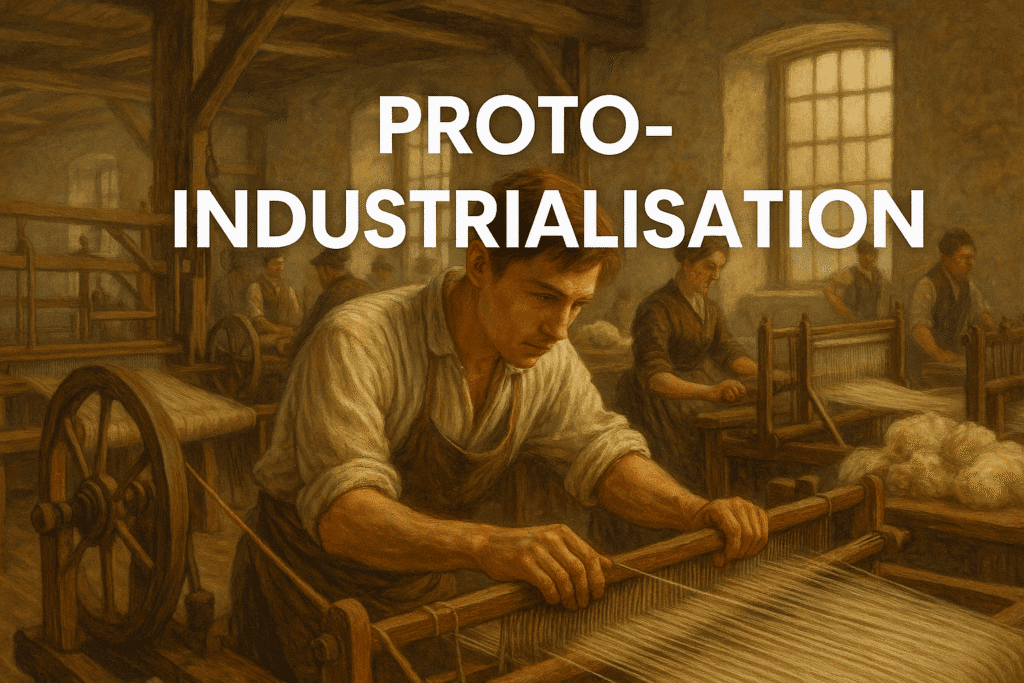
Before studying factories and machines, it is important to understand that industrial production existed long before the Industrial Revolution. We often think that industrialisation began only when factories were established and large numbers of workers started producing goods using machines. However, this view is incomplete. Even before factories appeared in England and Europe, there was already extensive production for international markets. This earlier stage of industrial development is known as proto-industrialisation.
Proto-industrialisation refers to a system in which merchants organized production in rural areas rather than in factories. During the seventeenth and eighteenth centuries, European merchants began moving to the countryside and supplied money and raw materials to peasants and artisans. They persuaded them to produce goods for export to international markets. This system developed because world trade was expanding and European powers were acquiring colonies, which greatly increased the demand for manufactured goods.
Merchants could not easily expand production within towns because urban craft and trade guilds were powerful. Guilds were associations of producers that controlled training, regulated prices and competition, and restricted the entry of new producers into the trade. They were often granted monopoly rights by rulers to produce and sell specific goods. These restrictions made it difficult for new merchants to establish businesses in urban areas, so they turned to the countryside where such controls were weaker.
In rural areas, poor peasants and artisans were willing to work for merchants because they needed additional income. This was a period when common lands were being enclosed. Earlier, villagers had depended on these common lands to collect firewood, berries, vegetables, hay, and straw. Once these lands were enclosed, many cottagers and small peasants lost an important source of livelihood. Their tiny plots of land could not provide enough work or income for all family members. Therefore, when merchants offered advances to produce goods at home, peasant households readily accepted.
This arrangement benefited both merchants and rural families. Merchants could increase production without facing the restrictions imposed by urban guilds, while peasants could supplement their shrinking agricultural income and make full use of family labour. They could continue cultivating their small plots while also producing goods for the market.
A close relationship developed between towns and the countryside under this system. Merchants were based in towns, but the actual production was carried out in villages. In the English cloth industry, for example, a merchant clothier purchased wool from a wool stapler and distributed it to spinners. The spun yarn was then passed to weavers, fullers, and dyers. Finally, the cloth was sent to London for finishing before being exported to international markets. London became an important finishing centre. At every stage of production, different groups of workers participated, and a single merchant could coordinate the labour of hundreds of people.
This proto-industrial system was therefore part of a wide commercial network. Goods were produced in family homes rather than factories, but production was large in scale and closely controlled by merchants. It laid the foundation for later industrial development.
The Coming Up of the Factory
The earliest factories in England were established in the 1730s, but their numbers increased significantly only in the late eighteenth century. The industry that symbolized this new era was cotton.
Cotton production expanded rapidly. In 1760, Britain imported 2.5 million pounds of raw cotton. By 1787, imports had risen to 22 million pounds. This dramatic growth was made possible by a series of technological inventions that improved various stages of production, such as carding, spinning, twisting, and rolling. These inventions increased the output of each worker and enabled the production of stronger and finer yarn.
A major breakthrough came when Richard Arkwright created the cotton mill. Previously, cloth production had been spread across village households. With the introduction of expensive machinery, production was brought together under one roof. Machines could now be purchased, installed, and maintained in mills.
The factory system offered several advantages. Managers could supervise workers more closely, monitor the quality of goods, and regulate labour more effectively. Such control had been difficult when production was scattered across rural households.
By the early nineteenth century, factories had become a visible and impressive feature of the English landscape. Their size and the apparent power of machines fascinated contemporaries. As a result, many people began to associate industrialisation mainly with factories, even though much production still continued in small workshops and homes.
Hand Labour and Steam Power
The Age of Industrialisation Class 10 Notes
Industrialisation was neither as rapid nor as complete as it is often imagined.
First, the most dynamic industries in Britain were cotton and metals. Cotton led industrial growth up to the 1840s. After that, the iron and steel industries became more important, especially as the expansion of railways increased demand for these materials. By 1873, Britain was exporting iron and steel worth about £77 million.
Second, new industries did not immediately replace traditional industries. Even by the end of the nineteenth century, less than 20 percent of the British workforce was employed in technologically advanced sectors. In textiles, a significant share of production still took place outside factories in domestic units.
Third, traditional industries were not stagnant. Small improvements and innovations stimulated growth in sectors such as food processing, pottery, glasswork, furniture making, tanning, and the production of tools and implements.
Fourth, technological change spread slowly. New machines were expensive, prone to breakdowns, and costly to repair. Industrialists were cautious about adopting them and often continued using older methods.
The steam engine provides a good example. James Watt patented his improved steam engine in 1781, and his partner Matthew Boulton began producing it. Yet adoption remained slow. At the beginning of the nineteenth century, there were only 321 steam engines in England. Of these, 80 were used in the cotton industry, 9 in the wool industry, and the rest in mining, canal works, and iron works. Many other industries did not use steam power until much later.
This shows that industrialisation was a gradual process. Factories and machines were important, but they did not immediately dominate production. For much of the nineteenth century, the typical worker was still a traditional craftsperson or labourer rather than a machine operator in a large factory.
Life of the Workers
The Age of Industrialisation Class 10 Notes
The large supply of labour had a profound effect on the lives of workers.
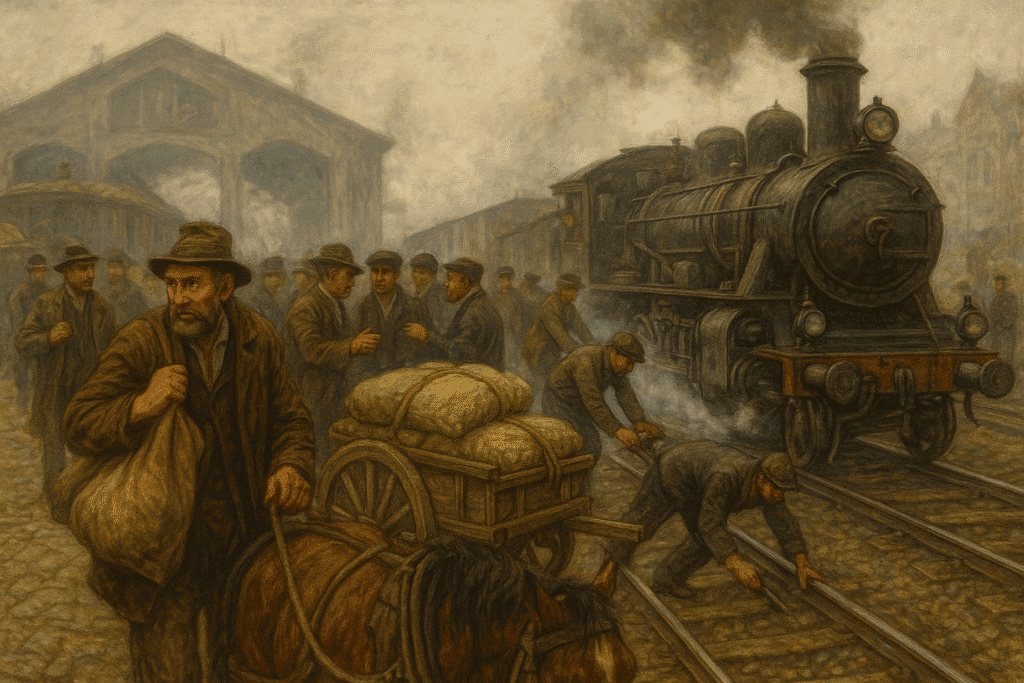
As news of job opportunities spread, many people left the countryside and traveled to cities. Finding work often depended on having friends or relatives already employed in factories or workshops. Those without such connections could remain unemployed for weeks.
Many job-seekers lived in extremely harsh conditions. Some slept under bridges or in night shelters. Others stayed in Night Refuges established by charitable individuals or in Casual Wards maintained by Poor Law authorities.
Seasonal employment created long periods of joblessness. When the busy season ended, workers were again left without work. Some returned temporarily to the countryside, but many survived by taking irregular and poorly paid odd jobs.
Although money wages rose somewhat during the early nineteenth century, this did not necessarily improve living standards. During periods such as the Napoleonic Wars, prices rose sharply, reducing the purchasing power of wages.
The welfare of workers depended not only on wage rates but also on the number of days they could find employment.
Even in relatively prosperous times, about 10 percent of the urban population lived in extreme poverty. During economic crises, such as the depression of the 1830s, unemployment in some regions rose to between 35 and 75 percent.
Because their livelihoods were so insecure, workers often opposed the introduction of new machinery. When the Spinning Jenny was introduced in the woollen industry, women who earned a living through hand spinning feared losing their jobs and attacked the machines. These conflicts reflected the anxiety and resistance caused by technological change.
Conditions began to improve somewhat after the 1840s. Urban construction expanded rapidly:
- Roads were widened.
- Railway stations were built.
- Railway lines were extended.
- Tunnels were dug.
- Drainage and sewer systems were installed.
- Rivers were embanked.
These projects created many new jobs.
Employment in the transport sector doubled during the 1840s and doubled again over the following thirty years.
Thus, while industrialisation brought uncertainty and hardship to many workers, it also gradually created new employment opportunities and transformed the economic landscape of Britain.
Industrialisation in the Colonies
To understand industrialisation fully, it is important to study what happened in colonies like India. Industrial development in India followed a path very different from that of Britain because it was shaped by colonial rule. In India, industrialisation affected not only factories but also the large non-mechanised sector, especially the textile industry, which had long been one of India’s greatest strengths.
The Age of Indian Textiles
The Age of Industrialisation Class 10 Notes
Before the rise of machine industries in Europe, India was one of the world’s leading producers and exporters of cotton and silk textiles. Indian fabrics were famous for their fine quality, beautiful designs, and durable craftsmanship. While many countries produced coarse cotton cloth, the finest varieties were often manufactured in India.
Indian textiles were traded across Asia, Europe, and Africa. Armenian and Persian merchants carried goods from Punjab to Afghanistan, eastern Persia, and Central Asia. Large bales of cloth traveled on camelback through mountain passes and deserts. At the same time, India’s ports connected it to a vast maritime trade network.
Important pre-colonial ports included:
- Surat, which connected India to the Persian Gulf and Red Sea.
- Masulipatnam, which traded with Southeast Asia.
- Hooghly.
A complex network of Indian merchants and bankers financed production and organized trade. Supply merchants advanced money to weavers, collected cloth from villages, and transported it to ports. Brokers at the ports negotiated prices and sold the goods to large exporters.
By the mid-eighteenth century, this flourishing system began to weaken. European trading companies, especially the East India Company, gradually secured trading privileges and monopoly rights.
As European influence expanded:
- Traditional ports like Surat and Hooghly declined.
- Trade shifted to new colonial ports such as Bombay and Calcutta.
- Indian trading houses lost access to credit.
- Many local bankers went bankrupt.
For example, the value of trade through Surat declined from Rs 16 million in the late seventeenth century to Rs 3 million by the 1740s.
This shift reflected the growing control of colonial powers over Indian trade.
What Happened to Weavers?
The Age of Industrialisation Class 10 Notes
After the East India Company established political power in Bengal and Carnatic during the 1760s and 1770s, it strengthened its control over textile production.
Initially, this did not reduce textile exports. British textile industries were still developing, and Indian fine cloth remained highly valued in Europe. The Company wanted to expand exports and ensure a regular supply of goods.
Before the Company gained political control, Indian weavers had several buyers, including French, Dutch, Portuguese, and Indian merchants. This competition allowed weavers to bargain for better prices.
Once the Company became politically powerful, it imposed a monopoly over trade.
The Company’s Methods of Control
The Company used two main methods to control weavers.
First, it appointed paid agents known as gomasthas.
A gomastha:
- Supervised weavers.
- Collected cloth.
- Checked quality.
- Enforced Company rules.
Second, the Company introduced a system of advances.
Weavers were given loans to purchase raw materials. In return, they were required to supply cloth exclusively to the Company and were prohibited from selling to other buyers.
Impact on Weavers
At first, many weavers accepted advances, hoping to increase their earnings.
However, they soon faced serious problems:
- They lost the freedom to choose buyers.
- Prices paid by the Company were very low.
- Loans trapped them in debt.
- Gomasthas often behaved arrogantly and violently.
- Delays in production could result in beatings and flogging.
Unlike earlier merchants, who often lived in the villages and maintained close relationships with weavers, gomasthas were outsiders with no social ties to the community.
As conditions worsened:
- Some weavers fled to other villages.
- Others revolted against Company officials.
- Many stopped weaving and turned to agricultural labor.
Thus, colonial control severely damaged the independence and livelihood of India’s traditional artisans.
Manchester Comes to India
The Age of Industrialisation Class 10 Notes
In 1772, Company official Henry Patullo believed that demand for Indian textiles would never decline because no other country produced goods of equal quality.
Yet by the early nineteenth century, Indian textile exports began to collapse.
The share of cotton piece goods in India’s exports fell:
- 33% in 1811–12
- 3% in 1850–51
Rise of British Textile Industry
As the cotton industry expanded in Manchester, British manufacturers sought protection from Indian competition.
They persuaded the British government to impose duties on Indian textiles entering Britain.
At the same time, the East India Company promoted the sale of British machine-made cloth in India.
Flood of British Imports
The import of British cotton goods into India rose rapidly.
By:
- 1850, cotton piece goods made up over 31% of Indian imports.
- 1870s, they accounted for more than 50%.
Double Blow to Indian Weavers
Indian weavers faced two simultaneous crises:
- Their export markets declined.
- Their domestic markets were flooded with cheap machine-made cloth from Britain.
Because British textiles were produced by machines, they were much cheaper than handmade Indian cloth.
As a result, weaving regions across India experienced severe decline and poverty.
Raw Cotton Crisis During the American Civil War
In the 1860s, the American Civil War interrupted cotton exports from the United States.
Britain turned to India for raw cotton.
This caused:
- Sharp increases in cotton prices.
- Shortages for Indian weavers.
- Rising production costs.
Many weavers could no longer earn a living.
Competition from Indian Factories
By the end of the nineteenth century, factories established in India began producing machine-made textiles.
Traditional artisans now faced competition from:
- British imports.
- Indian factory-made goods.
This created a new challenge for handloom weavers and craftspeople, who struggled to survive in an increasingly industrialized market.
Factories Come Up
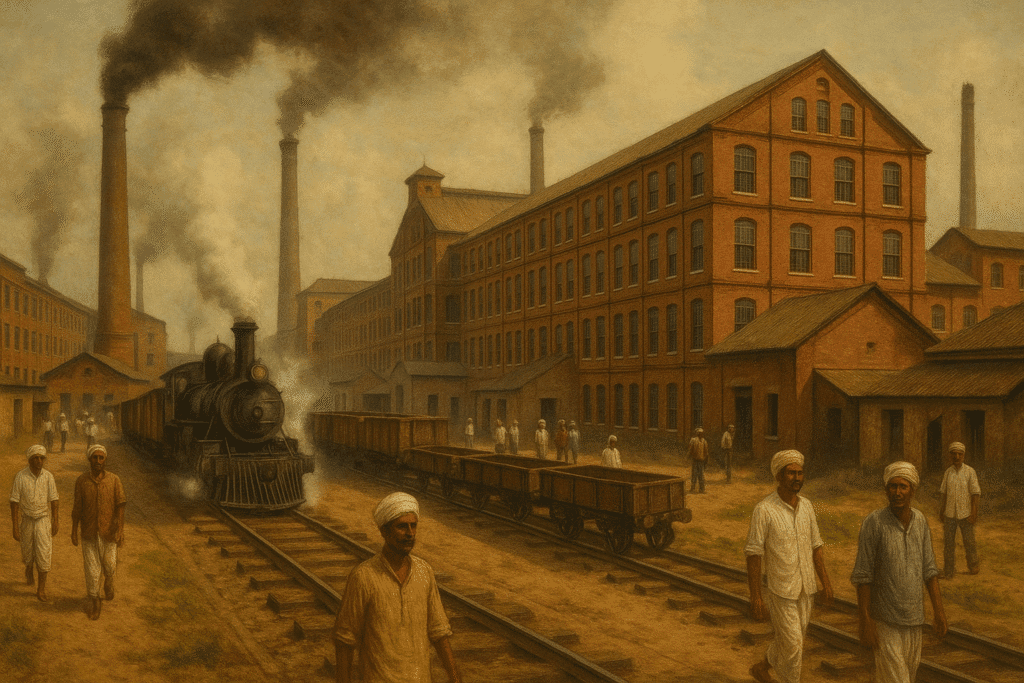
The first modern cotton mill in India was established in Bombay in 1854 and started production two years later, in 1856. This event marked the beginning of the factory era in India. Bombay soon became the leading centre of cotton textile production.
Industrial growth then spread to other regions:
- By 1862, four cotton mills were operating in Bombay with 94,000 spindles and 2,150 looms.
- The first jute mill was set up in Bengal in 1855, and another followed in 1862.
- In the 1860s, the Elgin Mill was established in Kanpur.
- A year later, Ahmedabad’s first cotton mill was founded.
- In 1874, the first spinning and weaving mill began production in Madras.
This gradual expansion of factories laid the foundation for modern industrial development in India.
The Early Entrepreneurs
The establishment of factories required large amounts of capital. This capital was provided by Indian entrepreneurs who had accumulated wealth through trade.
Many early industrialists had earned profits from trade with China. During the late eighteenth and early nineteenth centuries, the British exported opium from India to China and imported tea from China to England. Indian merchants participated in this trade by financing shipments, procuring goods, and arranging transport.
Several successful traders later became industrialists.
Dwarkanath Tagore of Bengal made a fortune in the China trade and invested in six joint-stock companies during the 1830s and 1840s.
In Bombay, Parsis such as Dinshaw Petit and Jamsetji Nusserwanji Tata built large industrial enterprises using profits earned from trade with China and exports of raw cotton to England.
Seth Hukumchand, who established the first Indian-owned jute mill in Calcutta in 1917, also accumulated wealth through trade with China.
The family of G. D. Birla was similarly connected to commercial trade.
Other merchants from Madras traded with Burma, East Africa, and the Middle East. Some Indian traders and bankers operated entirely within India, carrying goods, transferring money between cities, and financing domestic trade. When industrial opportunities emerged, they invested in factories as well.
However, Indian entrepreneurs faced serious limitations under colonial rule. As British control over Indian trade tightened:
- Indian merchants were excluded from trade with Europe in manufactured goods.
- They were mainly restricted to exporting raw materials such as cotton, wheat, indigo, and opium.
- They were gradually pushed out of the shipping business.
Before the First World War, much of Indian industry was controlled by European Managing Agencies such as:
- Bird Heiglers & Co.
- Andrew Yule & Co.
- Jardine Skinner & Co.
These agencies raised capital, established companies, and managed industrial enterprises. In many cases, Indian financiers provided the money, but Europeans controlled all important decisions.
European industrialists also had exclusive chambers of commerce that Indian businessmen were not allowed to join.
Thus, Indian industrialists played a major role in establishing industries, but they worked within a colonial system that favored European interests.
Where Did the Workers Come From?
Factories required a large labour force. As industrialisation expanded, the demand for workers increased rapidly.
In 1901, Indian factories employed about 584,000 workers. By 1946, the number had risen to more than 2,436,000.
Most workers came from nearby villages and districts. Peasants and artisans who were unable to find sufficient work in rural areas migrated to industrial centres.
Examples include:
- More than half of the workers in Bombay cotton mills in 1911 came from the neighbouring district of Ratnagiri.
- The mills of Kanpur recruited most of their labourers from nearby villages.
Many workers maintained close links with their villages. They often returned home during harvest seasons and festivals, moving back and forth between city and countryside.
As information about employment spread, workers began travelling greater distances. Labourers from the United Provinces (present-day Uttar Pradesh) migrated to Bombay’s textile mills and Calcutta’s jute mills.
Finding a job, however, was extremely difficult. The number of people seeking work was always greater than the jobs available.
Recruitment was usually handled by a jobber.
A jobber was a trusted senior worker who:
- Recruited labourers, often from his own village.
- Helped them obtain jobs.
- Assisted them in finding accommodation.
- Provided financial help during difficult times.
Because of his influence, the jobber gained significant authority over workers. Over time, many jobbers began demanding money and gifts in return for their help.
Although the number of factory workers increased steadily, they still formed only a small fraction of India’s total industrial workforce. A much larger number of people continued to work in handloom weaving, small workshops, and traditional industries outside the factory system.
The Peculiarities of Industrial Growth
European Managing Agencies, which controlled a large part of industrial production in colonial India, were interested mainly in industries that served British economic interests. They invested in tea and coffee plantations, mining, indigo, and jute. These industries produced goods that were primarily meant for export to Britain and other foreign markets rather than for sale within India. The colonial government supported these enterprises by granting land at cheap rates and providing various facilities.
When Indian entrepreneurs began establishing industries in the late nineteenth century, they adopted a different strategy. They generally avoided direct competition with British-made cloth from Manchester, because British textiles were produced in highly mechanised mills and sold at low prices. Instead, Indian mills concentrated on producing coarse cotton yarn rather than finished cloth. This yarn was used by handloom weavers within India and was also exported to China. Since British imports into India consisted mainly of finished cloth rather than yarn, Indian industrialists found this to be a profitable and less competitive field.
By the first decade of the twentieth century, several developments changed the pattern of industrial growth. The Swadeshi Movement encouraged Indians to boycott foreign cloth and use goods made in India. Nationalist leaders inspired people to support indigenous industries, while Indian industrialists organised themselves to demand tariff protection and concessions from the government. At the same time, exports of Indian yarn to China declined because Chinese and Japanese mills began producing yarn more cheaply and captured the Chinese market.
As a result, Indian industrialists shifted from yarn production to cloth manufacturing. Cotton piece-goods production in India doubled between 1900 and 1912, showing the rapid expansion of the domestic textile industry.
Industrial growth remained relatively slow until the First World War. The war transformed the situation dramatically. British factories were fully occupied with war production and could no longer export large quantities of cloth to India. This created a huge opportunity for Indian mills, which suddenly had a vast domestic market to supply. In addition, Indian factories were asked to produce goods needed for the war effort, such as jute bags, military uniforms, tents, leather boots, saddles, and other supplies. To meet this increased demand, new factories were established, existing factories operated multiple shifts, and many more workers were employed. Working hours became longer, and industrial production increased sharply.
After the war, British manufacturers were unable to regain their earlier dominance in the Indian market. Britain faced severe economic difficulties and could not modernise its industries sufficiently to compete with countries such as the United States, Germany, and Japan. As British exports declined, Indian industrialists strengthened their position and increasingly captured the domestic market.
Small-scale Industries Predominate
Although factory industries expanded after the First World War, they still represented only a small part of India’s industrial economy. Most large factories were concentrated in Bengal and Bombay, which together accounted for about 67 percent of registered factories in 1911.
The majority of industrial workers did not work in large factories:
- Only 5 percent of the total industrial labour force worked in registered factories in 1911.
- By 1931, this proportion had increased to only 10 percent.
The remaining workers were employed in small workshops, family-based enterprises, and household industries, often located in narrow lanes and villages and largely invisible to outsiders.
In some sectors, traditional handicraft production actually expanded during the twentieth century. The handloom industry is a striking example. While machine-made yarn had destroyed the old spinning industry in the nineteenth century, weaving survived and even grew. Between 1900 and 1940, handloom cloth production nearly tripled.
This growth was partly due to the adoption of new technology. Weavers introduced the fly shuttle, a simple but highly effective improvement that:
- Increased the speed of weaving.
- Raised output per worker.
- Reduced labour requirements.
By 1941, more than 35 percent of India’s handlooms used fly shuttles. In regions such as Travancore, Madras, Mysore, Cochin, and Bengal, the proportion reached 70 to 80 percent.
Weavers also survived because some specialized products could not be easily reproduced in mills. Mill-made cloth was suitable for standard goods, but it could not match the artistic quality and intricate designs of products such as:
- Banarasi saris
- Baluchari saris
- Madras lungis
- Decorative handkerchiefs
The demand for these finer goods remained relatively stable because they were purchased by wealthier consumers. Even during famines and economic crises, affluent buyers continued to purchase such products, while demand for coarse cloth used by the poor often declined sharply.
However, survival did not mean prosperity. Weavers and craftspeople lived difficult lives and worked very long hours. Entire families, including women and children, participated in different stages of production. Their continued existence demonstrates that industrialisation in India was not limited to large factories. Traditional and small-scale industries remained an essential and dynamic part of the industrial economy throughout the twentieth century.
Market for Goods
As industrial production increased during the nineteenth and twentieth centuries, manufacturers faced an important challenge: producing goods was not enough; they also had to convince people to buy them. Consumers needed to believe that these new products were useful, trustworthy, and desirable. To create this demand, manufacturers relied heavily on advertising.
Advertisements played a major role in shaping consumer behaviour. They did more than simply provide information about a product. Their purpose was to influence the minds of people, create new desires, and make products appear essential to everyday life. In the modern world, advertisements surround us through newspapers, magazines, billboards, television, and the internet. However, this practice began much earlier. From the very beginning of the industrial age, advertisements were used to expand markets and build a new consumer culture.
When manufacturers in Manchester started selling cloth in India, they attached labels to bundles of cloth. These labels served several purposes. They informed buyers where the cloth was produced and identified the company that manufactured it. More importantly, they acted as a symbol of quality. When customers saw the words “Made in Manchester,” they were expected to trust that the cloth was of high quality and worth purchasing.
These labels often contained attractive illustrations rather than just words. Manufacturers understood that visual images could appeal to buyers more effectively than plain text.
One striking feature of these labels was the use of images of Indian gods and goddesses. Figures such as Lord Krishna and Goddess Saraswati were commonly printed on labels. The intention was to make foreign-made goods seem familiar and acceptable to Indian consumers. The presence of sacred images suggested that the products had a kind of divine blessing and could therefore be trusted.
By the late nineteenth century, manufacturers began using calendars as a powerful advertising medium. Calendars were extremely popular because they were used by both literate and illiterate people. They were displayed in homes, tea shops, offices, and shops, ensuring that the advertisement remained visible throughout the year. Since people saw these images every day, calendars became an effective way to promote products.
Like labels, calendars also featured religious and cultural symbols. Gods and goddesses were shown alongside product names and company logos, reinforcing familiarity and trust.
Manufacturers also used images of kings, emperors, and nawabs in advertisements. These royal figures conveyed prestige and authority. The message was clear: if respected rulers used or endorsed a product, then the product must be of superior quality. This association helped manufacturers create a sense of confidence among consumers.
Indian manufacturers used advertisements in a different but equally powerful way. Their advertisements carried a strong nationalist message. They urged people to support Indian-made goods and reject foreign products. Buying Indian goods was presented not just as an economic choice, but as a patriotic duty.
This message became especially important during the Swadeshi Movement. Advertisements encouraged consumers to believe that purchasing indigenous products was a direct contribution to the nation’s struggle against colonial rule. In this way, advertising became an instrument of nationalism as well as commerce.
Conclusion
The age of industrialisation brought major changes to the world. It introduced new technologies, large factories, and a growing industrial workforce. At the same time, it transformed the way goods were marketed and sold.
However, industrialisation did not completely replace traditional production methods. Hand technology and small-scale industries continued to play a vital role in the economy. Craftspeople, handloom weavers, and family-based producers remained an essential part of industrial development.
The history of industrialisation therefore shows that economic change was complex. Modern factories and machines grew rapidly, but they coexisted with older forms of production. Advertising, technology, and nationalism all combined to shape both the industrial economy and the consumer culture of the modern world.
Other Resources
- The Age of Industralization Quiz
- The Age of Industralization Test
- The Age of Industralization flashcards
Other Chapters Notes
The Age of Industrialisation Class 10 Notes (Advanced Exam Section)
FAQs
The Age of Industrialisation Class 10 Notes
1. What is meant by proto-industrialisation?
Proto-industrialisation refers to the phase before actual factories appeared. During this period, merchants in Europe began hiring rural families to produce goods from their homes. Guilds in towns restricted production, so merchants moved to villages for cheap labour and fewer rules. This created large-scale output even before machines arrived and laid the foundation for modern industrialisation.
2. Why did factories first appear in Britain?
Factories first appeared in Britain due to several advantages: abundant coal and iron, a strong banking network, a stable government, and access to global markets through colonies. Britain also had growing demand due to its rising population. These factors made it easier to build machines, hire workers, produce goods quickly, and export cheaply, making Britain the birthplace of industrialisation.
3. What problems did early factory workers face?
Early factory workers experienced very harsh conditions. They had to work 12–14 hours daily, often in unsafe buildings with loud machines, dust, and poor ventilation. Wages were extremely low, and children were also employed in many factories. Workers had no job security or legal protection. Injuries, illness, and exhaustion were common due to the pressure to keep up with machine speed.
4. Why did Britain still use hand labour even after machines?
Hand labour remained important because many tasks required delicate craftsmanship that early machines could not provide. Luxury items such as embroidery, lace, carpets, and fine furniture needed skilled hands. Machines were expensive to install and maintain, so small-scale producers avoided them. Seasonal industries also preferred flexible human labour instead of costly machines that sat idle during off-season.
5. What caused the decline of traditional Indian industries?
Traditional Indian industries declined mainly because of British policies. British machine-made textiles flooded Indian markets at very low prices, making Indian handwoven cloth less competitive. The British also controlled Indian raw cotton, leaving weavers without enough good-quality fibre. Heavy taxes, unfair tariffs, and restrictions on Indian exporters further damaged local artisans and forced many into poverty.
6. How did Indian factories begin to grow?
Indian factories grew slowly at first, mainly in Bombay (cotton) and Bengal (jute). Entrepreneurs like J.N. Tata and G.D. Birla invested in mills. Initially, they faced competition from British companies, but gradually Indian industries expanded. World War I and II played a big role because British mills were busy producing war supplies, so Indian mills filled the demand gap and grew rapidly.
7. What were the peculiarities of Indian industrial growth?
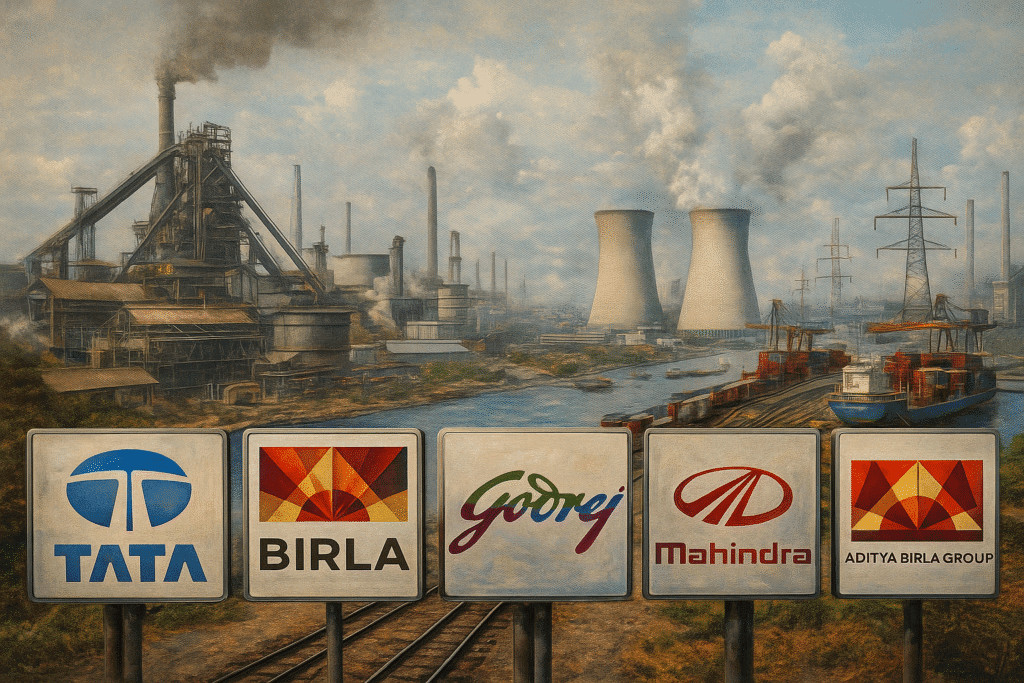
Indian industrial growth was irregular and uneven. Some industries grew quickly during wars, but slowed down afterward. European firms still dominated major sectors, leaving Indian businesses with limited space. Imports of cheap British goods harmed local workers. Despite this, Indian entrepreneurs slowly built large business groups like Tata, Birla, and Godrej, forming a strong industrial base over time.
8. How did advertisements shape consumer culture?
Advertisements played a huge role in shaping modern consumer culture. Companies used colourful posters, newspapers, calendars, and labels to attract attention. Logos helped identify brands in a crowded market, especially for illiterate buyers. Packaging became a way to show quality. As mass production increased, advertisements helped create demand and turned everyday items into symbols of status and modern living.
9. What was the role of traders and bankers in Indian industrialisation?
Indian traders and bankers acted as crucial intermediaries. People like Dwarkanath Tagore financed early industries, while Gujarati and Marwari traders handled export and import networks. Chettiar bankers funded businesses in Burma and Ceylon. These groups provided credit, raw materials, and distribution channels that Indian industrialists needed to compete with European companies.
10. How did railways support industrialisation?
Railways connected mining regions, factory towns, and ports. This allowed fast transport of coal, raw cotton, iron, and finished goods. Railways lowered transport costs and created a unified market. Industries like steel, machine tools, and engineering grew because railways needed parts and maintenance. In India, railways helped mills in Bombay and Bengal reach national and global markets.
5 Long-Answer Questions
The Age of Industrialisation Class 10 Notes
1. Explain the major features of proto-industrialisation in Europe.
Proto-industrialisation created large-scale production even before factories. Merchants hired rural families to spin and weave because guilds in towns restricted expansion. These merchants supplied raw materials and collected finished products from peasant households. This system allowed production for international markets while workers remained in villages. It helped create a commercial economy, increased rural incomes, and prepared the foundation for later factory-based industrial production.
2. Describe the working conditions in early British factories.
Working conditions in early factories were extremely harsh. Workers had to adjust their speed to match fast-moving machines, making the work stressful. The factory floors were noisy, airless, and overcrowded. Wages were very low, and workers had no rights or protection. Children worked long hours and often suffered injuries. Factory owners imposed strict rules, and workers could be fined or dismissed easily. These conditions eventually led to worker protests and demands for labour reforms.
3. How did British industrialisation affect Indian textile workers and weavers?
Indian weavers suffered greatly due to British industrialisation. Cheap machine-made cloth from Britain flooded Indian markets, reducing demand for handmade textiles. British officials also forced weavers to sell cloth only to them at low prices. Raw cotton was exported to Britain, causing shortages and high prices for Indian artisans. Many skilled weavers lost their livelihoods, shifted to agriculture, or worked in poorly paid jobs. This resulted in widespread poverty among traditional artisan families.
4. Discuss the growth of Indian industries during and after World War I.
World War I gave a major boost to Indian industries. British factories were busy producing military supplies and could not export cloth and jute goods to India. As a result, Indian factories filled the gap and expanded production. Demand increased for cotton cloth, leather goods, iron, and steel. After the war, many industries slowed down due to reduced demand, but overall long-term growth continued. Business groups like Tata and Birla grew stronger, laying the foundation for India’s industrial future.
5. Explain how consumer culture developed in the industrial age.
Consumer culture grew as mass production made goods cheaper and accessible. Manufacturers began using posters, advertisements, calendars, and colourful labels to attract buyers. Logos helped customers identify brands easily. Goods were packaged beautifully to appeal visually. Consumer credit systems increased purchasing power. Buying became a part of modern identity, and people purchased items to show status and lifestyle. Thus, industrialisation and marketing together created a powerful consumer-driven society.
MCQs
The Age of Industrialisation Class 10 Notes
Proto-industrialisation refers to:
a) Production using robots
b) Early phase of production before factories
c) Farming with tools
d) Transport revolution
Answer: bFirst factories in Britain were linked to:
a) Steel
b) Cotton textiles
c) Automobiles
d) Farming
Answer: bWho improved the steam engine?
a) Henry Ford
b) James Watt
c) Hargreaves
d) Edison
Answer: bSpinning Jenny was invented by:
a) John Kay
b) Richard Arkwright
c) James Hargreaves
d) Watt
Answer: cThe first Indian cotton mill was set up in:
a) Delhi
b) Bombay
c) Chennai
d) Kolkata
Answer: bWhich industry rose in Bengal?
a) Jute
b) Cotton
c) Steel
d) Automobile
Answer: aWhy did Indian industries grow during wars?
a) British mills closed
b) Cheap labour
c) Free trade
d) New machines
Answer: aWho was an early Indian industrial financier?
a) Gandhi
b) Dwarkanath Tagore
c) Tagore the poet
d) Sardar Patel
Answer: bAdvertisements helped manufacturers by:
a) Reducing costs
b) Creating demand
c) Reducing labour
d) Stopping competition
Answer: bIndian weavers declined due to:
a) New roads
b) Cheap British cloth
c) New crops
d) Heavy rainfall
Answer: b
5-Marker Questions
The Age of Industrialisation Class 10 Notes
Describe the major inventions that led to the Industrial Revolution.
How did railways transform industrialisation in Britain and India?
Explain the reasons for the decline of Indian handloom industries.
Discuss the role of Indian business groups like Tata and Birla in early industrial growth.
Explain the peculiarities of industrial growth in India under colonial rule.
Supportive Study Material Class 10 Science
- Class 10 Science Quiz
- Class 10 Science tests
- Class 10 Science Worksheets
- Class 10 Science PYQs
- Class 10 Science NCERT Solution
CBSE Class 10 Complete Exam Preparation Materials
✅ Oswaal Class 10 SST — Topper's Choice
✅ Together With SST — Best for Practice
✅ Oswaal Science Class 10 — Chapter Wise
✅ RD Sharma Maths — Most Popular
✅ Oswaal Class 10 SST — Topper's Choice
✅ Together With SST — Best for Practice
✅ Oswaal Science Class 10 — Chapter Wise
✅ RD Sharma Maths — Most Popular