
Print Culture and the Modern World Class 10 Notes
Complete CBSE Exam-Ready
Introduction
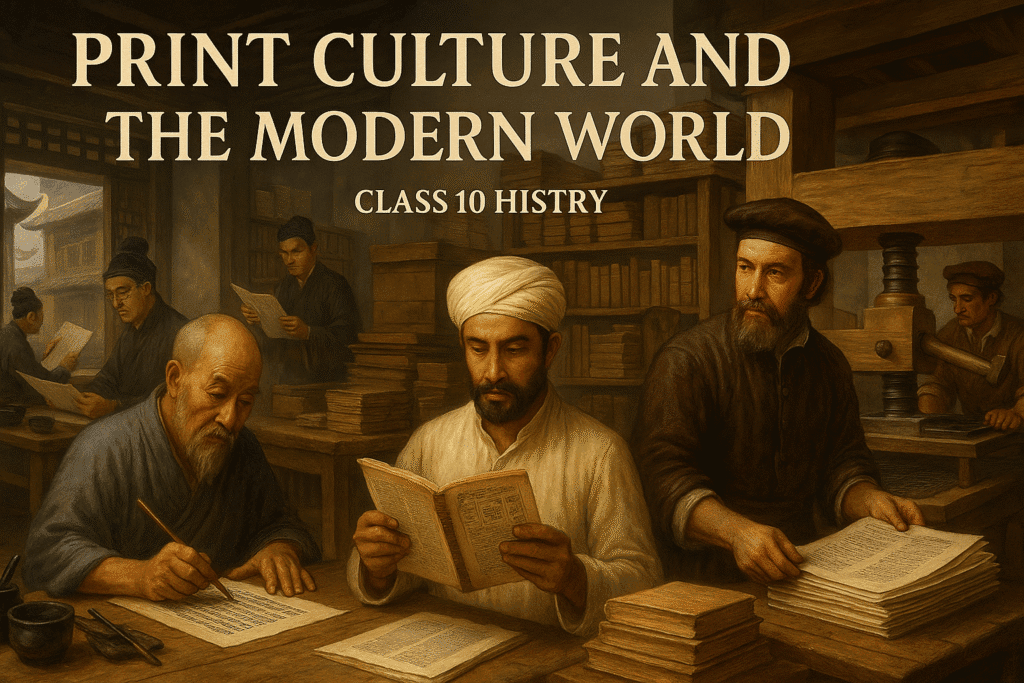
Print Culture and the Modern World Class 10 Notes explain how printing began in China, how it spread to Korea and Japan, how Europe revolutionised printing with the invention of the Gutenberg press, and how printed books shaped the Reformation, Scientific Revolution, Enlightenment and political change.
The chapter also explains how print arrived in India, how newspapers grew, how censorship controlled the press, and how printed literature influenced everyday life, social reform, and the national movement.
These notes are written to help students understand the chapter quickly with clear, structured and exam-focused explanations.
1. THE FIRST PRINTED BOOKS
Print Culture and the Modern World Class 10 Notes
1.1 Print in China – The Beginning of a Print Revolution
Print Culture and the Modern World Class 10 Notes
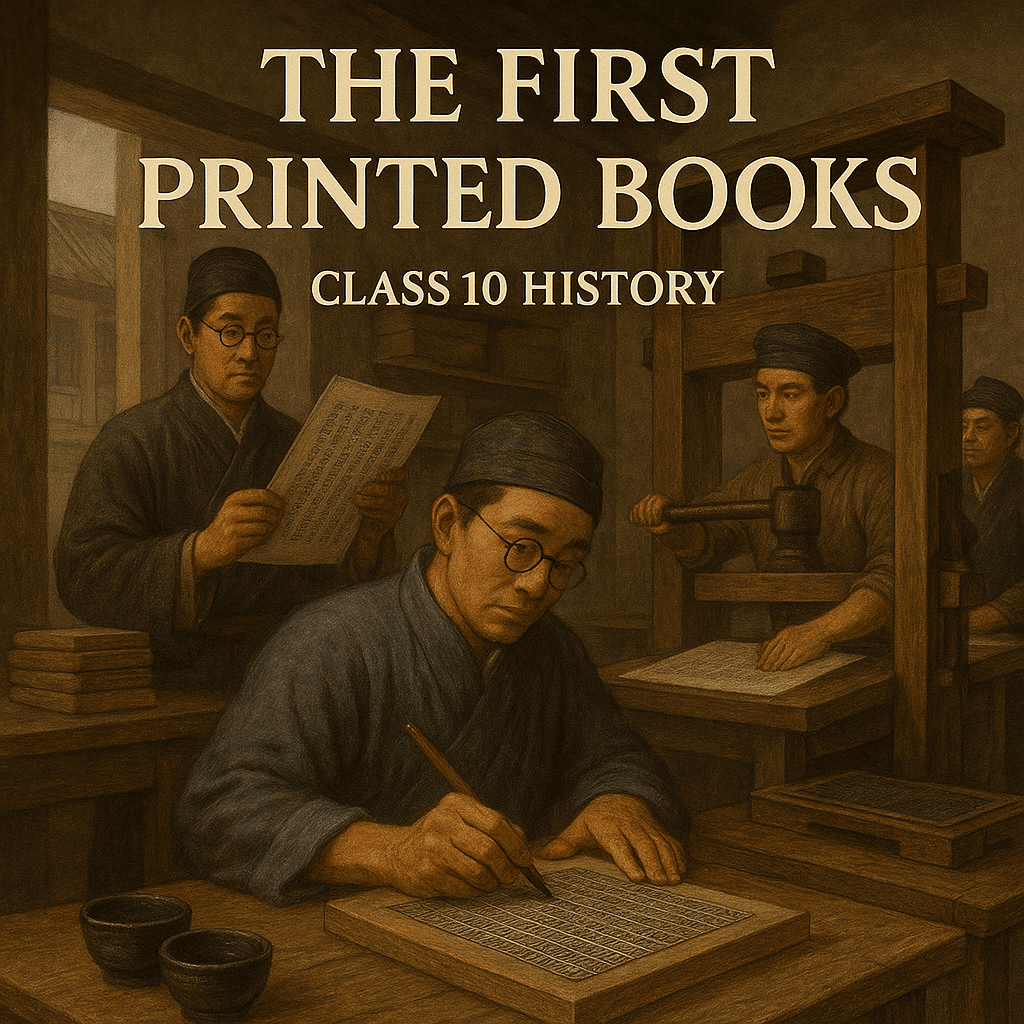
Woodblock Printing
Originated in China around the 2nd century CE.
Text or images were carved on wooden blocks.
The blocks were inked and pressed onto paper.
Used mainly in government offices, monasteries, and by scholars.
Why printing expanded rapidly in China
China had a huge bureaucratic system.
Civil service examinations required many textbooks.
Scholars needed dictionaries, classical literature and commentaries.
By 17th century, printing became commercial—private publishers hired skilled craftsmen.
What Chinese people read
Print Culture and the Modern World Class 10 Notes
Romance novels
Travel stories
Poetry collections
Encyclopaedias
Illustrated books
China had a large reading public much earlier than Europe.
Timeline: India During & After World War I (Chapter-2)
| Year | Event | What Indians Experienced |
|---|
| 1914 | WWI begins | Taxes increase; shortages begin |
| 1916 | War demands rise | Inflation becomes severe |
| 1917 | Forced recruitment | Rural anger grows |
| 1918 | Crop failure + epidemic | Lakhs die |
| 1919 | Rowlatt Act | Nationwide protest |
| 1920 | Non-Cooperation begins | First mass movement |
1.2 Print in Japan and Korea
Print Culture and the Modern World Class 10 Notes
Japan
Printing reached Japan from China in the 8th century.
By the 17th century, Edo (Tokyo) became a major publishing centre.
Popular printed works included:
Illustrated books
Women’s literature
Poetry
Art books (Ukiyo-e tradition)
Korea
Korea invented metal movable type around the 13th century—before Europe.
Used for official documents and Buddhist texts.
East Asia laid the foundation for global print culture.
2. PRINT COMES TO EUROPE
Print Culture and the Modern World Class 10 Notes
2.1 From Handwriting to Print
Before printing:
Books were handwritten manuscripts.
Produced by monks in monasteries (scriptoria).
Slow, expensive, and prone to errors.
Only wealthy elites could own books.
Printing changed this situation entirely.
Print Culture and the Modern World Class 10 Notes
2.2 Gutenberg and the Printing Press
Johannes Gutenberg
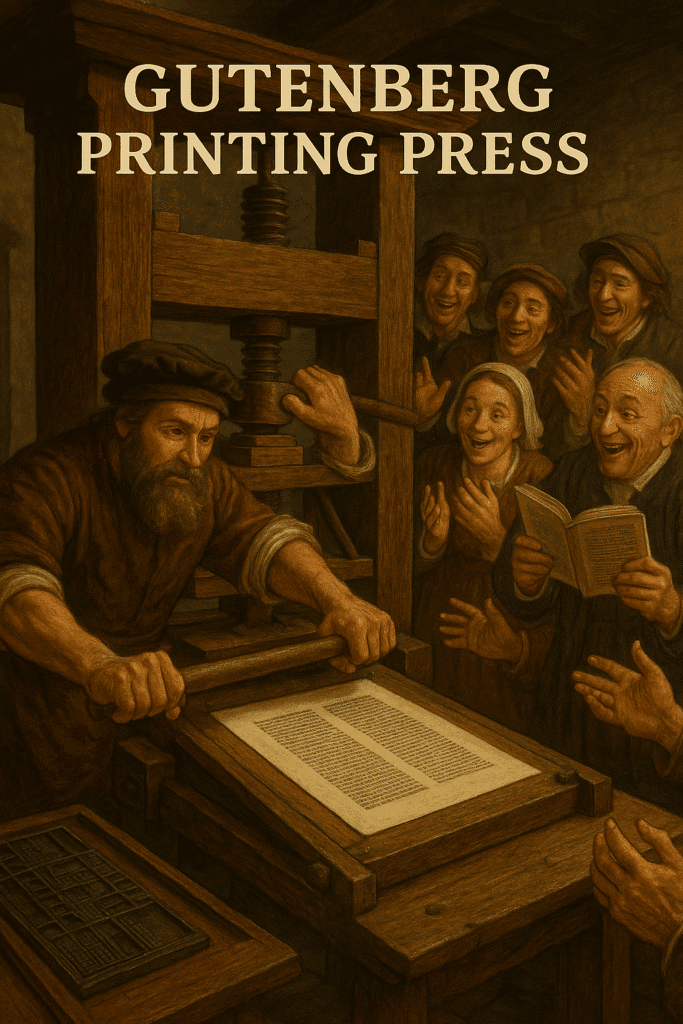
A German craftsman who developed the first mechanical printing press in the mid-15th century.
Combined ideas from:
Wine and olive press
Metal casting moulds
His goldsmithing skills
Key features of the Gutenberg press
Print Culture and the Modern World Class 10 Notes
Movable metal type
Reusable letters
Faster, cleaner, and uniform printing
Mass production became possible
The Gutenberg Bible
First major book printed with movable type.
Symbol of the European print revolution.
Within 100 years, printing presses spread across Europe.
2.3 Impact on the Reading Public
Books became cheaper
More copies printed quickly.
Middle-class readership grew.
Rise of literacy
Literacy rates increased across Europe.
Schools and universities expanded.
New reading culture
Chapbooks (small pocket books)
Ballads
Almanacs
Illustrated literature for children
Early newspapers
Print broke the monopoly of knowledge held by the church and monarchy.
3. THE PRINT REVOLUTION AND ITS IMPACT
Print Culture and the Modern World Class 10 Notes
3.1 Print and the Reformation
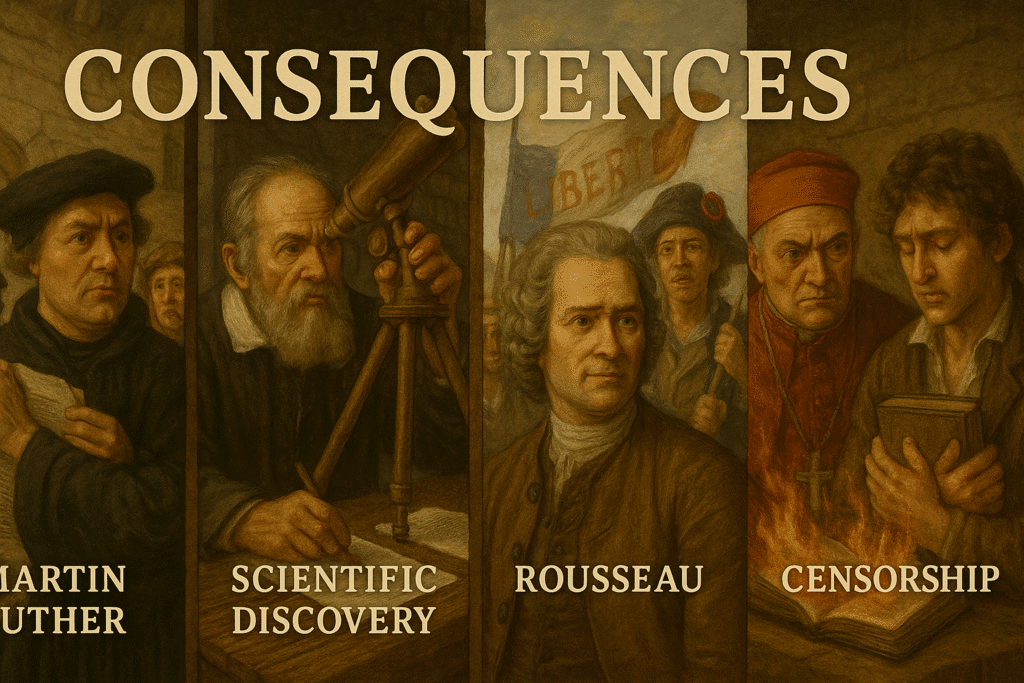
Martin Luther
Criticised the Catholic Church.
Wrote his famous “95 Theses” in 1517.
Printing allowed his ideas to spread quickly.
Impact
eople questioned religious authority.
Bibles were translated into local languages.
Common people could read religious texts themselves.
The Church faced major criticism.
Print weakened Church dominance permanently.
3.2 Print and the Scientific Revolution
Scientists like Galileo, Copernicus and Newton published their discoveries.
Diagrams, formulas and observations could be reproduced accurately.
New knowledge spread quickly among scholars.
Encouraged experimentation and debate.
Printing supported the growth of scientific thinking.
3.3 Print and Modern Politics
Enlightenment thinkers (Voltaire, Rousseau) spread ideas of liberty and equality.
Political discussions increased in public spaces.
In France, pamphlets and cartoons criticised the monarchy.
Helped mobilise people before the French Revolution.
Print created the foundation for modern democratic ideas.
3.4 Fears About Print
Print Culture and the Modern World Class 10 Notes
Not everyone welcomed printing.
Concerns
Rulers feared spread of rebellious ideas.
Church worried about losing control.
Moral critics believed books would spoil people.
Result
Censorship laws were introduced.
Publishing required official permissions.
Fear showed how powerful printing had become.
Print Culture and the Modern World Class 10 Notes
4. INDIA AND THE WORLD OF PRINT
Print Culture and the Modern World Class 10 Notes
4.1 Manuscripts Before Print
Written on palm leaves and handmade paper.
Slow to produce, fragile and expensive.
Hard to carry; could not be widely distributed.
Limited access—mostly for scholars and upper classes.
4.2 Arrival of Print in India
Portuguese missionaries brought printing to Goa in mid-16th century.
Printed:
Religious texts
Grammars
Dictionaries
Soon printing spread to:
Bengal
Bombay
Madras
Kerala
This supported the growth of modern Indian languages like Tamil, Malayalam, Bengali, Urdu, and Marathi.
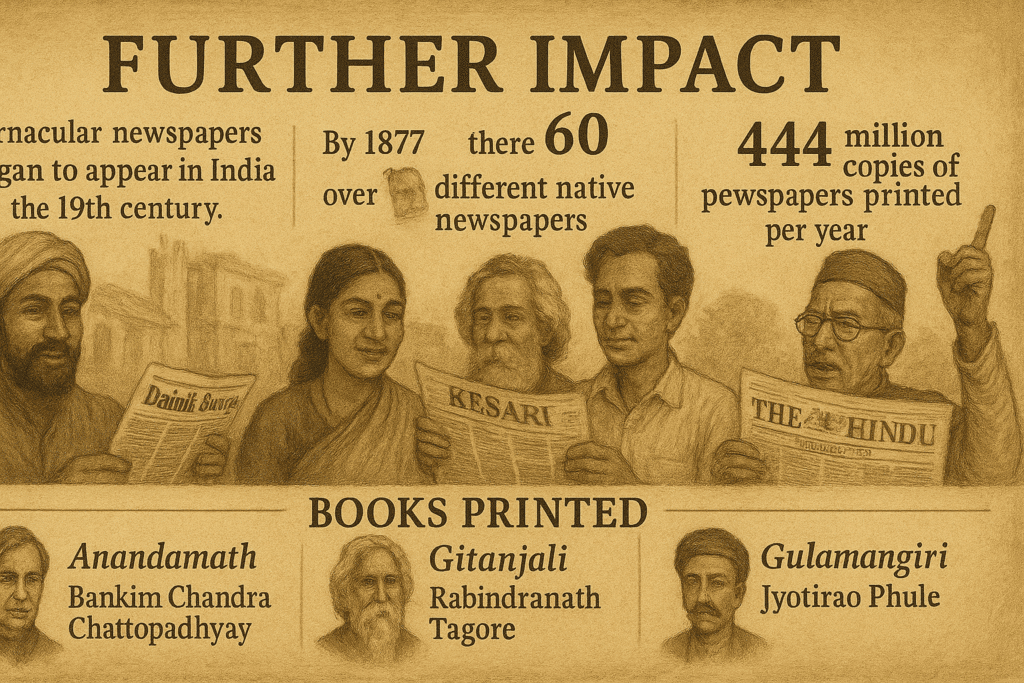
4.3 Rise of Newspapers and Journals
Print Culture and the Modern World Class 10 Notes
First Indian newspaper
Bengal Gazette (1780) by James Hickey.
Criticised British officials → shut down.
Vernacular newspapers
Samachar Darpan
Kesari
Jam-i-Jahan Nama
Amrita Bazar Patrika
Why newspapers grew
Literacy increased
Cost of printing fell
Social reform movements spread
Nationalism gained strength
4.4 The Vernacular Press Act (1878)
Passed by British to control Indian-language newspapers.
Features
Government could confiscate printing equipment.
Newspapers banned without trial.
Targeted nationalist press.
Indians strongly opposed it—it became a symbol of colonial repression.
Print Culture and the Modern World Class 10 Notes
Print Culture and the Modern World Class 10 Notes
5. EVERYDAY LIFE, CULTURE AND POLITICS
Print Culture and the Modern World Class 10 Notes
5.1 New Forms of Reading
Cheap books for new readers
Religious pamphlets
Prayer books
Low-cost novels
Almanacs & calendars
Books for women, children and workers
Novels broadened imagination and introduced modern ideas about society.
5.2 Print and Women
Print Culture and the Modern World Class 10 Notes
Women’s literacy increased.
Magazines discussed household education, reform, fashion, domestic life.
Women authors emerged (Rashsundari Devi, Tarabai Shinde).
Print supported reform debates on education, widow remarriage and women’s rights.
5.3 Print and Workers/Peasants
Workers read political literature.
Socialists published books on workers’ rights.
Peasants learned about struggles elsewhere and mobilised.
Print became a tool for social awareness.
5.4 Print and Nationalism in India
Print was essential for India’s freedom movement.
How print supported nationalism
Spread anti-colonial ideas
Promoted Swaraj
United people across regions
Political cartoons exposed British cruelty
Gandhi, Tilak, Nehru used newspapers to mobilise masses
Printing helped unite millions during the national movement.
Summary
Print Culture and the Modern World Class 10 Notes
Print Culture and the Modern World Class 10 focuses on how printing transformed societies across Asia, Europe and India. The chapter begins with woodblock printing in China, followed by the spread of printing to Japan and Korea. The invention of the Gutenberg press in Europe triggered a major revolution—books became cheaper, literacy increased, and ideas spread quickly. Printing shaped the Reformation, Scientific Revolution, Enlightenment and political movements like the French Revolution.
In India, print arrived through missionaries in Goa. Newspapers, journals and vernacular printing played a major role in social reform and nationalism. The Vernacular Press Act tried to control Indian newspapers, but it failed to stop the growth of public opinion. Printing changed everyday life—new readers emerged, women accessed education, workers read political literature, and peasants mobilised. Ultimately, print became one of the strongest forces behind modern democracy, social reform and India’s freedom movement.
Print Culture and the Modern World Class 10 — Important Questions, FAQs, MCQs
FAQs
Print Culture and the Modern World Class 10 Notes
1. Why was the Gutenberg printing press considered revolutionary?
The Gutenberg printing press allowed books to be printed quickly using movable metal type. Earlier, manuscripts had to be copied by hand, making them slow and expensive. With the press, books became cheaper, literacy spread, and ideas travelled across countries. It enabled the Reformation, scientific discoveries and political change. The press dramatically increased the speed at which knowledge could reach ordinary people.
2. How did print support Martin Luther’s Reformation movement?
Martin Luther wrote the “95 Theses” attacking the Church’s practices. Printing helped reproduce his ideas rapidly, allowing thousands of copies to reach people across Germany and Europe. For the first time, common people could read religious texts themselves. The Church could no longer control interpretation. Thus, print played a decisive role in weakening religious authority and spreading Protestant ideas widely.
3. What changes did printing bring to European society?
Printing created a new reading public. Books became cheaper, literacy increased, and people from different backgrounds could access knowledge. Scientific texts helped researchers share discoveries. Newspapers allowed political debates. Pamphlets criticised governments. People questioned old beliefs and demanded change. This print culture laid the foundation for modern democratic thinking.
4. How did print influence the French Revolution?
Printing spread Enlightenment ideas that criticised monarchy and inequality. Writers like Rousseau and Voltaire used printed books and pamphlets to explain ideas of liberty and rights. Cartoons mocked the nobility and exposed social injustice. Newspapers encouraged public discussions. This growing political awareness inspired people to revolt in 1789. Print made revolutionary ideas accessible to common citizens.
5. What were the fears about printing?
Rulers feared that printed books could spread rebellion. The Church believed people might interpret religious texts wrongly. Some thinkers argued that books made people lazy or rebellious. As a result, governments imposed censorship. Authors needed permission before publishing, and books could be banned. These fears proved how powerful the printed word had become.
6. What was the Vernacular Press Act of 1878?
The British passed the Vernacular Press Act to restrict Indian-language newspapers. It allowed the government to confiscate printing presses, demand security deposits and ban publications without trial. The Act targeted nationalist newspapers spreading anti-British ideas. Indians saw it as an attack on free speech. Despite repression, vernacular press continued to grow and played a major role in nationalism.
7. How did print shape everyday life in India?
Print introduced cheap books, calendars, almanacs, novels and newspapers. Women accessed magazines on education and household matters. Children read illustrated stories. Workers and peasants read political pamphlets that encouraged awareness. Print supported literacy, social reform and communication between people. By the early 20th century, reading became a common part of everyday life.
8. How did print support social reform in India?
Reformers like Ishwar Chandra Vidyasagar, Jyotirao Phule and Periyar used books and newspapers to oppose caste discrimination, child marriage and the treatment of widows. Women authors wrote about their experiences. Vernacular newspapers sparked debates on education, women’s rights and untouchability. This print culture created awareness and encouraged people to support modern reforms.
9. Why is print considered essential for nationalism in India?
Print spread anti-colonial ideas across regions and languages. Newspapers like Kesari, Amrita Bazar Patrika and Bengali journals inspired unity. Political cartoons exposed British cruelty. Leaders like Tilak, Gandhi and Nehru used print to communicate with masses. Without print, national movements could not have reached millions simultaneously.
10. How was print different in Asia and Europe?
Asia had early woodblock and movable type printing, especially in China and Korea. Europe developed mechanical printing, which allowed fast mass production. Europe’s print revolution spread rapidly due to high literacy, trade networks and demand for books. Asia’s print was older but less industrial, while Europe’s print became the foundation for modern global communication.
5 Long-Answer Questions
Print Culture and the Modern World Class 10 Notes
Q1. Explain the impact of print on the Reformation movement.
Printing played a crucial role in spreading Martin Luther’s ideas. His “95 Theses” challenging Catholic practices were printed and distributed across Germany within weeks. People read the Bible in their own languages instead of relying on priests. This weakened the Church’s authority. Pamphlets, debates and sermons spread rapidly. Common people began discussing religious issues openly. Printing enabled large-scale circulation of new ideas, making the Reformation one of the first mass movements in history.
Q2. Describe the spread of print culture in India.
Print was introduced in India by Portuguese missionaries in Goa during the 16th century. They printed religious literature, grammars and dictionaries. Over time, printing spread to Bengal, Madras, Bombay and Kerala. Newspapers and journals appeared in several languages like Bengali, Marathi, Urdu and Tamil. By the 19th century, printing became essential for social reform and nationalism. Indian authors published novels, poems, religious texts and political writings. Print transformed literacy, public opinion and awareness.
Q3. How did print influence modern politics in Europe?
Printing allowed Enlightenment thinkers such as Rousseau and Voltaire to publish ideas of liberty, equality and individual rights. These texts circulated widely and shaped public debates. Newspapers criticised monarchies. Pamphlets exposed corruption. Cartoons mocked rulers. The printing press created a space for informed citizens to question authority. This widespread political awareness contributed directly to revolutions and democratic movements in Europe, especially the French Revolution.
Q4. What role did print play in everyday life during the 19th century?
Print introduced new forms of reading. Cheap books, illustrated stories, newspapers, chapbooks, calendars and novels became widely accessible. Women read magazines, workers read political writings and children read storybooks. People discussed public issues and participated in social debates. This reading culture encouraged education and critical thinking, reshaping personal and social life. Print widened the world of information and connected different groups through shared knowledge.
Q5. Explain the importance of newspapers in the Indian national movement.
Newspapers became a powerful tool of nationalism. They spread anti-British ideas, exposed discrimination and united people. Leaders like Tilak used Kesari to criticise colonial policies. Newspapers informed people about protests, movements and injustices. They encouraged Swadeshi, Swaraj and public participation. Despite censorship and the Vernacular Press Act, newspapers reached millions. They linked different regions and helped transform nationalism into a mass movement.
MCQs
Print Culture and the Modern World Class 10 Notes
The earliest printing technology developed in:
a) Japan
b) China
c) Europe
d) India
Ans: b)Gutenberg’s press used:
a) Wooden type
b) Stone tablets
c) Movable metal type
d) Screen printing
Ans: c)The first printed Bible is known as the:
a) Roman Bible
b) Gutenberg Bible
c) European Bible
d) Christian Bible
Ans: b)Martin Luther started the:
a) Renaissance movement
b) Industrial Revolution
c) Protestant Reformation
d) Russian Revolution
Ans: c)The Vernacular Press Act was passed in:
a) 1905
b) 1780
c) 1878
d) 1885
Ans: c)The first English newspaper in India was:
a) Kesari
b) Dainik Jagran
c) Bengal Gazette
d) Amrita Bazar Patrika
Ans: c)Who invented the metal movable type in Europe?
a) James Hargreaves
b) Johannes Gutenberg
c) Isaac Newton
d) Voltaire
Ans: b)Ukiyo-e print culture developed in:
a) China
b) Korea
c) India
d) Japan
Ans: d)Which reformer printed “Gulamgiri”?
a) Dayanand Saraswati
b) Jyotiba Phule
c) Raja Ram Mohan Roy
d) Vivekananda
Ans: b)Printing helped spread:
a) Manuscripts
b) Scientific ideas
c) Wall paintings
d) Oral traditions
Ans: b)
5-Marker Questions
Print Culture and the Modern World Class 10 Notes
Explain how print culture developed in India and discuss the role of missionaries in spreading print.
“The print revolution transformed the lives of people and changed their relationship to information and knowledge.” Justify the statement.
Explain the impact of print on the spread of the Protestant Reformation in Europe.
Describe the role of print culture in the French Revolution.
How did print culture lead to the growth of nationalism in India? Explain with examples.
Supportive Study Material Class 10 Science
- Class 10 Science Quiz
- Class 10 Science tests
- Class 10 Science Worksheets
- Class 10 Science PYQs
- Class 10 Science NCERT Solution