Complete Notes Chapter 10: Living Creatures: Exploring Their Characteristics
Introduction: What Makes Something Alive?
Look around you. You may see a dog wagging its tail, a plant growing in a pot, birds flying in the sky, and people walking and talking. At the same time, you also see objects such as books, chairs, stones, and toys. Some of these things are living, while others are non-living.
At first glance, it may seem easy to distinguish between them. However, the real scientific question is: What characteristics make an organism living? A plant does not walk like an animal, yet it is alive. Seeds may appear lifeless, but under the right conditions they germinate and grow.
This chapter helps us understand the fundamental characteristics shared by all living organisms and explains how living beings survive and adapt to their surroundings.
What Are Living Creatures?
Living creatures, also called living organisms, are things that show life. They carry out a number of essential activities known as life processes.
A living organism is any organism that needs food, grows, breathes, responds to changes in the environment, removes waste, reproduces, and eventually dies.
Examples of living organisms include humans, animals, birds, insects, plants, and microscopic organisms such as bacteria.
Although living organisms may differ greatly in size, shape, and behavior, they all share certain common characteristics.
What Are Non-Living Things?
Non-living things are objects that do not show life processes.
They do not need food, do not grow by themselves, do not breathe, and cannot reproduce.
Examples include rocks, chairs, books, pencils, and water bottles.
Some non-living things may appear to move, such as cars and fans, but their movement depends on external energy and not on life processes.
Understanding the difference between living and non-living things is the first step in studying biology.
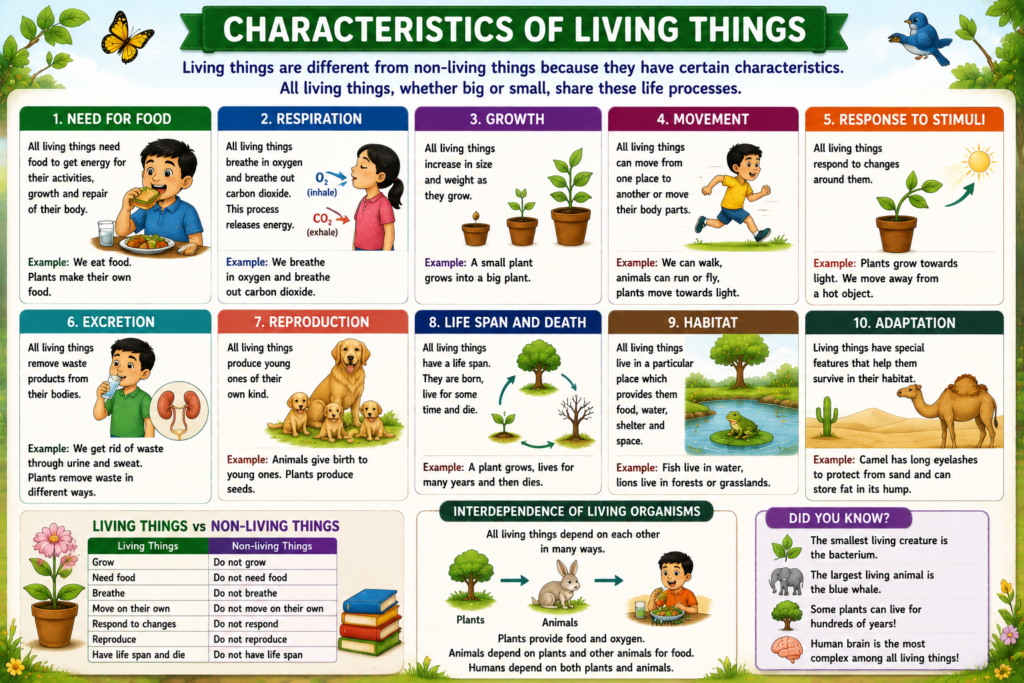
Difference Between Living and Non-Living Things
Living things are made of cells and perform life processes. Non-living things do not perform these processes.
A puppy grows into a dog, but a toy dog remains unchanged. A plant needs water and sunlight, while a plastic plant does not. Birds reproduce and lay eggs, but stones cannot produce new stones.
These differences help scientists classify objects and organisms accurately.
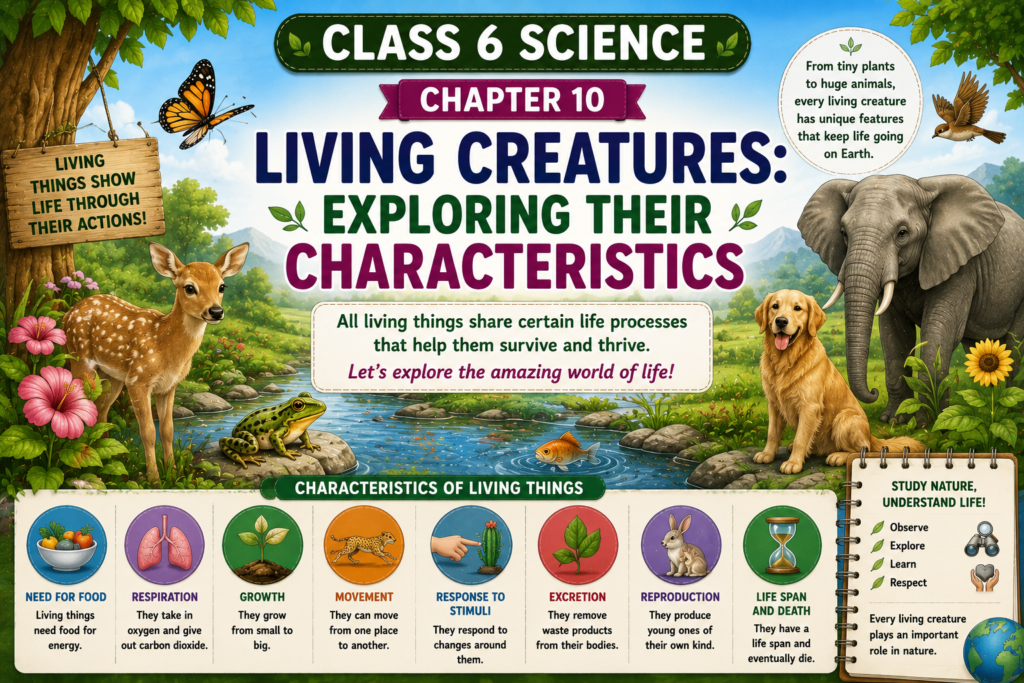
Characteristics of Living Organisms
All living organisms share certain common features.
These characteristics include:
- Need for food
- Respiration
- Growth
- Movement
- Response to stimuli
- Excretion
- Reproduction
- Limited life span
Each of these characteristics provides evidence that an organism is alive.
Need for Food (Nutrition)
All living organisms need food to survive.
The process by which organisms obtain and use food is called nutrition.
Food provides energy for movement and life processes, materials for growth and repair, and substances needed to maintain health.
Animals obtain food by eating plants or other animals. Plants prepare their own food using sunlight, carbon dioxide, water, and chlorophyll through the process of photosynthesis.
Without food, living organisms cannot survive.
Respiration
Respiration is the process by which living organisms release energy from food.
This energy is used for growth, movement, and all other life activities.
In most organisms, oxygen is taken in and carbon dioxide is released.
Humans and animals breathe through lungs or other respiratory organs. Plants also respire, although they do not have lungs.
Respiration is different from breathing. Breathing is the physical act of taking in air, while respiration is the chemical process that releases energy.
Growth
Growth is a permanent increase in size and mass.
All living organisms grow during their life cycle.
A baby grows into an adult, a seed develops into a plant, and a caterpillar becomes a butterfly.
Growth in living organisms occurs from within as new cells are formed.
Non-living things may appear larger if material is added externally, but this is not true growth.
Movement
All living organisms show movement.
Movement means a change in position of the whole organism or movement of body parts.
Animals can walk, run, crawl, swim, or fly. Plants do not move from place to place, but they do show movement. Sunflower buds turn toward sunlight, roots grow downward, and touch-me-not leaves fold when touched.
Movement is an important sign of life.
Response to Stimuli (Sensitivity)
Living organisms respond to changes in their surroundings. This ability is called sensitivity or response to stimuli.
A stimulus is any change in the environment that causes a reaction.
Examples include:
- We pull our hand away from a hot object.
- Plants bend toward light.
- The touch-me-not plant closes its leaves when touched.
- Birds fly away when they sense danger.
This ability helps organisms survive.
Excretion)
Excretion is the process of removing waste substances produced in the body.
Waste products can be harmful if they accumulate.
Humans remove wastes through urine, sweat, and exhaled carbon dioxide. Plants also remove waste substances through leaves, stems, and roots.
Excretion keeps the body clean and functioning properly.
Reproduction
Reproduction is the process by which living organisms produce new individuals of their own kind.
Animals may reproduce by laying eggs or giving birth to young ones. Plants reproduce through seeds, spores, or vegetative parts.
Reproduction ensures the continuation of a species.
Although an individual organism can survive without reproducing, a species cannot continue if reproduction does not occur.
Life Span and Death
Every living organism has a definite life span.
The life span is the period between birth and natural death.
Some organisms, such as mosquitoes, live for only a few days, while some trees may live for hundreds of years.
Eventually, all living organisms die. Death is a natural part of life and marks the end of life processes.
Do Seeds and Eggs Show Life?
Seeds and eggs may appear inactive, but they are living.
A dry seed does not grow until it receives water, air, and warmth. Once suitable conditions are available, it germinates and develops into a plant.
Similarly, a fertilized egg can develop into a chick or another organism.
This shows that living things may sometimes remain dormant, or temporarily inactive.
What Is a Habitat?
A habitat is the natural home or environment where an organism lives.
A habitat provides everything the organism needs, including food, water, air, shelter, and suitable temperature.
Different organisms live in different habitats according to their needs.
Examples include forests, deserts, oceans, ponds, mountains, and grasslands.
Types of Habitats
Habitats can be broadly divided into two major groups.
Terrestrial Habitats
Terrestrial habitats are land-based habitats.
Examples include deserts, forests, mountains, and grasslands.
Aquatic Habitats
Aquatic habitats are water-based habitats.
Examples include ponds, lakes, rivers, seas, and oceans.
Each habitat has unique environmental conditions.
Terrestrial Habitats in Detail
Desert Habitat
Deserts receive very little rainfall and experience extreme temperatures.
Plants such as cactus store water and have spines instead of leaves. Animals such as camels can survive with little water.
Mountain Habitat
Mountains are cold and windy.
Animals such as yaks have thick fur, and many trees are cone-shaped to shed snow.
Forest Habitat
Forests receive good rainfall and support rich biodiversity.
Grassland Habitat
Grasslands are dominated by grasses and support grazing animals.
Aquatic Habitats in Detail
Aquatic habitats include freshwater and marine environments.
Fish have streamlined bodies and gills to help them swim and breathe in water. Water plants may have flexible stems and broad leaves.
Marine habitats such as oceans contain salt water, while ponds and rivers contain fresh water.
Organisms living in water are adapted to these conditions.
Adaptation
Adaptation is a special feature or behavior that helps an organism survive in its habitat.
Adaptations may be structural, such as a camel’s hump, or behavioral, such as birds migrating to warmer places.
Without adaptations, organisms would struggle to obtain food, avoid predators, and cope with environmental conditions.
Adaptation is one of the most important concepts in biology.
Examples of Adaptations
- Cactus stores water and has spines to reduce water loss.
- Camel has broad feet and can survive long periods without drinking water.
- Fish have gills and fins.
- Polar bears have thick fur and a layer of fat.
- Birds have hollow bones and wings for flight.
These examples show how organisms are suited to their habitats.
Interdependence of Living Organisms
Living organisms depend on one another.
Plants provide food and oxygen. Animals help in pollination and seed dispersal. Decomposers break down dead matter and return nutrients to the soil.
This mutual dependence is called interdependence.
It helps maintain balance in ecosystems.
Plants as Living Organisms
Plants are living organisms even though they do not move from place to place.
They grow, prepare food, respire, respond to stimuli, reproduce, and eventually die.
Plant movements may be slow and less obvious, but they clearly show all major characteristics of life.
This is why plants are classified as living beings.
Microscopic Living Organisms
Some living organisms are too small to be seen with the naked eye.
These are called microorganisms.
Examples include bacteria, fungi, and protozoa.
Although tiny, they perform all life processes and play important roles in nature.
Why Studying Living Organisms Is Important
The study of living organisms helps us understand our own body, the natural world, and the environment.
It teaches us how organisms survive, interact, and adapt.
This knowledge helps us protect biodiversity and use natural resources responsibly.
Key Scientific Terms and Definitions
- Living Organism: A thing that performs life processes.
- Nutrition: Process of obtaining and using food.
- Respiration: Release of energy from food.
- Growth: Permanent increase in size.
- Stimulus: Change in the surroundings.
- Sensitivity: Ability to respond to stimuli.
- Excretion: Removal of wastes.
- Reproduction: Production of new individuals.
- Habitat: Natural home of an organism.
- Adaptation: Feature that helps survival.
- Interdependence: Mutual dependence among organisms.
Chapter Summary
Living organisms are distinguished from non-living things by their ability to perform life processes such as nutrition, respiration, growth, movement, response to stimuli, excretion, and reproduction. Every organism lives in a habitat that provides suitable conditions for survival. Organisms possess adaptations that help them live successfully in their habitats. All living organisms are interconnected and depend on one another, forming a balanced natural world.
Conclusion
This chapter reveals the amazing features shared by all living organisms. Whether it is a towering tree, a tiny ant, a fish in a pond, or a human being, every living creature carries out similar life processes.
By understanding these characteristics, students begin to appreciate the unity and diversity of life on Earth. The chapter also teaches us an important lesson: all living beings are connected, and protecting them means protecting the delicate balance of nature itself.
Additional Resources
- NCERT Science Textbook: https://ncert.nic.in/textbook.php
- NCERT Official Website: https://ncert.nic.in
- FlashCards of this Chapter : Click Here
Recommended Book for Extra Practice
If you want to strengthen your understanding of this chapter and get plenty of chapter-wise practice questions, revision notes, diagrams, and competency-based questions, this book is an excellent companion for Class 6 Science.
 Oswaal CBSE Class 6 One for All Science (Curiosity) for 2026–27 Exam
 Oswaal CBSE Class 6 One for All Science (Curiosity) for 2026–27 Exam
This book is based on the latest NCERT and CBSE syllabus and includes:
- Chapter-wise question bank
- Detailed revision notes
- Clear theory explanations
- Well-labeled diagrams
- Competency-based and application questions
- Practice exercises with answers
It is especially useful for students who want to go beyond the textbook and build a stronger conceptual foundation.
 Buy Now: https://amzn.to/4uAnwFu
Oswaal CBSE Class-6 One for All Science (Curiosity) for 2026–27 Exam | As Per Latest NCERT & CBSE Syllabus | Chapter-Wise Question Bank, Revision Notes, Theory, Diagrams & Competency-Based Questions
This is a highly recommended resource for students, parents, and teachers looking for a complete practice and revision book for Class 6 Science.
✅ Oswaal Class 10 SST — Topper's Choice
✅ Together With SST — Best for Practice
✅ Oswaal Science Class 10 — Chapter Wise
✅ RD Sharma Maths — Most Popular
✅ Oswaal Class 10 SST — Topper's Choice
✅ Together With SST — Best for Practice
✅ Oswaal Science Class 10 — Chapter Wise
✅ RD Sharma Maths — Most Popular