✅ Oswaal Class 10 SST — Topper's Choice
✅ Together With SST — Best for Practice
✅ Oswaal Science Class 10 — Chapter Wise
✅ RD Sharma Maths — Most Popular
Complete and Detailed Diversity in the Living World Class 6 Notes
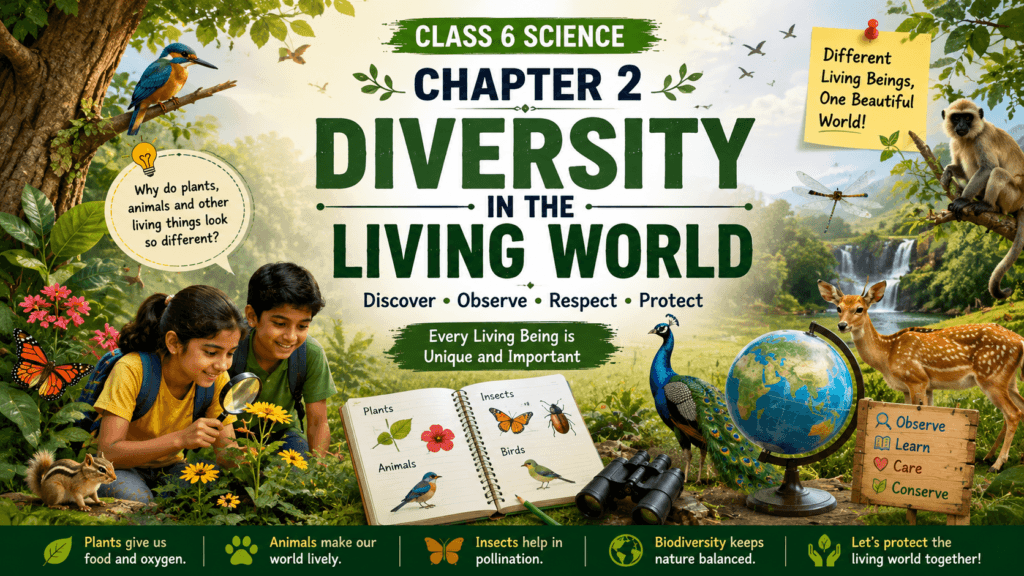
Introduction: The Earth Is Full of Life
If you look around your surroundings, you will notice that our planet is filled with life in countless forms. Tiny ants move in long lines on the ground, butterflies visit flowers, birds build nests on trees, fish swim in water, and human beings live in cities and villages. Some organisms are so small that they can be seen only with a microscope, while others, such as elephants and whales, are among the largest living creatures on Earth.
This enormous variety of life is what makes nature so beautiful and interesting. The chapter Diversity in the Living World Class 6 Notes helps us understand that although all living organisms are different, they are connected through common characteristics and shared needs. By studying this diversity, we begin to appreciate the richness of life and the importance of protecting nature.
What Does Diversity in the Living World Mean?
The word diversity means variety. Therefore, diversity in the living world refers to the presence of many different kinds of living organisms on Earth. These organisms differ in size, shape, colour, structure, food habits, habitat, and behaviour.
For example, a banyan tree, a cactus, and a blade of grass are all plants, yet they look very different from one another. Similarly, a sparrow, a fish, a lion, and a butterfly are all animals, but each has its own special features and way of life.
The term biodiversity is used to describe this variety of life. Biodiversity is one of Earth’s greatest treasures because it keeps ecosystems healthy and supports all living beings.
Living and Non-Living Things
Before studying diversity in the living world, we must first understand what makes something living. Living things are organisms that carry out essential life processes such as nutrition, respiration, growth, reproduction, excretion, and response to changes in their surroundings.
A seed germinates into a plant, a kitten grows into a cat, and a bird lays eggs to produce young ones. These are all examples of living processes.
Non-living things, such as rocks, tables, and toys, do not grow on their own, do not need food, and cannot reproduce. They may move only when acted upon by an external force.
This distinction helps us identify living organisms and study their remarkable diversity.
Characteristics Common to All Living Organisms
Although living organisms differ greatly, they share some common characteristics. Every living organism needs energy to survive. Plants prepare their own food through photosynthesis, while animals obtain food by eating plants or other animals.
Living things grow and develop with time. A baby becomes an adult, and a small sapling becomes a large tree. They also respire to release energy from food and excrete waste materials from their bodies.
Another important characteristic is reproduction. Most living organisms produce young ones of their own kind, ensuring the continuation of life.
These shared features show that all living organisms are connected, even though they appear very different.
Variation Among Living Organisms
The living world is full of differences. This variation is the reason biodiversity is so rich and fascinating.
Some organisms are microscopic, such as bacteria, while others, such as blue whales, are gigantic. Shapes also vary widely: snakes have long bodies, birds have wings, and trees have branches and leaves.
Habitats differ too. Fish live in water, camels survive in deserts, and monkeys are adapted to life in trees. Food habits vary from herbivores that eat plants to carnivores that eat flesh.
These variations help organisms survive in different environments and contribute to the diversity in the living world.
Biodiversity: The Scientific Name for Life’s Variety
Biodiversity means the variety of living organisms present in a region or on Earth as a whole. It includes different species of plants, animals, fungi, and microorganisms, as well as the ecosystems they form.
A forest with many kinds of trees, birds, insects, and mammals has high biodiversity. In contrast, an area with very few species has low biodiversity.
Biodiversity is essential because each organism plays a role in maintaining ecological balance. Plants produce oxygen, insects pollinate flowers, earthworms enrich the soil, and predators control populations.
Without biodiversity, ecosystems become weak and unstable.
Habitats: Natural Homes of Organisms
A habitat is the natural place where an organism lives and obtains everything it needs, including food, water, air, and shelter.
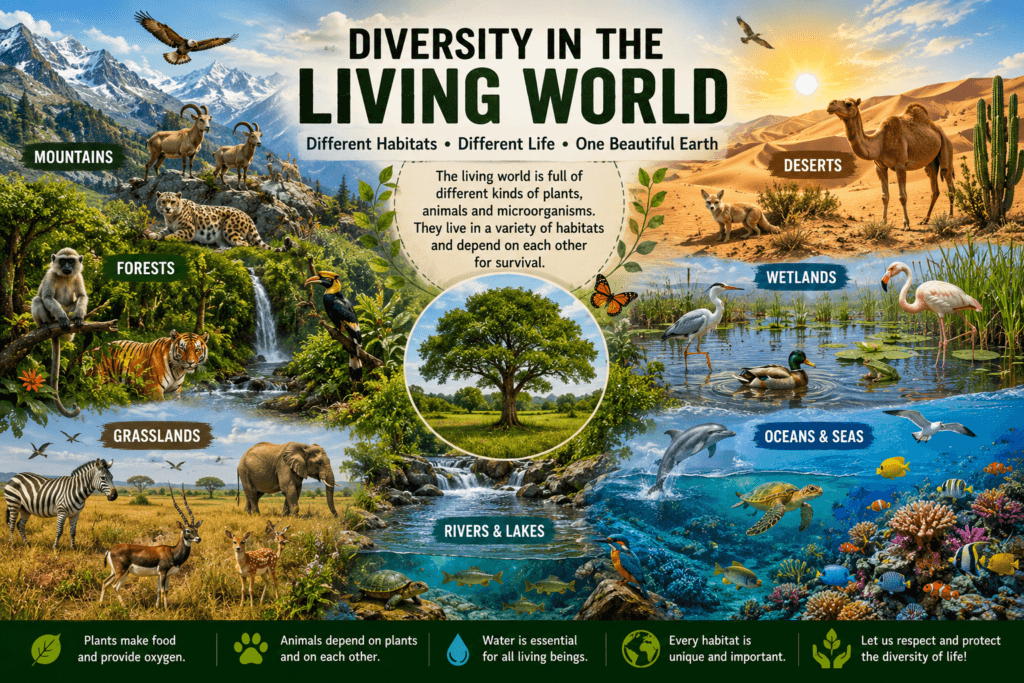
Different organisms are suited to different habitats. A pond is a habitat for fish, frogs, and aquatic plants. A desert is a habitat for camels and cacti. Forests provide shelter to monkeys, birds, insects, and large mammals.
Habitats can be broadly divided into terrestrial habitats (land) and aquatic habitats (water). Each habitat has unique conditions, and organisms living there possess special features to survive.
Thus, habitats play a major role in creating diversity in the living world.
Adaptations: Special Features for Survival
An adaptation is a special feature or behaviour that helps an organism survive in its habitat.
Fish have streamlined bodies and fins for swimming. Birds have wings and hollow bones that make flying easier. Cacti have spines instead of leaves to reduce water loss. Polar bears have thick fur and a layer of fat to keep warm.
Adaptations develop over time and allow organisms to live successfully in specific environments. Because habitats differ, adaptations also differ, resulting in the extraordinary diversity seen in the living world.
Diversity in Plants
Plants show great diversity in size, structure, and habitat. Some are tiny, while others are gigantic. Some grow in water, some in deserts, and some on mountains.
Plants are commonly classified into herbs, shrubs, trees, climbers, and creepers.
Herbs are small plants with soft green stems, such as mint and spinach. Shrubs are medium-sized plants with woody stems, such as rose and hibiscus. Trees are tall and strong, with a thick trunk, such as mango and neem.
Climbers, such as pea plants, need support to grow upward, while creepers, such as pumpkin and watermelon, spread along the ground.
This variety among plants contributes significantly to biodiversity.
Diversity in Animals
Animals differ in body structure, movement, habitat, and food habits.
Some animals, such as fish, swim using fins. Birds fly with wings, snakes crawl, and kangaroos hop. Mammals like cows and humans give birth to young ones, while birds lay eggs.
Animals are found in all habitats—from deep oceans to high mountains and from deserts to polar regions.
This immense variety helps scientists study how animals are adapted to their environments and how they are interconnected in ecosystems.
Food Habits of Animals
Animals can be grouped according to the type of food they eat.
Herbivores
Herbivores are animals that eat only plants or plant products. They feed on grass, leaves, fruits, and seeds. Examples include cows, goats, deer, and rabbits. These animals often have broad teeth for grinding plant material.
Carnivores
Carnivores are animals that eat the flesh of other animals. Lions, tigers, eagles, and snakes are carnivores. They usually have sharp teeth or claws to catch and tear their prey.
Omnivores
Omnivores eat both plants and animals. Humans, bears, and crows are common examples. Their flexible diet helps them survive in a variety of environments.
Classification: Organising the Living World
There are millions of living organisms on Earth. Studying each one individually would be very difficult. To make this task easier, scientists use a system called classification.
Classification means grouping organisms based on similarities and differences.
For example, plants may be grouped according to stem type, while animals may be grouped according to habitat, body covering, or food habits.
Classification helps scientists identify organisms, understand relationships, and study biodiversity in a systematic way.
Why Classification Is Important
Classification is important because it brings order to the enormous variety of life.
It helps us:
- Identify unfamiliar organisms.
- Compare organisms easily.
- Understand evolutionary relationships.
- Avoid confusion caused by local names.
- Study life in a systematic way.
Without classification, biology would become confusing and difficult to understand.
Microorganisms: The Invisible Living World
Not all living organisms are visible to the naked eye. Some are so small that they can only be seen under a microscope. These tiny organisms are called microorganisms.
Examples include bacteria, fungi, protozoa, and some algae.
Microorganisms are extremely important. Some help decompose dead matter, some are used to prepare curd and bread, and some produce medicines such as antibiotics.
Even though they are tiny, microorganisms form a vital part of biodiversity.
Life Cycles Add to Diversity
Different organisms have different life cycles.
A butterfly begins life as an egg, develops into a caterpillar, forms a pupa, and finally emerges as an adult butterfly. A frog starts as an egg, becomes a tadpole, and later transforms into an adult frog.
These fascinating changes show that living organisms can undergo dramatic transformations during their lives.
The wide variety of life cycles adds another layer to the diversity in the living world.
Importance of Biodiversity
Biodiversity is essential for life on Earth.
Plants produce oxygen and food. Insects pollinate flowers. Earthworms improve soil fertility. Predators keep prey populations under control.
Biodiversity also provides humans with food, medicines, timber, fibres, and many other resources.
When biodiversity is rich, ecosystems are more stable and resilient.
Protecting biodiversity means protecting the life-support system of our planet.
Threats to Biodiversity
Human activities are reducing biodiversity at an alarming rate.
Deforestation destroys habitats. Pollution contaminates air, water, and soil. Climate change alters environmental conditions. Overhunting and illegal wildlife trade threaten many species.
When species become extinct, ecosystems lose important components.
Understanding these threats helps us realize why conservation is necessary.
Conservation of Biodiversity
Conservation means protecting living organisms and their habitats.
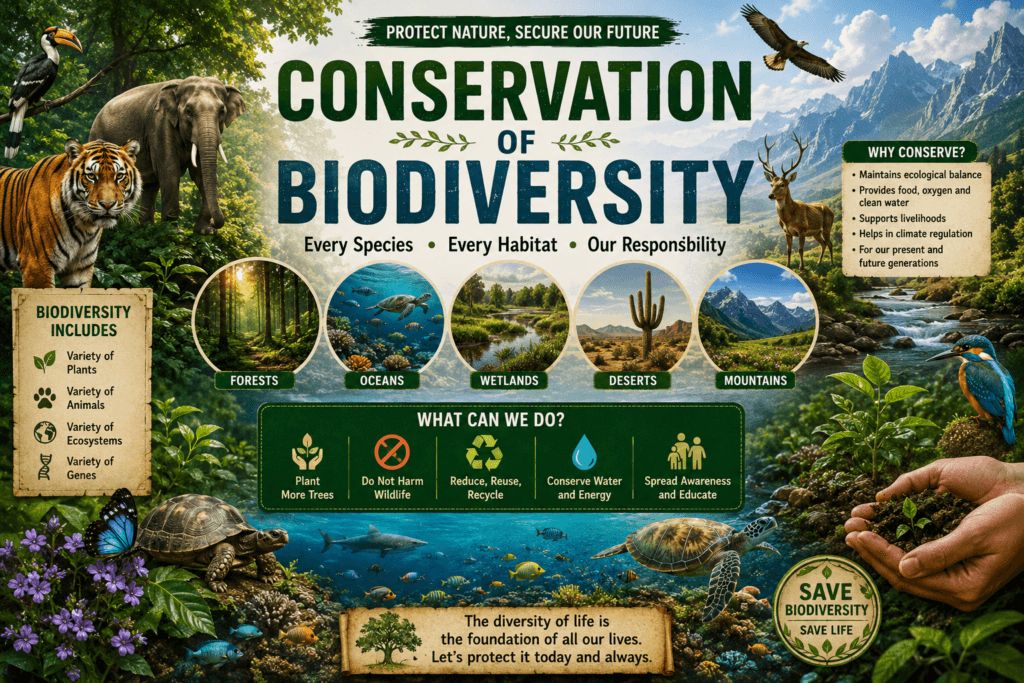
We can conserve biodiversity by planting trees, reducing pollution, saving water, and protecting forests and wildlife.
National parks, wildlife sanctuaries, and biosphere reserves are special protected areas where plants and animals are preserved.
Conservation ensures that future generations can also enjoy the rich diversity of life on Earth.
India’s Rich Biodiversity
India is one of the world’s mega-diverse countries. It has a wide range of habitats, including the Himalayas, Thar Desert, Western Ghats, forests, rivers, and coastal regions.
These diverse habitats support thousands of plant and animal species, many of which are found nowhere else in the world.
Examples include the Bengal tiger, Asiatic lion, one-horned rhinoceros, and numerous medicinal plants.
India’s biodiversity is a valuable natural heritage that must be protected.
Chapter Keywords
- Diversity
- Living Organisms
- Biodiversity
- Habitat
- Adaptation
- Classification
- Herbivore
- Carnivore
- Omnivore
- Microorganism
- Conservation
- Ecosystem
Chapter Summary
Diversity in the Living World Class 6 Notes explain that Earth is home to an incredible variety of living organisms. This variety is called biodiversity. Organisms differ in size, shape, habitat, and food habits, but all living things share common characteristics such as growth, respiration, and reproduction. Habitats and adaptations help organisms survive, while classification helps scientists organize the living world. Biodiversity is essential for ecological balance and must be conserved for future generations.
Quick Revision Points
- Diversity means variety.
- Biodiversity refers to the variety of living organisms.
- All living organisms share common characteristics.
- A habitat is the natural home of an organism.
- Adaptations help organisms survive.
- Classification groups organisms systematically.
- Biodiversity maintains ecological balance.
- Conservation protects living organisms and habitats.
Student Reflection Questions
- Which living organisms do you observe near your home?
- How are plants and animals different from one another?
- Why are habitats important?
- What steps can you take to protect biodiversity?
Additional Resources
- NCERT Science Textbook: https://ncert.nic.in/textbook.php
- NCERT Official Website: https://ncert.nic.in
- FlashCards of this Chapter : Click Here
Conclusion
The chapter Diversity in the Living World Class 6 Notes reveals the astonishing variety of life that exists on our planet. From tiny microorganisms to giant trees and animals, each organism has unique features and plays an important role in nature. By understanding biodiversity, habitats, adaptations, and classification, students develop a deep appreciation for the living world and learn why protecting nature is one of our greatest responsibilities.
Recommended Book for Extra Practice
If you want to strengthen your understanding of this chapter and get plenty of chapter-wise practice questions, revision notes, diagrams, and competency-based questions, this book is an excellent companion for Class 6 Science.
📘 Oswaal CBSE Class 6 One for All Science (Curiosity) for 2026–27 Exam
This book is based on the latest NCERT and CBSE syllabus and includes:
- Chapter-wise question bank
- Detailed revision notes
- Clear theory explanations
- Well-labeled diagrams
- Competency-based and application questions
- Practice exercises with answers
It is especially useful for students who want to go beyond the textbook and build a stronger conceptual foundation.
👉 Buy Now: https://amzn.to/4uAnwFu
Oswaal CBSE Class-6 One for All Science (Curiosity) for 2026–27 Exam | As Per Latest NCERT & CBSE Syllabus | Chapter-Wise Question Bank, Revision Notes, Theory, Diagrams & Competency-Based Questions
This is a highly recommended resource for students, parents, and teachers looking for a complete practice and revision book for Class 6 Science.
✅ Oswaal Class 10 SST — Topper's Choice
✅ Together With SST — Best for Practice
✅ Oswaal Science Class 10 — Chapter Wise
✅ RD Sharma Maths — Most Popular
✅ Oswaal Class 10 SST — Topper's Choice
✅ Together With SST — Best for Practice
✅ Oswaal Science Class 10 — Chapter Wise
✅ RD Sharma Maths — Most Popular