✅ Oswaal Class 10 SST — Topper's Choice
✅ Together With SST — Best for Practice
✅ Oswaal Science Class 10 — Chapter Wise
✅ RD Sharma Maths — Most Popular
Chapter 7: Temperature and Its Measurement Class 6 Notes (CBSE 2026–27) – Smart Learning Notes
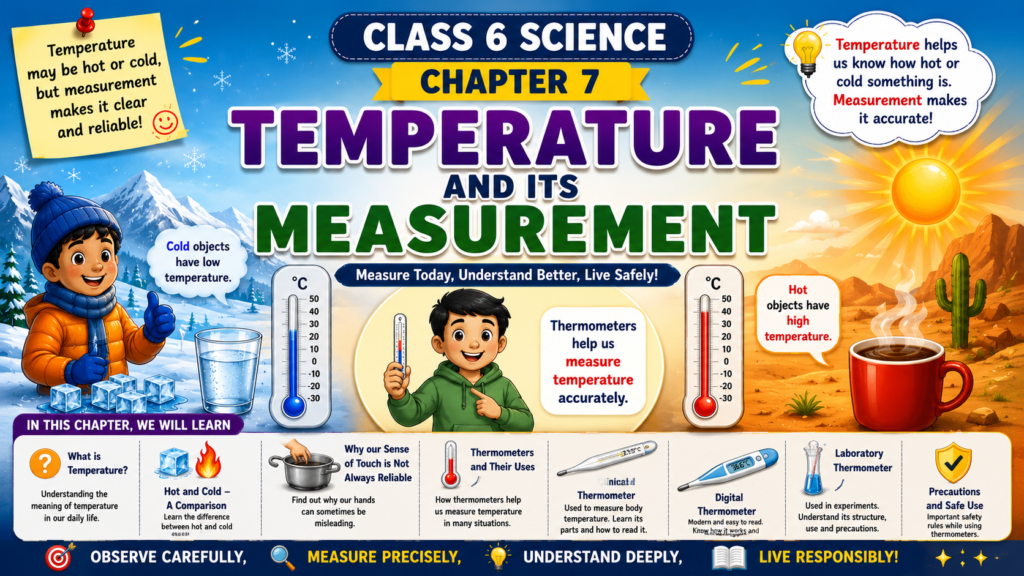
Introduction: How Do We Know Whether Something Is Hot or Cold?
Every day, we come across objects that feel hot, warm, cool, or cold. A cup of tea feels hot, an ice cube feels cold, and bath water may feel pleasantly warm. We often decide the temperature of an object simply by touching it with our hands. This method seems easy, but it is not always correct.
Imagine that you keep one hand in cold water and the other hand in warm water for a minute. When both hands are then placed in normal water, the same water feels warm to one hand and cool to the other. This surprising activity shows that our sense of touch can be misleading.
Science gives us a better solution. Instead of guessing, we use a measurable quantity called temperature. Temperature tells us exactly how hot or cold an object is. By measuring temperature, we can compare objects accurately and make scientific conclusions.
What Is Temperature?
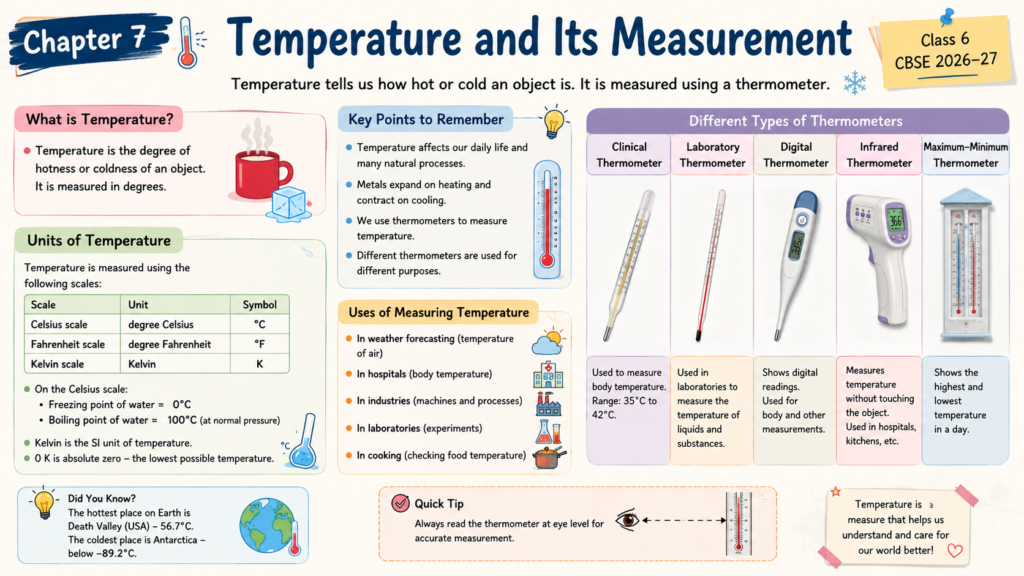
Temperature is the measure of the degree of hotness or coldness of an object.
In simple words, temperature tells us how hot or how cold something is. If an object has a higher temperature, it feels hotter. If it has a lower temperature, it feels colder.
For example, boiling water has a very high temperature, ice has a very low temperature, and the human body normally remains at a nearly constant temperature.
Temperature is important because it gives us a numerical value. Instead of saying “the water is very hot,” we can say “the water is 80 °C.” This makes our observations precise and understandable to everyone.
Why Is Temperature Important in Daily Life?
Temperature affects almost every part of our lives. Doctors check body temperature to detect fever. Weather forecasts tell us the temperature outside so we can decide what clothes to wear. Refrigerators keep food at low temperatures to prevent spoilage. Ovens and stoves use controlled temperatures to cook food properly.
Temperature also affects nature. Water freezes at low temperatures and evaporates at high temperatures. Plants and animals survive only within suitable temperature ranges. By understanding temperature, we understand how our body, our home, and the environment function.
Why Our Sense of Touch Is Not Reliable
Our skin is useful for sensing heat and cold, but it does not measure temperature accurately. It only gives a rough idea based on comparison.
Suppose you touch a metal spoon and a wooden spoon kept in the same room. The metal spoon may feel colder, even though both are at the same temperature. This happens because metal transfers heat from your hand more quickly.
This shows that feeling alone cannot be trusted. Scientific work requires exact values, and for that we use thermometers.
Unit of Temperature
The most commonly used unit of temperature is degree Celsius, written as °C.
In India and most countries, temperature is measured in Celsius.
Some familiar values are:
- Normal body temperature = 37 °C
- Freezing point of water = 0 °C
- Boiling point of water = 100 °C
These standard values help students understand the Celsius scale and compare temperatures easily.
What Is a Thermometer?
A thermometer is an instrument used to measure temperature.
The word thermometer comes from two Greek words: thermo meaning heat and meter meaning measure. Therefore, a thermometer is an instrument used to measure temperature accurately.
Thermometers are used in hospitals, homes, weather stations, laboratories, and industries. Different types of thermometers are designed for different purposes, but all of them serve the same basic function: measuring temperature.
How Does a Thermometer Work?
Many traditional thermometers contain a liquid such as mercury or colored alcohol inside a narrow glass tube.
When the temperature increases, the liquid expands and rises upward in the tube. When the temperature decreases, the liquid contracts and moves downward. The tube is marked with numbers, and the position of the liquid shows the temperature.
This simple principle of expansion and contraction makes it possible to measure temperature with great accuracy.
Clinical Thermometer
A clinical thermometer is specially designed to measure the temperature of the human body.
Doctors use it to check whether a person has a fever. Since body temperature usually stays within a small range, the thermometer is marked only from about 35 °C to 42 °C.
This limited range allows the thermometer to show small changes in body temperature clearly. If the reading is above 37 °C, it may indicate fever. Because it is designed only for body temperature, it should not be used to measure very hot or very cold substances.
Structure of a Clinical Thermometer
A clinical thermometer has several important parts. At one end, there is a bulb containing mercury or another liquid. This bulb is placed under the tongue or in the armpit. Above the bulb is a narrow capillary tube through which the liquid rises.
A special constriction, or kink, is present near the bulb. This constriction prevents the liquid from falling immediately when the thermometer is removed from the body, giving enough time to read the temperature.
The glass tube is marked with a Celsius scale for accurate reading.
Normal Human Body Temperature
The normal body temperature of a healthy person is approximately 37 °C.
This temperature may vary slightly depending on the time of day, physical activity, and age, but 37 °C is considered the standard value.
If the temperature rises significantly above 37 °C, the person may have a fever. If it drops too low, it may indicate other health problems. Monitoring body temperature is therefore an important part of medical diagnosis.
How to Use a Clinical Thermometer
Before using the thermometer, it should be cleaned with an antiseptic solution or clean water. If it is a mercury thermometer, it should be gently shaken so that the mercury level falls below 35 °C.
The bulb is placed under the tongue or in the armpit and kept there for the recommended time. After removing the thermometer, hold it at eye level and note the temperature where the mercury column ends.
After reading, clean the thermometer again and store it safely.
How to Read a Clinical Thermometer
Reading a clinical thermometer requires patience and careful observation. Hold the thermometer horizontally at eye level and slowly rotate it until the shiny mercury line becomes visible.
Observe the number nearest to the top end of the mercury column. That number represents the body temperature.
Reading at eye level is important because viewing from an angle may lead to errors. Once students practice this a few times, reading a thermometer becomes simple and accurate.
Precautions While Using a Clinical Thermometer
A clinical thermometer is delicate and should be handled carefully. Always hold it by the stem and not by the bulb. Clean it before and after use. Never use hot water to wash it because the glass may crack.
If the thermometer is made of glass, do not drop it. If it breaks, an adult should handle it, especially if it contains mercury.
Following these precautions ensures both safety and accurate temperature readings.
Digital Thermometer
A digital thermometer is an electronic device that measures temperature and displays the reading on a small screen.
It is now commonly used in homes and hospitals because it is easy to read and usually gives results within a few seconds. Most digital thermometers do not contain mercury, making them safer than traditional glass thermometers.
Because the numbers appear directly on the screen, there is no need to interpret a mercury column, which makes digital thermometers very user-friendly.
Advantages of Digital Thermometers
Digital thermometers have many advantages. They are fast, accurate, and easy to use. The display is clear, so children and adults can read it without difficulty.
They are also safer because they do not contain toxic mercury. Many digital thermometers beep when the measurement is complete, which adds convenience.
These features have made digital thermometers one of the most popular devices for measuring body temperature today.
Laboratory Thermometer
A laboratory thermometer is used to measure the temperature of liquids and other substances during scientific experiments.
Unlike a clinical thermometer, it has a much wider range, usually from –10 °C to 110 °C. This allows students and scientists to measure both very cold and very hot substances.
Laboratory thermometers are commonly used in school experiments to observe changes during heating and cooling.
Structure of a Laboratory Thermometer
A laboratory thermometer also contains a bulb and a capillary tube, but it does not have a constriction.
Because there is no constriction, the liquid level falls immediately when the thermometer is removed from the substance. Therefore, the reading must be taken while the bulb is still immersed in the liquid.
The wider range of markings makes this thermometer suitable for experiments involving boiling water, melting ice, and other temperature changes.
How to Use a Laboratory Thermometer
Place the bulb of the thermometer in the liquid whose temperature is to be measured. Make sure the bulb is fully immersed, but it should not touch the sides or bottom of the container.
Hold the thermometer upright and wait until the liquid level becomes steady. Read the temperature while the thermometer remains in the liquid.
This method ensures an accurate reading and prevents sudden changes in the liquid column.
6. Types of Chemical Reactions
Precautions While Using a Laboratory Thermometer
The bulb should be fully surrounded by the liquid, but it must not touch the container because that may affect the reading.
The thermometer should be held vertically, and the reading should be taken at eye level to avoid parallax error.
Since laboratory thermometers are made of glass, they must be handled gently to prevent breakage.
Difference Between Clinical and Laboratory Thermometers
A clinical thermometer is used only to measure body temperature, while a laboratory thermometer is used in experiments.
The clinical thermometer has a constriction and a narrow range of 35 °C to 42 °C. The laboratory thermometer does not have a constriction and has a wider range, often from –10 °C to 110 °C.
These differences make each thermometer suitable for its specific purpose.
Mercury in Thermometers
Mercury was widely used in thermometers because it expands uniformly, is shiny and easy to see, and does not stick to the glass tube.
However, mercury is poisonous. If a thermometer breaks, mercury can be harmful to people and the environment.
Because of this risk, digital thermometers and alcohol thermometers are increasingly used as safer alternatives.
Alcohol Thermometers
Some thermometers use colored alcohol instead of mercury. Alcohol is less harmful and can measure very low temperatures because it remains liquid even in extremely cold conditions.
The colored liquid is easy to see, which makes reading the thermometer simple.
These thermometers are often used in weather instruments and in places where temperatures may fall below the freezing point of mercury.
Temperature in Weather Reports
Weather reports tell us the maximum and minimum temperatures expected during the day.
For example, if the forecast says 42 °C, we know the day will be very hot. If the temperature is expected to be 8 °C, we prepare for cold weather.
These readings help us plan clothing, travel, and outdoor activities.
Temperature and Human Health
Temperature is one of the most important signs doctors use to assess health.
Fever often indicates that the body is fighting an infection. Doctors use temperature readings along with other symptoms to diagnose illness.
By checking body temperature regularly during sickness, we can monitor recovery and decide whether medical attention is needed.
Real-Life Uses of Temperature Measurement
Temperature measurement is useful in many places. In kitchens, it helps control cooking. In refrigerators, it preserves food. In laboratories, it allows experiments to be conducted accurately.
In industries, temperature is monitored while making medicines, steel, and electronic components. In agriculture, farmers watch temperature to protect crops.
This shows that temperature is one of the most widely measured quantities in science and everyday life.
Important Temperature Values to Remember
Some temperatures are so important that every student should remember them.
- Freezing point of water = 0 °C
- Normal body temperature = 37 °C
- Boiling point of water = 100 °C
These three values are used repeatedly in science and form the basis for understanding the Celsius scale
Chapter Keywords
Temperature, Thermometer, Degree Celsius, Clinical Thermometer, Laboratory Thermometer, Digital Thermometer, Mercury, Constriction, Fever, Celsius Scale.
Chapter Summary
Temperature tells us how hot or cold an object is. Our sense of touch can be misleading, so scientists use thermometers for accurate measurement. Clinical thermometers are used to measure body temperature, laboratory thermometers are used in experiments, and digital thermometers provide quick and easy readings. Temperature is measured in degree Celsius. Accurate temperature measurement is essential in health, weather, cooking, and scientific investigations.
Additional Resources
- NCERT Science Textbook: https://ncert.nic.in/textbook.php
- NCERT Official Website: https://ncert.nic.in
- FlashCards of this Chapter : Click Here
Recommended Book for Extra Practice
If you want to strengthen your understanding of this chapter and get plenty of chapter-wise practice questions, revision notes, diagrams, and competency-based questions, this book is an excellent companion for Class 6 Science.
 Oswaal CBSE Class 6 One for All Science (Curiosity) for 2026–27 Exam
 Oswaal CBSE Class 6 One for All Science (Curiosity) for 2026–27 Exam
This book is based on the latest NCERT and CBSE syllabus and includes:
- Chapter-wise question bank
- Detailed revision notes
- Clear theory explanations
- Well-labeled diagrams
- Competency-based and application questions
- Practice exercises with answers
It is especially useful for students who want to go beyond the textbook and build a stronger conceptual foundation.
 Buy Now: https://amzn.to/4uAnwFu
Oswaal CBSE Class-6 One for All Science (Curiosity) for 2026–27 Exam | As Per Latest NCERT & CBSE Syllabus | Chapter-Wise Question Bank, Revision Notes, Theory, Diagrams & Competency-Based Questions
This is a highly recommended resource for students, parents, and teachers looking for a complete practice and revision book for Class 6 Science.
✅ Oswaal Class 10 SST — Topper's Choice
✅ Together With SST — Best for Practice
✅ Oswaal Science Class 10 — Chapter Wise
✅ RD Sharma Maths — Most Popular
✅ Oswaal Class 10 SST — Topper's Choice
✅ Together With SST — Best for Practice
✅ Oswaal Science Class 10 — Chapter Wise
✅ RD Sharma Maths — Most Popular