Complete CBSE Exam Ready Nationalism in India Class 10 Notes
Introduction
Nationalism in India Class 10 Notes help us understand how ordinary Indians slowly discovered the strength of unity. During 1915–1930, people were dealing with high prices, epidemics, unfair taxes and harsh British decisions. Gandhi entered this environment with the idea of Satyagraha, which encouraged people to resist injustice peacefully. Over time, farmers, students, workers, women, plantation labourers, and business groups joined the movement in their own ways.
Let Starts with Nationalism in India Class 10 Notes .
Nationalism in India Class 10 Notes
1. The First World War, Khilafat & Non-Cooperation
1.1 How the First World War changed India
Even though the war took place in Europe, the effects were strongly felt in India.
Economic Impact
Prices of basic goods such as wheat, rice, sugar, kerosene and cloth rose sharply.
British diverted Indian resources—grains, metals, fuel—for army needs, causing shortages everywhere.
Heavy war loans and new taxes were introduced, increasing pressure on poor households.
Village families often had to sell jewellery or livestock to survive inflation.
Forced recruitment took many young men from villages, disrupting farming activities.
Social & Health Impact
Severe crop failure in 1918 reduced food supply even further.
The influenza epidemic spread quickly across India due to crowded living conditions.
Limited medical facilities led to extremely high death rates in rural belts.
Entire families suffered losses, creating fear and emotional stress.
People began questioning why a government that demanded so much gave so little support during crises.
Overall Effect
Shared suffering created a shared identity among Indians.
A feeling of “we are all facing this together” gradually pushed people toward collective action.
This environment made it easier for Gandhi’s ideas to be accepted across the country.
Timeline: India During & After World War I
| Year | Event | What Indians Experienced |
|---|
| 1914 | WWI begins | Taxes increase; shortages begin |
| 1916 | War demands rise | Inflation becomes severe |
| 1917 | Forced recruitment | Rural anger grows |
| 1918 | Crop failure + epidemic | Lakhs die |
| 1919 | Rowlatt Act | Nationwide protest |
| 1920 | Non-Cooperation begins | First mass movement |
1.2 Gandhi introduces Satyagraha
Gandhi’s aim was to awaken people’s conscience, not to frighten or punish the opponent.
What Satyagraha Meant
Truth should guide action.
Violence weakens a movement, while moral strength enhances it.
Suffering voluntarily shows the purity of one’s cause.
The goal is to change the opponent’s heart, not destroy them.
Early Satyagraha Movements
Champaran (1917)
Indigo farmers were trapped in unfair agreements.
Gandhi collected evidence, organised meetings and made the issue national.
Result: Planters withdrew many oppressive conditions.
Kheda (1917)
Crop failure made paying revenue impossible.
Gandhi and Sardar Patel supported peasants.
Result: Revenue collection was suspended.
Ahmedabad Mill Strike (1918)
Mill workers demanded better wages.
Gandhi fasted until a fair compromise was reached.
These movements strengthened the belief that organised, peaceful struggle could produce real change.
1.3 Rowlatt Act: An Unfair Law
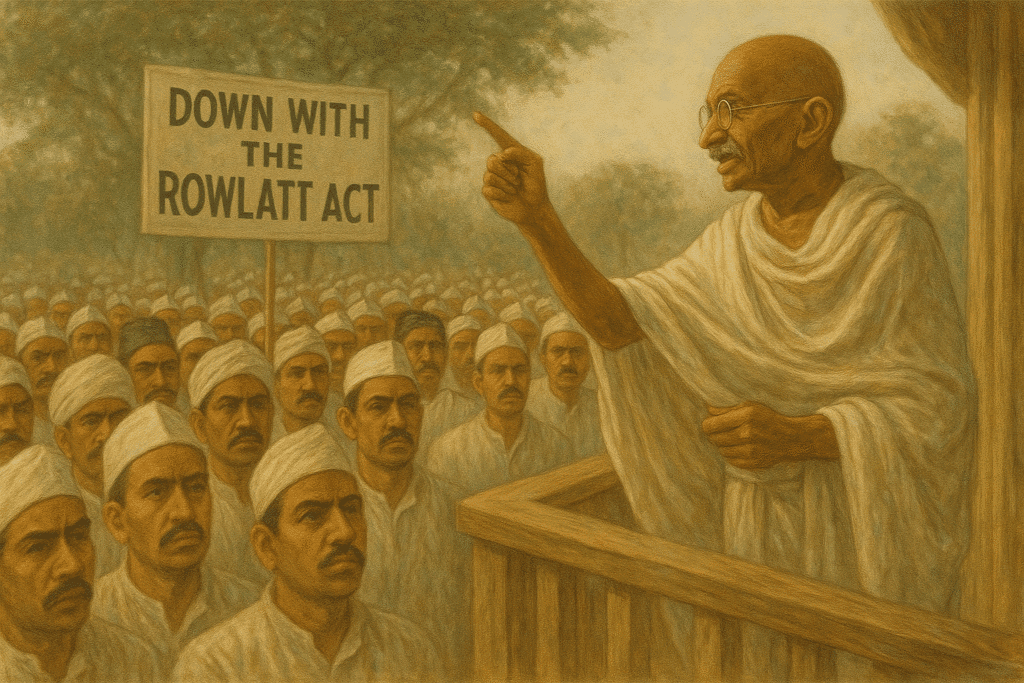
The Rowlatt Act deeply angered Indians because it took away fundamental rights.
The Act allowed police to arrest anyone on suspicion without evidence.
Trials could be held in secret courts without allowing lawyers.
The law felt like a betrayal because Indians expected rewards for supporting Britain in the war.
Peaceful protests were organised across India, showing that people had lost trust in British intentions.
British officers reacted violently, increasing public resentment and further encouraging the desire for freedom.
1.4 Jallianwala Bagh Massacre
People gathered peacefully to protest the Rowlatt Act and to attend a Baisakhi fair.
General Dyer blocked the exit and ordered firing without any warning.
The narrow passage made escape impossible, resulting in massive casualties.
News of the massacre spread across India, causing grief and deep anger.
Many Indians who were earlier moderate became strongly anti-British after this event.
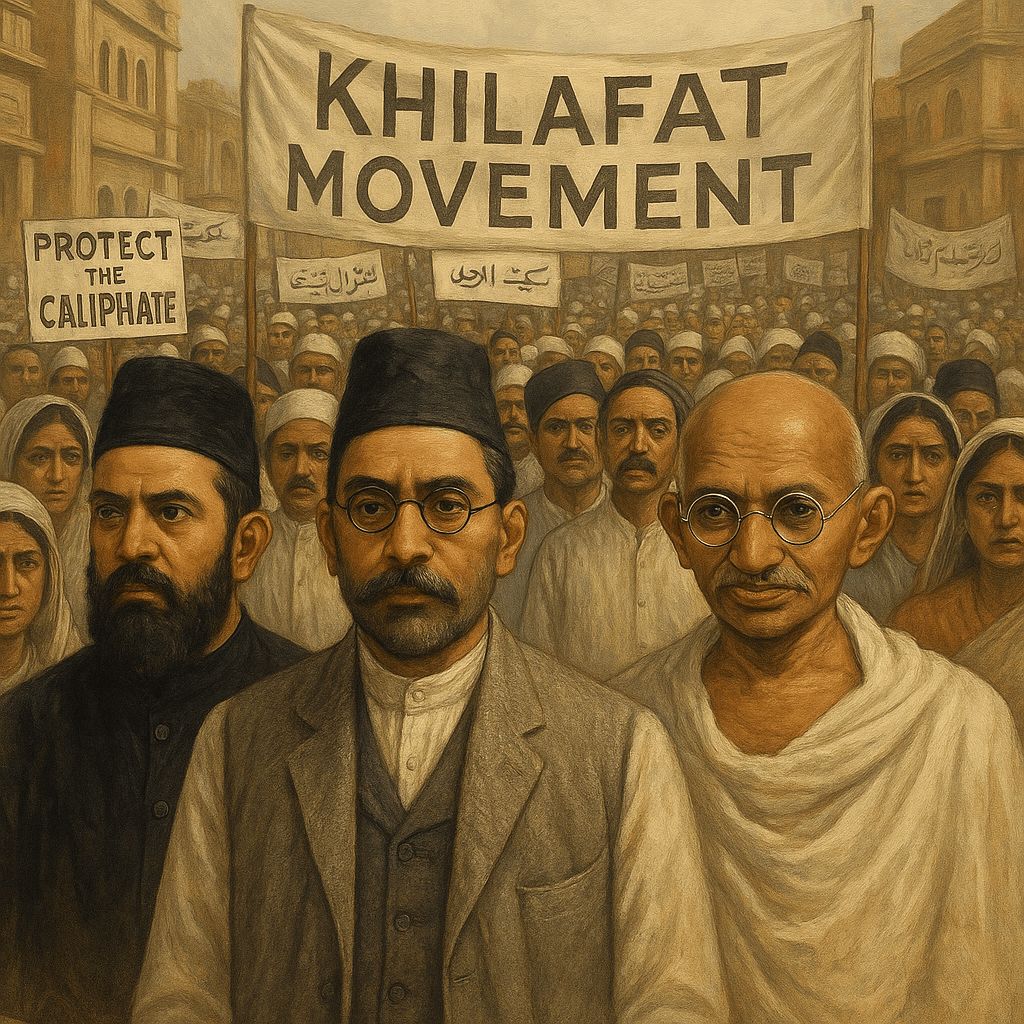
1.5 Khilafat Movement
After WWI, Britain imposed harsh terms on Turkey, insulting the Khalifa, who was respected by Indian Muslims.
Indian Muslim leaders felt betrayed by British actions.
Muhammad Ali and Shaukat Ali travelled across India, addressing public meetings.
Gandhi supported the movement to build Hindu-Muslim unity at a crucial time.
The Khilafat issue helped transform Indian nationalism into a more inclusive, united movement.
1.6 Why Gandhi launched the Non-Cooperation Movement
Key Reasons
Rowlatt Act symbolised injustice.
Jallianwala Bagh showed Britain’s cruelty.
Khilafat issue upset Indian Muslims.
Rising unemployment and poverty created frustration.
Gandhi felt cooperation with the British was strengthening oppression.
Gandhi’s Plan
Boycott government schools and colleges.
Boycott foreign cloth and promote Khadi.
Refuse government titles like Rai Bahadur.
Leave government jobs.
Encourage Panchayats and Indian-run institutions.
The movement united different social classes for the first time.
2. Differing Strands Within the Movement
Supporters
Students seeking Indian-run education.
Teachers wanting moral, independent institutions.
Lawyers who no longer wanted to work under unjust courts.
Middle-class groups affected by economic hardships.
Actions
Students withdrew from government schools in large numbers.
National institutions like Jamia Millia Islamia were established.
Foreign cloth shops were picketed, lowering their sales significantly.
Many lawyers gave up their practice, weakening the colonial legal system.
Why Movement Slowed Down
Khadi was expensive and time-consuming to produce.
Middle-class professionals returned to work due to financial needs.
National institutions lacked funds and teachers.
The enthusiasm of early months gradually reduced in cities.
2.2 Peasant Movements in the Countryside
Awadh Movement
Farmers suffered due to high rents, illegal taxes, and forced labour.
Baba Ramchandra, who had travelled widely, became their leader.
Peasants demanded reduction of rents and abolition of begar.
They organised meetings, marches and social boycotts of oppressive landlords.
Congress leaders guided the movement to remain non-violent.
However, local anger sometimes led to violent clashes, which Gandhi condemned.
Other Rural Struggles
In some places, tribals demanded the right to use forest products freely.
Forest laws had limited their traditional livelihood.
Tribal groups joined the larger national movement with their own demands.
2.3 Swaraj in Plantations (Assam)
Plantation workers were bound by strict laws under the Inland Emigration Act.
They could not leave plantations without permission, trapping them in low wages.
Gandhi’s call for Swaraj created hope that they could return to their home villages.
Thousands left plantations and walked long distances towards their homes.
Many were stopped, beaten, or forced back, showing the harshness of the plantation system.
This episode demonstrated that Swaraj meant different things to different people.
Nationalism in India Class 10 Notes
3. Towards Civil Disobedience
3.1 Simon Commission
The Commission was appointed to suggest constitutional reforms.
No Indian was included, which was seen as an insult.
People felt Britain did not consider Indians capable of governing themselves.
Protests were organised across India with black flags.
The slogan “Simon Go Back” reflected strong nationalist feelings.
3.2 Congress demands Purna Swaraj
At the Lahore Session in December 1929, young leaders pushed for full independence.
Jawaharlal Nehru hoisted the tricolour on the banks of the Ravi River.
Congress declared 26 January as Independence Day.
It marked a shift from asking for reforms to demanding complete freedom.
3.3 The Salt March
Why Salt?
Salt was essential for everyone, so the tax affected all Indians.
Gandhi wanted a symbol that united both poor and rich.
Breaking the salt law was a simple yet powerful act of defiance.
Gandhi’s March
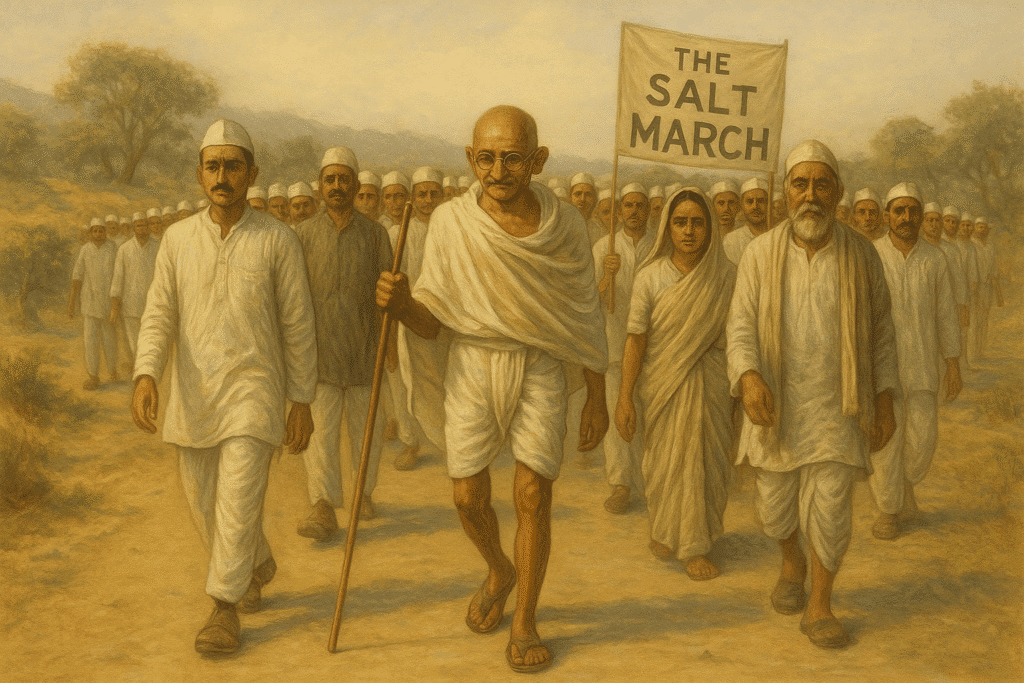
The march lasted 24 days and covered 240 km.
Gandhi spoke to crowds in every village, increasing awareness.
The march received international media coverage, making the world notice India’s freedom struggle.
When Gandhi made salt at Dandi, it inspired thousands to break the law across India.
Nationwide Participation
People manufactured salt illegally in many regions.
Women took a leading role in picketing liquor shops.
Tribals protested against forest laws.
Farmers stopped paying revenue.
Students boycotted British schools.
Nationalism in India Class 10 Notes
3.4 How Different Groups Participated
Rich Peasants
Faced high land revenue and economic pressure.
Supported the movement expecting tax reduction.
Withdrew when no immediate relief was given.
Poor Peasants
Were in heavy debt and wanted rent reduction.
Participated enthusiastically but felt ignored later.
Business Class
Wanted lower import duties and fewer trade restrictions.
Supported Congress initially.
Grew uncomfortable when Congress supported workers.
Women
Participated in marches, made salt, and boycotted liquor shops.
Their participation was voluntary and courageous despite social restrictions.
After the movement, they still did not receive political rights, causing disappointment.
3.5 Limits of Civil Disobedience
The movement was not equally successful in all regions.
Different groups had different expectations, causing friction.
Dalits felt Congress did not fully support their issues.
Ambedkar demanded separate electorates to protect Dalit rights.
Muslims felt alienated as communal tensions were rising in some areas.
British repression—arrests, beatings, fines—slowed the movement.
Despite challenges, the movement left a deep impact and united millions under the idea of freedom.
Nationalism in India Class 10 Notes
4. Sense of Collective Belonging
Symbols & Songs
The tricolour flag became a unifying identity for Indians.
The spinning wheel symbolised self-reliance and Swadeshi.
“Vande Mataram” was sung across meetings, creating emotional connections.
National symbols allowed diverse communities to feel part of a shared movement.
Bharat Mata
Abanindranath Tagore’s painting depicted the nation as a compassionate mother.
The image helped people imagine India not just as a territory, but as a living, nurturing presence.
Different artists adapted the image in their own styles, strengthening the emotional bond.
Rediscovering India’s Past
Nationalists collected folk songs, tales, and traditions from villages.
These cultural elements reminded Indians of their shared heritage.
Scholars rewrote Indian history to highlight ancient achievements in science, architecture and literature.
This revived pride and pushed Indians to believe they were capable of ruling themselves.
FAQs
Nationalism in India Class 10 Notes
1. What is the meaning of Nationalism in India Class 10?
Nationalism in India Class 10 refers to the process through which Indians developed a shared identity and collective desire for freedom. It shows how political events, economic hardships, and Gandhian methods united different groups—peasants, students, workers, women, tribals, and plantation labourers—under one goal: ending British rule. The chapter explains how a common national consciousness gradually replaced regional and social divisions.
2. How did World War I help in the growth of Indian nationalism?
World War I created widespread inflation, food shortages, crop failures, and forced recruitment. Indian families suffered without adequate support from the British government. The influenza epidemic worsened the situation, killing lakhs. These difficulties made people realise that colonial rule was neither helpful nor protective. This shared suffering encouraged Indians to unite, question British authority, and support national leaders like Gandhi, who promised dignity and justice.
3. What is Satyagraha as explained in Class 10 History?
Satyagraha, introduced by Gandhi, means insisting on truth through non-violent methods. Instead of using force, Satyagraha encourages peaceful resistance, moral courage, and self-suffering. Gandhi believed that a just cause becomes stronger when people refuse to harm others. Through movements like Champaran, Kheda and Ahmedabad, he proved that truth combined with discipline could pressure even the most powerful government.
4. Why was the Rowlatt Act opposed across India?
The Rowlatt Act allowed the British to arrest people without trial or legal rights. Indians felt betrayed because they expected reforms after supporting Britain in World War I. The Act took away basic freedoms, leading to strikes, hartals, and public meetings. The widespread anger and the unfair nature of the Act united Indians across religions and regions, increasing distrust toward the colonial government.
5. What was the significance of the Jallianwala Bagh massacre?
The Jallianwala Bagh massacre was a turning point in the Indian freedom struggle. General Dyer ordered firing on an unarmed gathering trapped inside a closed garden. The brutality shocked Indians and destroyed any remaining trust in British rule. Many moderates who once believed in constitutional methods turned toward mass movements. The incident strengthened the call for complete independence, not just reforms.
6. What was the Non-Cooperation Movement and why was it started?
The Non-Cooperation Movement aimed to withdraw Indian support from British institutions—schools, courts, titles, government jobs and foreign goods. Gandhi launched it because of the Rowlatt Act, Jallianwala Bagh massacre, the Khilafat injustice and growing economic suffering. The idea was simple: if Indians refused cooperation, British rule would collapse morally and administratively. It became India’s first nationwide movement.
7. Why did peasants join the national movement?
Peasants joined the national movement because they faced high rents, illegal taxes, unpaid labour demands, and constant harassment by landlords and officials. Gandhi’s call for Swaraj raised hopes of relief and justice. Movements in Awadh and other regions reflected rural frustration. Although their expectations were sometimes different from Congress leadership, their participation made the movement reach India’s deepest rural areas.
8. How did the Salt March unite the nation?
The Salt March became a national symbol because salt was essential for every household. Gandhi walked 240 km to break the salt law, proving that an ordinary act could challenge an empire. People across India began making salt illegally, refusing taxes, and boycotting foreign goods. Women, students, tribals and farmers participated in large numbers. The movement gained global attention and transformed the struggle into a mass uprising.ulvinar dapibus leo.
9. Why did the Civil Disobedience Movement face limitations?
Despite widespread participation, the Civil Disobedience Movement struggled with internal divisions. Rich peasants, poor peasants, business classes and workers had different expectations. Dalits wanted stronger support for social rights, while Muslims feared political marginalisation. The British used repression to weaken the movement. These differences reduced unity, but the movement still strengthened national consciousness across the country.
10. What is the sense of collective belonging described in the chapter?
The sense of collective belonging refers to the emotional unity that developed among Indians. National symbols like the tricolour, patriotic songs like Vande Mataram, images of Bharat Mata, and rediscovery of folk traditions helped people imagine India as one nation. This cultural unity supported political movements by strengthening the feeling that India was not just a landmass but a shared homeland.
5 Long-Answer Questions
Nationalism in India Class 10 Notes
1. Explain how World War I created the foundation for Indian nationalism.
World War I placed enormous economic and social pressure on Indian society. Rising prices, shortages of essential items and forced recruitment created widespread frustration. The devastating influenza epidemic worsened living conditions. People realised that British rule demanded sacrifices but offered little support during crises. This shared experience of hardship connected Indians emotionally. It became easier for leaders like Gandhi to unite people under common issues, transforming scattered protests into organised national movements.
2. Describe the importance of the Non-Cooperation Movement in uniting India.
The Non-Cooperation Movement brought together students, teachers, lawyers, peasants, workers and women across India. It encouraged Indians to withdraw support from British schools, courts and goods, weakening the colonial system. For the first time, ordinary people felt they could challenge British authority. National schools grew, Khadi spread widely and local institutions gained importance. Although it had limitations, the movement strengthened unity and confidence, laying the groundwork for future mass struggles like Civil Disobedience.
3. Why was the Salt March considered a turning point in the freedom struggle?
The Salt March united India in a way no earlier movement had. Salt was an essential commodity for everyone, so the tax felt deeply unjust. Gandhi’s 240 km march brought national attention to simple, everyday oppression. People from all social groups participated by making salt, boycotting foreign goods and refusing taxes. International media covered the event, exposing British injustice. The movement broke fear, increased courage and transformed the struggle into a genuine national uprising.
4. How did different social groups experience the idea of Swaraj?
Different groups interpreted Swaraj according to their everyday struggles. Rich peasants wanted lower taxes; poor peasants wanted reduced rents. Plantation workers hoped Swaraj meant freedom to return home. Business classes expected fewer trade restrictions, while women viewed Swaraj as a chance for dignity and participation. These variations sometimes caused misunderstandings with Congress leadership. However, they also showed how deeply the idea of independence had travelled into India’s diverse social fabric.
5. Explain the cultural forms that helped develop nationalism in India.
Nationalism was strengthened not only through movements but also through cultural expression. The tricolour flag symbolised unity and swadeshi. Songs like Vande Mataram created emotional energy during protests. Images of Bharat Mata helped people imagine the nation as a mother figure. Folk tales, traditional stories and rediscovered histories promoted pride in India’s cultural heritage. These cultural tools made nationalism accessible to people who might not participate directly in political movements.
MCQs
Nationalism in India Class 10 Notes
Who introduced the idea of Satyagraha?
a) Nehru
b) Gandhi
c) Patel
d) Tilak
Answer: bThe Rowlatt Act allowed:
a) Free speech
b) No tax
c) Arrest without trial
d) Land reforms
Answer: cJallianwala Bagh incident took place in:
a) Lahore
b) Amritsar
c) Kolkata
d) Surat
Answer: bThe Khilafat leaders were:
a) Ali brothers
b) Nehru brothers
c) Gandhi and Patel
d) Tilak and Lajpat Rai
Answer: aGandhi began the Salt March from:
a) Porbandar
b) Dandi
c) Sabarmati Ashram
d) Wardha
Answer: cSimon Commission arrived in India in:
a) 1928
b) 1930
c) 1919
d) 1942
Answer: aPurna Swaraj was declared in:
a) Delhi
b) Lahore
c) Bombay
d) Madras
Answer: bInland Emigration Act affected:
a) Lawyers
b) Plantation workers
c) Peasants
d) Women
Answer: bVande Mataram was written by:
a) Rabindranath Tagore
b) Bankim Chandra Chattopadhyay
c) Aurobindo
d) Sarojini Naidu
Answer: bCivil Disobedience began with:
a) Boycott of schools
b) Salt March
c) Swadeshi
d) Quit India
Answer: b
5-Marker Questions
Analyse the reasons behind the rise of nationalism in India after World War I.
Examine how Gandhian methods transformed Indian politics and motivated mass participation.
Describe the phases of the Non-Cooperation Movement and explain why it eventually slowed down.
Discuss the Civil Disobedience Movement and evaluate the participation of different social groups.
How did cultural nationalism—symbols, songs, folk tales and Bharat Mata—strengthen the idea of India as a nation?
Supportive Study Material Class 10 Science
- Class 10 Science Quiz
- Class 10 Science tests
- Class 10 Science Worksheets
- Class 10 Science PYQs
- Class 10 Science NCERT Solution