✅ Oswaal Class 10 SST — Topper's Choice
✅ Together With SST — Best for Practice
✅ Oswaal Science Class 10 — Chapter Wise
✅ RD Sharma Maths — Most Popular
Chapter 5:Measurement of Length and Motion Class 6 Notes
Introduction: Why Measuring and Motion Matter
Imagine that your friend says, “My table is this long,” and stretches out his hand. Another friend measures the same table using his own hand span and gets a different result. Which answer is correct? Now think of a bus moving on the road, a fan rotating overhead, or a pendulum swinging from side to side. How do we describe these movements accurately?
The answers to these questions are found in this chapter.
Science depends on two important ideas: measurement and motion. Measurement helps us express quantities accurately using standard units. Motion helps us understand how objects change their position over time.
Without measurement, science would be vague. Without understanding motion, we could not explain vehicles, machines, planets, or even our own movement.
What Is Measurement?
Measurement is the process of comparing an unknown quantity with a known standard quantity.
For example, when we say that a pencil is 15 centimetres long, we are comparing the pencil with a standard unit called the centimetre.
Measurement helps us answer questions such as:
- How long is a notebook?
- How tall is a tree?
- How far is the school from home?
- How much cloth is needed to stitch a shirt?
Measurement makes communication clear and accurate.
Why Measurement Is Important
Measurement is essential in everyday life.
Tailors measure cloth to stitch clothes. Carpenters measure wood to make furniture. Doctors measure body temperature and weight. Engineers measure distances to build roads and bridges. Scientists measure carefully to perform experiments.
Even small errors in measurement can lead to incorrect results.
Early Methods of Measurement
Long ago, people used body parts to measure length.
Common non-standard units included:
- Handspan
- Cubit (distance from elbow to fingertip)
- Footstep
- Finger width
These methods were simple but unreliable because body sizes differ from person to person.
A child’s handspan is smaller than an adult’s handspan, so the same object could appear to have different lengths.
Need for Standard Units
To avoid confusion, scientists developed standard units that are the same for everyone.
A standard unit is a fixed quantity accepted universally.
Using standard units ensures that measurements are accurate, consistent, and comparable anywhere in the world.
SI Unit of Length
The standard international system of units is called the SI system.
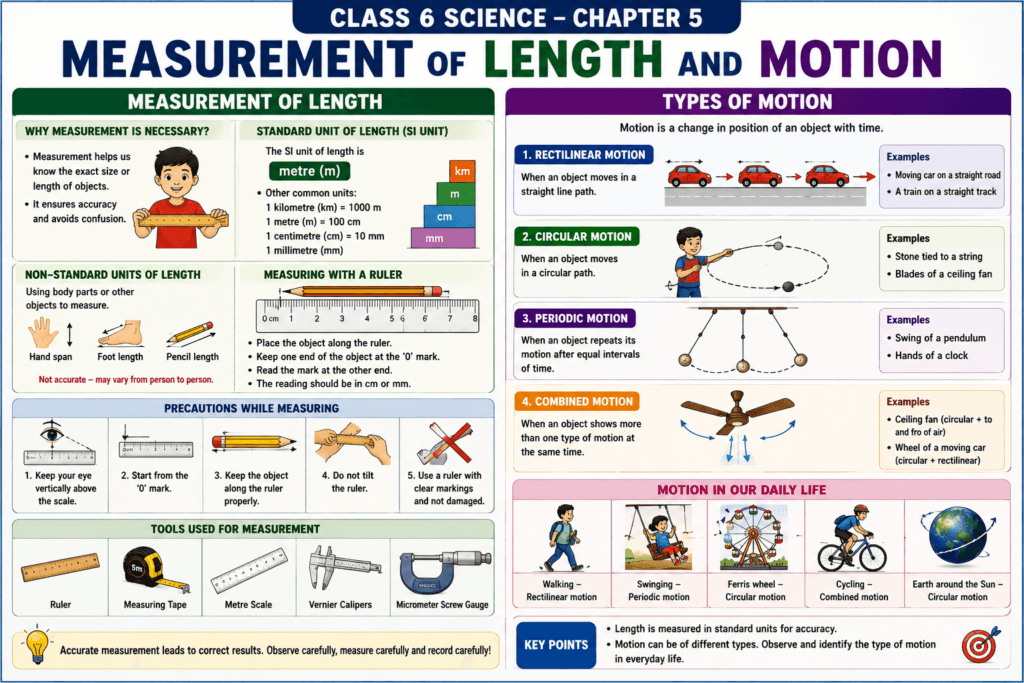
The SI unit of length is the metre (m).
Whether you are in India, Japan, or Brazil, one metre has the same value everywhere.
Common Units of Length
Different units are used depending on the size of the object being measured.
Millimetre (mm)
Used for very small lengths.
Examples: thickness of a coin, diameter of a pencil lead.
Centimetre (cm)
Used for small objects.
Examples: notebook, pencil, eraser.
Metre (m)
Used for larger objects.
Examples: height of a door, length of a room.
Kilometre (km)
Used for long distances.
Examples: distance between cities.
Conversion of Units
Understanding unit conversion is very important.
- 10 millimetres = 1 centimetre
- 100 centimetres = 1 metre
- 1000 metres = 1 kilometre
Example:
If a ribbon is 250 cm long, then:
250 cm = 250 ÷ 100 = 2.5 m
Measuring with a Ruler
A ruler or scale is commonly used to measure length.
Most school rulers are 15 cm or 30 cm long.
Each centimetre is divided into 10 smaller divisions called millimetres.
When measuring, the object should be placed along the ruler, and the reading should be noted carefully.
Correct Method of Measuring Length
Suppose you want to measure a pencil.
- Place the pencil along the ruler.
- Align one end with the zero mark.
- Read the marking at the other end.
- Record the length in centimetres or millimetres.
If the pencil starts at 0 cm and ends at 14.6 cm, its length is 14.6 cm.
What If the Zero Mark Is Broken?
Sometimes the edge of a ruler is damaged.
In that case:
- Place one end of the object at another clear mark, such as 1 cm.
- Note the reading at the other end.
- Subtract the starting reading from the final reading.
Example:
Start = 1.0 cm End = 8.4 cm Length = 8.4 – 1.0 = 7.4 cm
Precautions While Measuring Length
Accurate measurement requires careful observation.
Important precautions:
- Keep the object parallel to the ruler.
- Align the object properly.
- Read the scale with your eye directly above the mark.
- Avoid using damaged edges.
- Record the correct unit.
These steps reduce measurement errors.
Parallax Error
If you view a scale from an angle, the reading may appear different.
This mistake is called parallax error.
To avoid it, always place your eye vertically above the mark.
Measuring Curved Lines
Curved lines cannot be measured directly using a straight ruler.
A thread can be used.
Steps:
- Place the thread along the curve.
- Mark the two ends.
- Straighten the thread.
- Measure its length using a ruler.
This method is useful for measuring the edge of a leaf or a curved drawing.
Measuring Irregular Objects
For objects with unusual shapes, measuring tape, thread, or flexible scales are often used.
Tailors use measuring tapes to measure body dimensions because the tape bends easily.
What Is Motion?
An object is said to be in motion if its position changes with time.
Examples:
- A car moving on a road
- A bird flying in the sky
- A football rolling on the ground
- Earth revolving around the Sun
If the position does not change, the object is said to be at rest.
Rest and Motion Depend on Reference Point
Whether an object is at rest or in motion depends on the observer.
A passenger sitting inside a moving bus appears at rest relative to the bus, but in motion relative to a person standing on the road.
This idea shows that motion is relative.
Types of Motion
Objects move in different ways. To understand motion better, scientists classify it into different types.
Rectilinear Motion
When an object moves along a straight line, the motion is called rectilinear motion.
Examples:
- A train moving on a straight track
- A falling stone
- A car moving on a straight road
This is one of the simplest forms of motion.
Circular Motion
When an object moves along a circular path, the motion is called circular motion.
Examples:
- Blades of a fan
- Hands of a clock
- Merry-go-round
- Earth rotating on its axis
The object keeps moving around a fixed centre.
Periodic Motion
When a motion repeats itself after equal intervals of time, it is called periodic motion.
Examples:
- Swinging pendulum
- Vibrating guitar string
- Day and night cycle
- Changing phases of the Moon (over a regular cycle)
Periodic motion is regular and repeating.
Oscillatory Motion
Oscillatory motion is a to-and-fro motion about a fixed position.
Examples:
- Playground swing
- Pendulum
- Seesaw
Oscillatory motion is often periodic.
Rotational Motion
When an object spins about its own axis, the motion is called rotational motion.
Examples:
- Spinning top
- Earth rotating on its axis
- Potter’s wheel
Objects Can Show More Than One Type of Motion
Many objects exhibit multiple types of motion simultaneously.
A moving bicycle wheel:
- Rotates about its axle (rotational motion).
- Moves forward along the road (rectilinear motion).
Earth:
- Rotates on its axis.
- Revolves around the Sun.
Science often studies such combined motions.
Motion in Everyday Life
Motion is everywhere.
- People walking
- Cars driving
- Birds flying
- Fans rotating
- Rivers flowing
- Planets moving
Recognizing different types of motion helps us understand machines and natural phenomena.
Speed and Motion (Basic Idea)
Some objects move faster than others.
A cheetah runs faster than a tortoise. An airplane moves faster than a bicycle.
Speed tells us how fast an object moves, but detailed study of speed is done in higher classes.
Measuring Distance Travelled
Distance is the total path covered by a moving object.
Examples:
- If you walk 500 metres to school, the distance travelled is 500 metres.
- If a car travels from Delhi to Jaipur, the distance is measured in kilometres.
Accurate distance measurement is important in transport and navigation.
Instruments Used for Measurement
Different tools are used for measuring different lengths.
- Ruler: small objects
- Measuring tape: cloth and body measurements
- Metre scale: larger objects
- Odometer: distance travelled by vehicles
Each instrument is designed for a specific purpose.
Odometer in Vehicles
The odometer in a car or bike records the total distance travelled.
It displays the reading in kilometres.
This is an example of measurement used in everyday technology.
Importance of Accurate Measurement in Science
Scientific experiments require precision.
If two students measure the same object using standard units and proper methods, they should obtain nearly the same result.
Reliable measurements lead to reliable conclusions.
Key Terms and Definitions
Measurement: Comparing an unknown quantity with a standard unit.
Standard Unit: A fixed unit accepted universally.
SI Unit: Internationally accepted standard unit.
Metre: SI unit of length.
Motion: Change in position with time.
Rectilinear Motion: Motion in a straight line.
Circular Motion: Motion along a circular path.
Periodic Motion: Motion that repeats at regular intervals.
Parallax Error: Error caused by viewing a scale from an angle.
Chapter Keywords
- Measurement
- Length
- Standard Unit
- Metre
- Centimetre
- Millimetre
- Kilometre
- Motion
- Rectilinear Motion
- Circular Motion
- Periodic Motion
- Oscillatory Motion
- Parallax Error
- Odometer
Chapter Summary
Measurement is the process of comparing an unknown quantity with a standard unit. The SI unit of length is the metre. Common units include millimetre, centimetre, metre, and kilometre. Accurate measurements require proper techniques and precautions. Motion is the change in position of an object with time. Different types of motion include rectilinear, circular, periodic, oscillatory, and rotational motion. Understanding measurement and motion helps us describe the world scientifically.
Quick Revision Points
- Measurement compares an unknown quantity with a standard unit.
- The SI unit of length is the metre (m).
- 100 cm = 1 m.
- 1000 m = 1 km.
- A ruler is used to measure small lengths.
- Motion means change in position with time.
- Rectilinear motion occurs in a straight line.
- Circular motion occurs along a circular path.
- Periodic motion repeats after equal intervals.
- Accurate measurement is essential in science.
Did You Know?
- The metre was originally defined using Earth-related measurements.
- The Earth shows both rotational and circular motion.
- Odometers in vehicles measure total distance travelled.
- Tailors use flexible measuring tapes to measure curved surfaces.
- Even tiny errors in measurement can affect scientific results.
Conclusion
Measurement and motion are two fundamental concepts that form the foundation of science. Measurement gives us a precise way to describe length and distance, while motion helps us understand how objects move around us.
From measuring a pencil to observing planets orbiting the Sun, these concepts help us see the world with greater clarity and accuracy. By mastering them, students begin to think and work like real scientists.
Additional Resources
- NCERT Science Textbook: https://ncert.nic.in/textbook.php
- NCERT Official Website: https://ncert.nic.in
- FlashCards of this Chapter : Click Here
Recommended Book for Extra Practice
If you want to strengthen your understanding of this chapter and get plenty of chapter-wise practice questions, revision notes, diagrams, and competency-based questions, this book is an excellent companion for Class 6 Science.
 Oswaal CBSE Class 6 One for All Science (Curiosity) for 2026–27 Exam
 Oswaal CBSE Class 6 One for All Science (Curiosity) for 2026–27 Exam
This book is based on the latest NCERT and CBSE syllabus and includes:
- Chapter-wise question bank
- Detailed revision notes
- Clear theory explanations
- Well-labeled diagrams
- Competency-based and application questions
- Practice exercises with answers
It is especially useful for students who want to go beyond the textbook and build a stronger conceptual foundation.
 Buy Now: https://amzn.to/4uAnwFu
Oswaal CBSE Class-6 One for All Science (Curiosity) for 2026–27 Exam | As Per Latest NCERT & CBSE Syllabus | Chapter-Wise Question Bank, Revision Notes, Theory, Diagrams & Competency-Based Questions
This is a highly recommended resource for students, parents, and teachers looking for a complete practice and revision book for Class 6 Science.
✅ Oswaal Class 10 SST — Topper's Choice
✅ Together With SST — Best for Practice
✅ Oswaal Science Class 10 — Chapter Wise
✅ RD Sharma Maths — Most Popular
✅ Oswaal Class 10 SST — Topper's Choice
✅ Together With SST — Best for Practice
✅ Oswaal Science Class 10 — Chapter Wise
✅ RD Sharma Maths — Most Popular