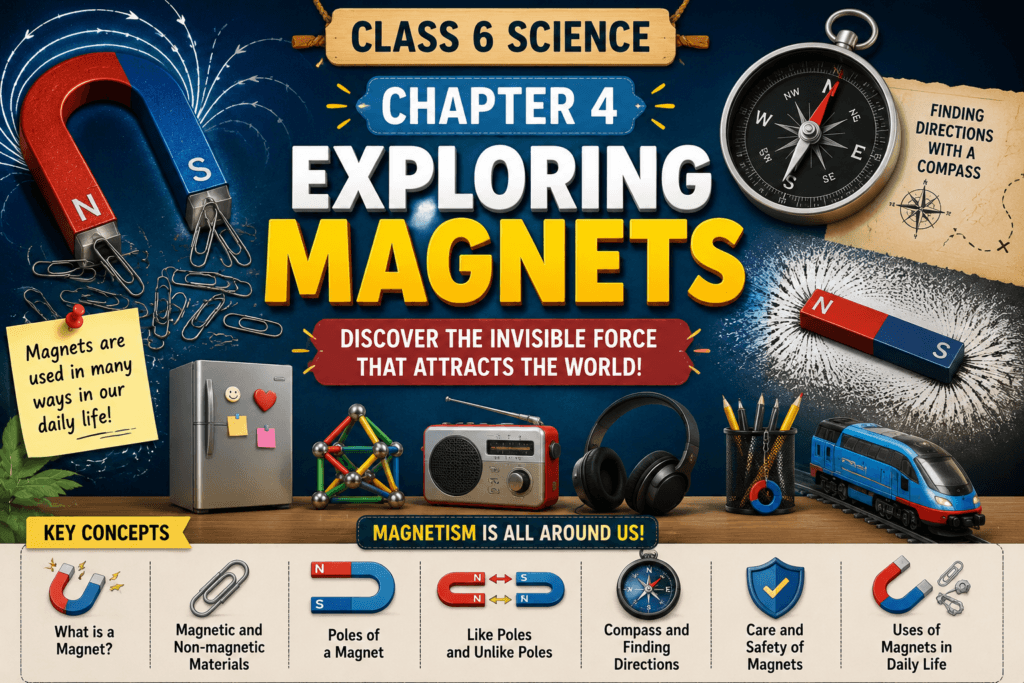
Chapter 4: Exploring Magnets Class 6 Notes
Introduction: The Invisible Force That Attracts
Have you ever played with a magnet and watched it pull small iron pins toward itself as if by magic? Have you seen colorful refrigerator magnets sticking firmly to a metal surface? Have you wondered how a compass needle always points in the north-south direction?
The answer to all these questions lies in the fascinating world of magnets.
Magnets are special objects that can attract certain materials such as iron, nickel, and cobalt. Although we cannot see the force produced by a magnet, we can clearly observe its effects. This invisible force is called magnetic force.
Magnets are used in toys, speakers, electric motors, refrigerators, mobile phones, and navigation tools. In this chapter, we will explore how magnets work, what materials they attract, and how they help us in daily life.
Exploring Magnets Class 6 Notes
What Is a Magnet?
A magnet is an object that attracts certain materials, especially those containing iron.
If you bring a magnet close to iron nails, safety pins, or paper clips, they move toward the magnet and stick to it. This attraction happens because magnets exert a force without touching the object.
The word magnet comes from a naturally occurring mineral called magnetite. This mineral has magnetic properties and can attract iron.
Magnets can be natural or man-made.
- Natural magnets occur in nature, such as lodestone.
- Artificial magnets are made by humans in different shapes and sizes.
The Discovery of Magnets
A popular story tells us that long ago, a shepherd named Magnes was walking in a region called Magnesia. The nails in his shoes and the metal tip of his stick were attracted to certain rocks on the ground. These rocks were natural magnets.
Whether the story is completely true or not, it reminds us that many scientific discoveries begin with careful observation.
People later studied these rocks and learned how to make artificial magnets for practical use.
Shapes of Magnets
Magnets are made in many shapes depending on their use.
Bar Magnet
A rectangular magnet with two ends called poles.
Horseshoe Magnet
A U-shaped magnet. Its poles are close together, making it stronger over a short distance.
Ring Magnet
A circular magnet often used in devices and toys.
Disc Magnet
A flat circular magnet used in electronic gadgets.
Magnetic Needle
A small, lightweight magnet that can rotate freely, as in a compass.
Different shapes may look different, but all magnets have poles and magnetic properties.
Exploring Magnets Class 6 Notes
Magnetic and Non-Magnetic Materials
Not all materials are attracted by magnets.
Materials that are attracted by magnets are called magnetic materials.
Materials that are not attracted by magnets are called non-magnetic materials.
Magnetic Materials
Examples include:
- Iron
- Steel
- Nickel
- Cobalt
Non-Magnetic Materials
Examples include:
- Wood
- Plastic
- Rubber
- Glass
- Paper
- Aluminium (for Class 6, usually treated as non-magnetic)
This property helps us sort and identify materials.
Activity: Testing Materials with a Magnet
Suppose you collect a coin, a nail, a pencil, a rubber band, a spoon, and a plastic ruler.
When you bring a magnet close to each object, you will notice that some are attracted while others are not. The nail and some steel spoons may stick to the magnet, while the pencil and ruler will not.
This simple activity shows how magnets help classify materials.
Poles of a Magnet
The two ends of a magnet are called its poles.
They are:
- North Pole (N)
- South Pole (S)
The magnetic force is strongest near the poles.
If you dip a bar magnet in iron filings, most filings collect near the two ends, showing that the poles are the most active parts of the magnet.
Exploring Magnets Class 6 Notes
Why Are the Poles Important?
The poles determine how magnets interact with each other.
No matter how many times you cut a magnet, each piece will still have a north pole and a south pole.
This means magnetic poles always exist in pairs.
Attraction and Repulsion
Magnets can both attract and repel.
- Unlike poles attract each other.
- Like poles repel each other.
This means:
- North pole attracts South pole.
- South pole attracts North pole.
- North pole repels North pole.
- South pole repels South pole.
Repulsion is considered a sure test of magnetism because ordinary magnetic materials may be attracted to a magnet, but only magnets can repel each other.
Magnetic Force Acts at a Distance
A magnet can attract certain objects even when it is not touching them.
This shows that magnetic force acts through space.
For example, if you place a paper clip near a magnet, the clip moves toward the magnet without direct contact.
This invisible action makes magnets seem magical, but it is a natural force.
Finding the Direction Using a Magnet
One of the most useful properties of a freely suspended magnet is that it always comes to rest in the north-south direction.
If you tie a bar magnet with a thread and allow it to rotate freely, one end points north and the other points south.
This property has been used for centuries by travelers and sailors.

The Compass
A compass is an instrument used to find directions.
It contains a small magnetic needle mounted on a pivot so that it can rotate freely.
The marked end of the needle points toward the north.
By using a compass, we can identify:
- North
- South
- East
- West
Compasses are important in navigation, trekking, surveying, and map reading.
How a Compass Works
Earth behaves like a giant magnet. Its magnetic field causes the compass needle to align in the north-south direction.
This is why the compass remains one of the simplest and most reliable direction-finding tools.
Exploring Magnets Class 6 Notes
Uses of Magnets in Daily Life
Magnets are all around us, often hidden inside devices we use every day.
At Home
- Refrigerator doors
- Cupboard catches
- Magnetic toys
- Speakers and headphones
In School
- Magnetic whiteboard accessories
- Compass for geography
In Hospitals
- MRI machines use powerful magnets.
In Industries
- Cranes lift heavy iron scrap.
In Transportation
- Electric motors and generators use magnets.
In Electronics
- Mobile phones, microphones, and hard drives contain magnets.
Magnets in Nature
Earth itself acts like a giant magnet.
Some animals, such as migratory birds, sea turtles, and certain fish, are believed to sense Earth’s magnetic field and use it to navigate over long distances.
This natural ability helps them find their way during migration.
Temporary and Permanent Magnets
Temporary Magnets
These remain magnetic only for a short time.
Example: An iron nail magnetized by rubbing with a magnet.
Permanent Magnets
These retain magnetism for a long time.
Examples: Bar magnets, refrigerator magnets.
Permanent magnets are usually made from special materials such as steel and magnetic alloys.
Care of Magnets
Magnets can lose their strength if not handled properly.
To keep magnets in good condition:
- Do not heat them strongly.
- Do not hammer or drop them repeatedly.
- Store bar magnets in pairs with soft iron keepers.
- Keep them away from electronic devices and magnetic cards when necessary.
Proper care ensures that magnets remain useful for a long time.
Why Heating and Hammering Affect Magnets
Inside a magnet, tiny magnetic regions are arranged in an orderly manner. Strong heating or repeated hammering disturbs this arrangement, reducing magnetic strength.
Although this explanation is more advanced, it helps us understand why magnets need careful handling.
Making a Simple Magnet
A steel needle can be magnetized by stroking it repeatedly in one direction with one pole of a magnet.
After several strokes, the needle may start attracting pins.
This activity demonstrates how artificial magnets can be made.
Electromagnets: Magnets Created by Electricity
When electric current passes through a wire coil, it can produce magnetism. Such magnets are called electromagnets.
Electromagnets are used in:
- Electric bells
- Cranes
- Relays
- Motors
They are useful because they can be switched on and off.
Difference Between Magnet and Magnetic Material
A magnetic material, such as iron, is attracted by a magnet.
A magnet not only attracts magnetic materials but also has two poles and can repel another magnet.
This distinction is important when identifying magnets.
Real-Life Example: Recycling Centers
Large scrapyards use powerful magnets attached to cranes to lift iron and steel objects from heaps of waste.
This makes sorting metals easier and faster.
Science helps solve practical problems in this way.
Key Terms and Definitions
Magnet: An object that attracts magnetic materials.
Magnetic Force: The invisible force exerted by a magnet.
Magnetic Material: A material attracted by a magnet.
Non-Magnetic Material: A material not attracted by a magnet.
Pole: Either end of a magnet where force is strongest.
Compass: An instrument used to find directions.
Repulsion: Pushing away of like poles.
Attraction: Pulling together of unlike poles.
Chapter Keywords
- Magnet
- Magnetite
- Magnetic Force
- Magnetic Material
- Non-Magnetic Material
- North Pole
- South Pole
- Attraction
- Repulsion
- Compass
- Direction
- Magnetic Needle
- Electromagnet
Chapter Summary
Magnets are special objects that attract certain materials such as iron. They have two poles called north and south poles. Unlike poles attract each other, while like poles repel each other. A freely suspended magnet always points in the north-south direction, which makes it useful in compasses. Magnets are widely used in homes, industries, hospitals, and electronic devices. Proper care helps magnets retain their strength.
Quick Revision Points
- A magnet attracts materials such as iron and steel.
- Magnetic materials are attracted by magnets.
- Non-magnetic materials are not attracted by magnets.
- Every magnet has a north pole and a south pole.
- Unlike poles attract and like poles repel.
- Magnetic force is strongest at the poles.
- A freely suspended magnet points north-south.
- A compass uses a magnetic needle to find directions.
- Magnets are used in many everyday devices.
- Heating and hammering can weaken magnets.
Did You Know?
- Earth behaves like a giant magnet.
- Birds may use Earth’s magnetic field to navigate.
- MRI machines use very powerful magnets.
- A magnet always has two poles, even if broken into smaller pieces.
- Repulsion is the surest test of magnetism.
Conclusion
Magnets are among the most fascinating objects in science. Their invisible force can attract, repel, and guide us in finding directions. From a simple refrigerator magnet to advanced machines used in hospitals and industries, magnets play an important role in modern life.
By understanding magnets, students discover how a powerful natural force works quietly behind many of the technologies we use every day.
Additional Resources
- NCERT Science Textbook: https://ncert.nic.in/textbook.php
- NCERT Official Website: https://ncert.nic.in
- FlashCards of this Chapter : Click Here
Recommended Book for Extra Practice
If you want to strengthen your understanding of this chapter and get plenty of chapter-wise practice questions, revision notes, diagrams, and competency-based questions, this book is an excellent companion for Class 6 Science
📘 Oswaal CBSE Class 6 One for All Science (Curiosity) for 2026–27 Exam
This book is based on the latest NCERT and CBSE syllabus and includes:
- Chapter-wise question bank
- Detailed revision notes
- Clear theory explanations
- Well-labeled diagrams
- Competency-based and application questions
- Practice exercises with answers
It is especially useful for students who want to go beyond the textbook and build a stronger conceptual foundation.
 Buy Now: https://amzn.to/4uAnwFu
Oswaal CBSE Class-6 One for All Science (Curiosity) for 2026–27 Exam | As Per Latest NCERT & CBSE Syllabus | Chapter-Wise Question Bank, Revision Notes, Theory, Diagrams & Competency-Based Questions
This is a highly recommended resource for students, parents, and teachers looking for a complete practice and revision book for Class 6 Science.