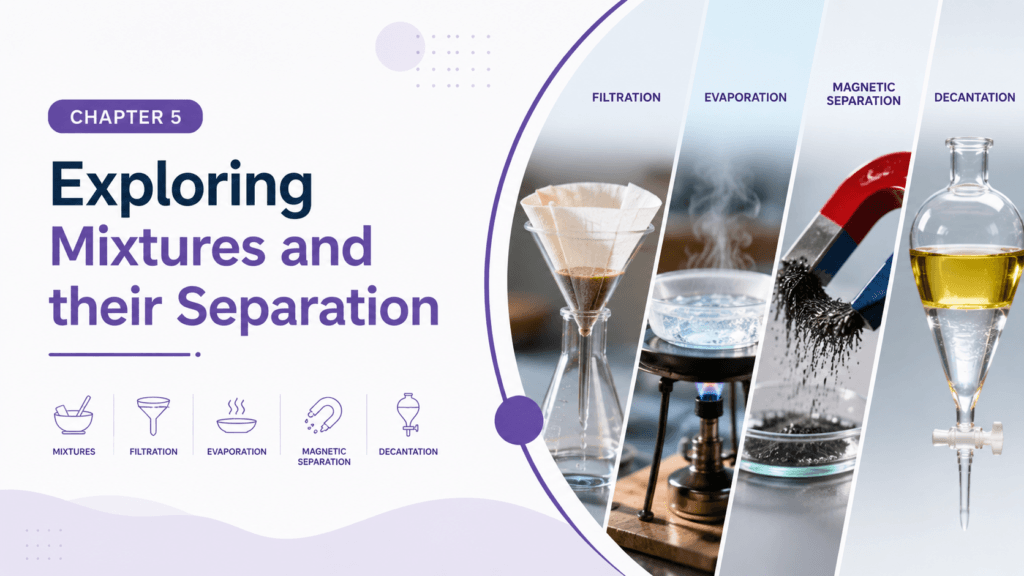
Class 9 Science Chapter 5 Notes | Exploring Mixtures and their Separation
Introduction
In our daily life, we rarely use completely pure substances. The water we drink contains dissolved salts and gases, the air we breathe is a mixture of many gases, milk contains several nutrients mixed together, and soil itself is made of different components. Such combinations of substances are called mixtures.
But not all mixtures are the same. Some mixtures appear completely uniform, while others clearly show different components. Some mixtures allow light to pass through easily, while others scatter light. Some mixtures can be separated easily, whereas others require special scientific techniques.
These detailed Class 9 Science Chapter 5 Notes explain how mixtures are formed, how they are classified, and how different separation techniques are used in science and daily life.
The chapter also explains important concepts such as solutions, colloids, suspensions, concentration, solubility, Tyndall effect, filtration, evaporation, distillation, and chromatography.
Understanding this chapter is extremely important because separation techniques are used everywhere — from preparing food and purifying water to industrial manufacturing and medical laboratories.
Mixture
A mixture is a combination of two or more substances that are physically mixed together without undergoing any chemical change.
In a mixture:
- each substance retains its own properties,
- substances can be present in any proportion,
- and components can usually be separated by physical methods.
For example:
- air,
- soil,
- milk,
- salt water,
- sand and iron filings.
These Class 9 Science Chapter 5 Notes explain that mixtures are different from compounds because compounds are formed through chemical reactions, whereas mixtures are formed through physical mixing.
Classification of Mixtures
Mixtures are mainly classified into:
- homogeneous mixtures,
- heterogeneous mixtures.
Homogeneous Mixture
A homogeneous mixture is a mixture that has uniform composition throughout.
In this type of mixture, the different components cannot be seen separately.
Every part of the mixture has the same properties and composition.
Examples include:
- salt solution,
- sugar solution,
- vinegar,
- air.
The textbook explains that a well-stirred sugar solution tastes equally sweet throughout because sugar particles are uniformly distributed.
Homogeneous mixtures are also called solutions.
Heterogeneous Mixture
A heterogeneous mixture is a mixture that does not have uniform composition throughout.
In this type of mixture, different components can often be seen separately.
Examples include:
- sand and water,
- oil and water,
- muddy water.
The textbook explains that sand particles in water are visible and settle down after some time.
Heterogeneous mixtures do not appear uniform because particles are unevenly distributed.
Solution
A solution is a homogeneous mixture formed when one substance dissolves completely in another substance.
The substance that dissolves is called the solute.
The substance in which the solute dissolves is called the solvent.
For example:
- in salt water, salt is the solute and water is the solvent.
The complete mixture formed is called the solution.
Properties of Solutions
Solutions have several important properties.
Uniform Composition
The particles are evenly distributed throughout the solution.
This makes the solution appear uniform.
Very Small Particle Size
The particles of a solution are extremely small and cannot be seen with naked eyes.
They also cannot be separated by ordinary filtration.
Stability
The particles in a solution do not settle down on standing.
Solutions remain stable for long periods.
No Scattering of Light
Solutions do not scatter light.
Therefore, the path of light passing through a true solution is not visible.
Concentration of Solution
The concentration of a solution describes the amount of solute present in a given amount of solvent or solution.
A solution containing more solute is called concentrated.
A solution containing less solute is called dilute.
The chapter introduces mass percentage concentration.
Formula:
Mass Percentage = (Mass of Solute / Mass of Solution) × 100
Concentration is extremely important in chemistry, medicine, food industry, and laboratories.
Solubility
Solubility is the maximum amount of solute that can dissolve in a given amount of solvent at a particular temperature.
Different substances have different solubilities.
Some substances dissolve easily, while others dissolve only slightly.
The solubility of many solids increases with temperature.
For example, more sugar dissolves in hot water than in cold water.
Suspension
A suspension is a heterogeneous mixture in which insoluble particles are suspended in a liquid.
The particles in a suspension are large enough to be seen with naked eyes.
Examples include:
- muddy water,
- chalk powder in water.
Properties of Suspensions
Visible Particles
Particles in suspensions are large and visible.
Unstable Nature
Particles settle down after some time when left undisturbed.
This process is called sedimentation.
Separation by Filtration
Suspended particles can be separated by filtration.
Scattering of Light
Suspensions scatter light because their particles are comparatively larger.
Colloid
A colloid is a heterogeneous mixture in which particles are intermediate in size between solutions and suspensions.
The particles do not settle down and cannot be separated easily by ordinary filtration.
Examples include:
- milk,
- fog,
- smoke,
- jelly.
Properties of Colloids
Intermediate Particle Size
Colloidal particles are larger than solution particles but smaller than suspension particles.
Stable Nature
Colloidal particles do not settle down on standing.
Tyndall Effect
Colloids scatter light.
The scattering of light by colloidal particles is called the Tyndall effect.
Because of this effect, the path of light becomes visible.
The textbook demonstrates this using laser light passing through mixtures.
Examples of Tyndall effect include:
- sunlight passing through fog,
- light beams visible in dusty rooms.
Separation of Mixtures
Different mixtures require different separation methods depending on:
- particle size,
- solubility,
- boiling point,
- magnetic properties,
- and density.
Separation techniques are extremely important in daily life and industries.
Filtration
Filtration is the process of separating insoluble solids from liquids using a filter.
The solid left behind is called residue.
The liquid passing through the filter is called filtrate.
Examples:
- separating tea leaves from tea,
- separating sand from water.
Sedimentation and Decantation
Sedimentation is the settling down of heavier insoluble particles at the bottom of a liquid.
Decantation is the process of carefully pouring the clear liquid into another container without disturbing the sediment.
These methods are commonly used for muddy water.
Evaporation
Evaporation is used to separate dissolved solids from liquids.
In this process, the liquid evaporates while the solid remains behind.
Example:
- obtaining salt from seawater.
Evaporation is widely used in salt production industries.
Centrifugation
Centrifugation is the process of separating lighter and heavier particles by rapid spinning.
Examples include:
- separating cream from milk,
- laboratory blood testing.
Rapid spinning forces heavier particles outward.
Distillation
Distillation is used to separate components of mixtures based on differences in boiling points.
The liquid with lower boiling point vaporises first and then condenses separately.
Distillation is used:
- in laboratories,
- petroleum refining,
- and preparation of distilled water.
Fractional Distillation
Fractional distillation is used when liquids have close boiling points.
It is commonly used in separating components of petroleum and gases of air.
Sublimation
Sublimation is the process in which certain solids change directly into vapour without becoming liquid.
This property is used to separate sublimable substances from mixtures.
Examples include:
- camphor,
- ammonium chloride,
- naphthalene.
Chromatography
Chromatography is a technique used to separate coloured components of mixtures.
The textbook mentions paper chromatography for separating pigments and food colours.
Chromatography works because different substances move at different speeds on a surface.
Applications include:
- ink analysis,
- medicine testing,
- food colouring analysis.
Importance of Separation Techniques
Separation techniques are essential in:
- water purification,
- food industries,
- medicine,
- agriculture,
- scientific laboratories,
- and environmental protection.
Without separation methods, obtaining pure substances would become extremely difficult.
Conclusion
The chapter “Exploring Mixtures and their Separation” explains how substances combine physically to form mixtures and how different scientific methods are used to separate them.
These detailed Class 9 Science Chapter 5 Notes explain solutions, suspensions, colloids, concentration, solubility, and separation techniques with strong conceptual clarity.
The chapter teaches students that understanding the nature of mixtures helps scientists choose appropriate separation methods for different situations.
This chapter forms the foundation for advanced chemistry topics related to compounds, reactions, purification, and industrial processes.
Quick Revision Points
- Mixtures are physical combinations of substances.
- Homogeneous mixtures have uniform composition.
- Heterogeneous mixtures have non-uniform composition.
- Solutions are homogeneous mixtures.
- Suspensions are unstable heterogeneous mixtures.
- Colloids show Tyndall effect.
- Filtration separates insoluble solids from liquids.
- Distillation separates liquids based on boiling points.
- Chromatography separates coloured substances.
MCQs from Class 9 Science Chapter 5 Notes
1. A homogeneous mixture is:
A. Non-uniform
B. Uniform throughout
C. Always solid
D. Always visible
Correct Answer: B. Uniform throughout
2. Which mixture is heterogeneous?
A. Salt solution
B. Sugar solution
C. Sand and water
D. Vinegar
Correct Answer: C. Sand and water
3. The substance dissolved in a solution is called:
A. Solvent
B. Solute
C. Residue
D. Filtrate
Correct Answer: B. Solute
4. Which mixture shows Tyndall effect?
A. True solution
B. Colloid
C. Pure water
D. Salt solution
Correct Answer: B. Colloid
5. Which process separates tea leaves from tea?
A. Distillation
B. Sublimation
C. Filtration
D. Chromatography
Correct Answer: C. Filtration
6. Which mixture has particles that settle down on standing?
A. Solution
B. Colloid
C. Suspension
D. Air
Correct Answer: C. Suspension
7. Which process is used to obtain salt from seawater?
A. Filtration
B. Evaporation
C. Chromatography
D. Centrifugation
Correct Answer: B. Evaporation
8. Milk is an example of:
A. Solution
B. Suspension
C. Colloid
D. Pure substance
Correct Answer: C. Colloid
9. Distillation is based on differences in:
A. Colour
B. Density
C. Boiling point
D. Shape
Correct Answer: C. Boiling point
10. Chromatography is used to:
A. Melt solids
B. Separate coloured substances
C. Freeze liquids
D. Compress gases
Correct Answer: B. Separate coloured substances
Long Answer Questions from Class 9 Science Chapter 5 Notes
1. Differentiate between homogeneous and heterogeneous mixtures.
Homogeneous mixtures have uniform composition throughout and their components cannot be distinguished easily. Heterogeneous mixtures have non-uniform composition and their components can often be seen separately.
2. Explain the properties of solutions.
Solutions have uniform composition, extremely small particles, stability, and do not scatter light. Their particles cannot be separated by ordinary filtration.
3. Explain colloids and Tyndall effect.
Colloids are heterogeneous mixtures with intermediate-sized particles that do not settle down. They scatter light, making the path of light visible. This phenomenon is called the Tyndall effect.
4. Explain different methods of separation of mixtures.
Different methods include filtration, evaporation, sedimentation, decantation, centrifugation, distillation, sublimation, and chromatography. Each method depends on the properties of mixture components.
5. Explain the importance of separation techniques.
Separation techniques are important in industries, laboratories, medicine, water purification, and food processing. They help obtain pure substances and remove unwanted materials.
Other Resources
Other Resources
- Download NCERT Books : – https://ncert.nic.in/textbook.php
Join our WhatsApp Channel for quick CBSE notes, PYQs, quizzes, exam tips, and daily study boosts. Get instant updates and score higher effortlessly! Follow now for smarter learning.