
Complete CBSE-Ready Sectors of the Indian Economy Class 10 Notes
(Avoid Common Mistakes)
The chapter Sectors of the Indian Economy Class 10 Notes helps us understand how every economic activity in a country can be classified into meaningful groups. These groups—called sectors—make it easier to study employment patterns, production trends, income distribution and the vital role of government policies. India’s economy is extremely diverse, so dividing activities into sectors helps identify growth patterns, strengths and weaknesses.
Daily Update: Quizzes, Flashcards, Tests, Worksheets etc are shared .
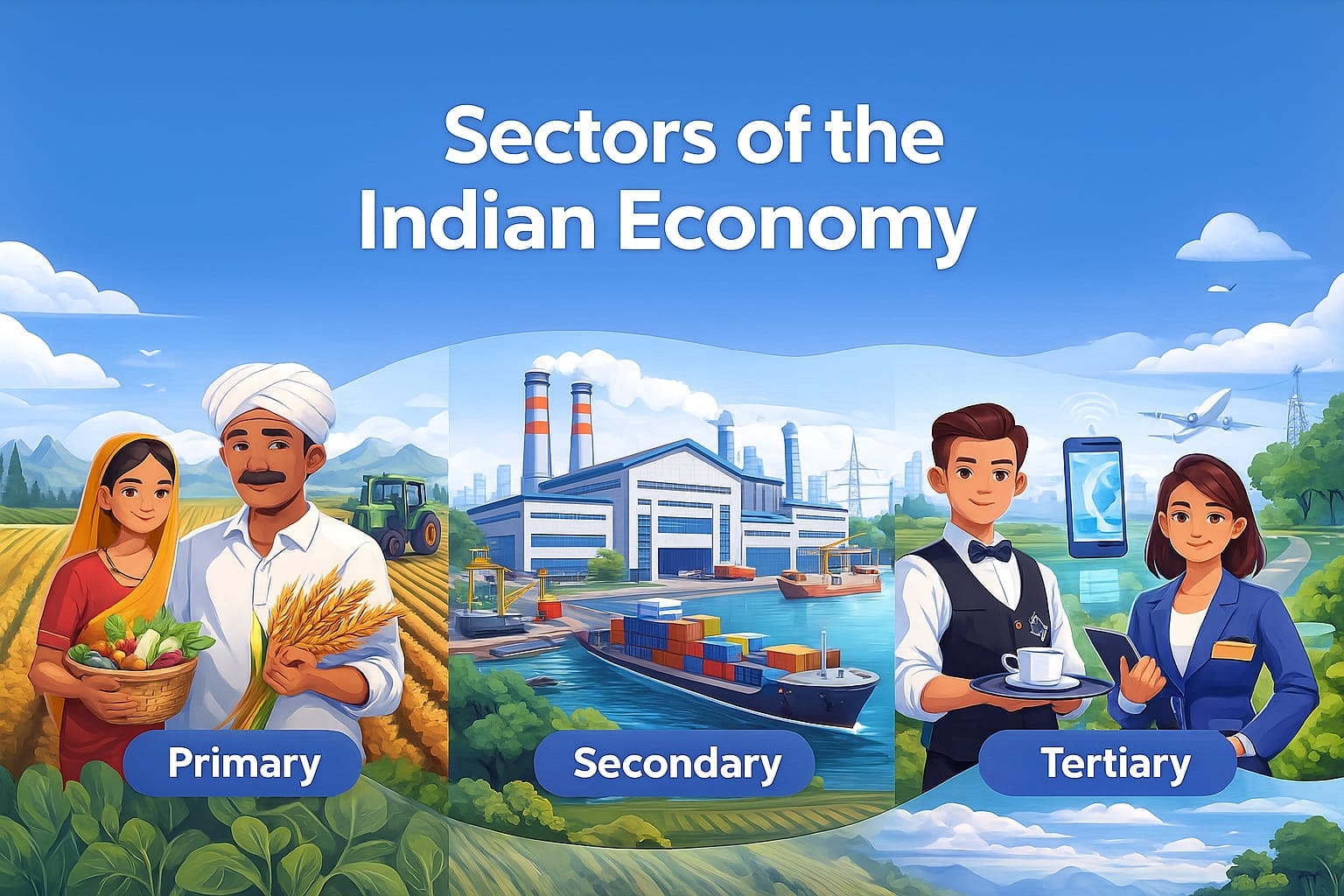
1. What Are Economic Sectors?
Economic sectors are groups of economic activities that share similar characteristics, inputs or purposes.
In Sectors of the Indian Economy Class 10 Notes, sectors help us understand how different parts of the economy function and how people earn their livelihoods.
Why do we classify into sectors?
Helps understand income patterns and growth differences
Helps plan government policies and resource distribution
Shows which sectors are strong or weak in employment
Helps identify future opportunities for economic development
India’s economy is classified based on:
Nature of activity → Primary, Secondary, Tertiary
Ownership → Public, Private
Employment conditions → Organised, Unorganised
Each classification provides different insights about the economy.
2. Sectors Based on Nature of Activity
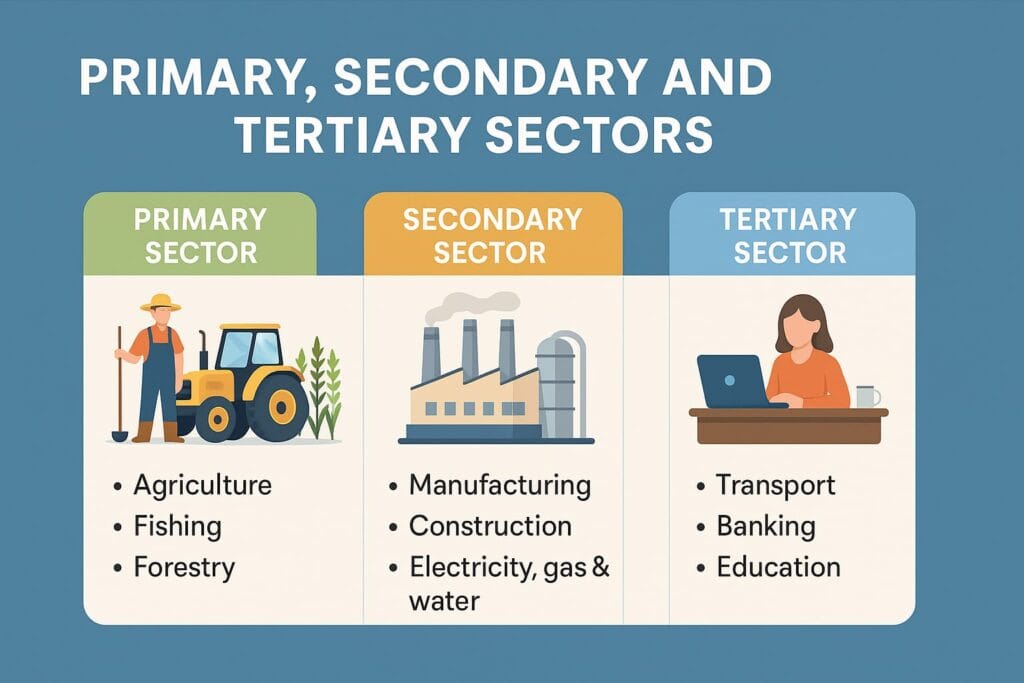
This is the most important classification in Sectors of the Indian Economy Class 10 Notes. It divides the economy into Primary, Secondary and Tertiary sectors.
A. Primary Sector (Agriculture & Natural Resources)
The primary sector includes activities that use natural resources directly to produce raw materials.
Activities Included
Agriculture
Dairy farming
Fishing and aquaculture
Forestry and logging
Mining of minerals and coal
Quarrying of stones
Key Characteristics
Depend heavily on natural conditions like rainfall and soil fertility
Most activities are labour-intensive and use traditional tools
Employ the largest percentage of Indian workers
Produce raw materials essential for secondary sector industries
Income is low because nature-controlled outcomes reduce stability
The primary sector forms the foundation of the economy because it supplies essential raw materials.
B. Secondary Sector (Manufacturing & Construction)
The secondary sector converts raw materials into finished or semi-finished goods through manufacturing and industrial processes.
Activities Included
Textile mills
Food processing units
Iron and steel industries
Cement production
Chemical manufacturing
Construction of buildings, roads and bridges
Key Characteristics
Adds value to raw materials, increasing their economic worth
Relies on machinery, electricity, technology and skilled labour
Generates large-scale employment opportunities
Depends directly on materials produced by the primary sector
Expands as industrialisation and modernisation increase
The secondary sector represents industrial growth and drives economic progress.
C. Tertiary Sector (Services Sector)
The tertiary sector provides services that support production, consumption and the smooth functioning of the economy.
Activities Included
Banking, insurance and finance
Transportation of goods and people
Retail and wholesale trade
Healthcare and education
IT and digital services
Communication and media
Key Characteristics
Supports both primary and secondary sectors through essential services
Has become the fastest-growing sector in India
Provides high-skilled employment, especially in IT, finance and communication
Contributes the largest share to India’s GDP today
Expands with modernisation, globalisation and technological growth
Examples:
A farmer needs transport to sell crops → Tertiary sector.
A factory needs banking, insurance and communication → Tertiary sector.
🟩 TABLE 1: Primary vs Secondary vs Tertiary Sectors
| Sector | What It Includes | Depends On | Contribution |
|---|---|---|---|
| Primary | Natural resources | Nature & climate | High employment, lower income |
| Secondary | Manufacturing | Raw materials | Industrial growth |
| Tertiary | Services | All sectors | Highest GDP contribution |
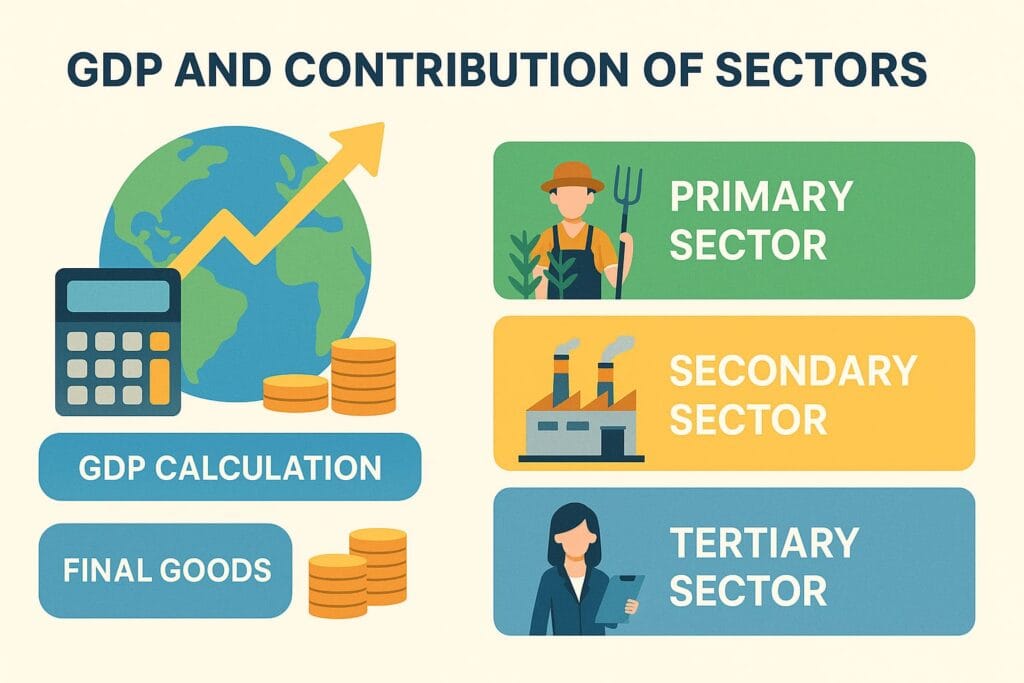
3. Comparing Sectors: Output and Employment
This section of Sectors of the Indian Economy Class 10 Notes highlights important economic observations:
1. Tertiary Sector → Highest GDP Contribution
Due to rapid expansion of IT, banking, communication, transportation and tourism.
2. Primary Sector → Largest Employer
Even though its GDP share is low, it employs the most people due to traditional farming methods.
3. Low Productivity in Primary Sector → Disguised Unemployment
Many people work in agriculture even when fewer workers could produce the same output.
4. Secondary Sector Growing, but Slower Than Tertiary
Industries are expanding, but services are growing faster due to digitalisation and globalisation.
This mismatch between GDP share and employment share shows imbalanced development.
4. Problems in Primary Sector Employment
The primary sector suffers major challenges in India.
A. Disguised Unemployment
This occurs when more people are working than actually needed to produce output.
Example:
If 5 people work on a field but only 3 are needed, the extra 2 are disguisedly unemployed.
Characteristics:
Common in agriculture-based families
Output remains same even if extra people stop working
Indicates hidden unemployment
Workers appear employed but contribute very little
B. Seasonal Unemployment
Agricultural work is available only during sowing, weeding and harvest seasons.
Consequences:
Workers remain jobless for months
Rural poverty increases
Migration to cities in search of work
Solutions:
Rural industries like dairy, weaving and food processing
Irrigation to support multiple crops
Development of roads, storage and rural employment schemes
5. Sectors Based on Organisation
Another major classification in Sectors of the Indian Economy Class 10 Notes divides jobs into Organised and Unorganised sectors.
A. Organised Sector
A well-regulated sector that follows government laws and labour rules.
Features
Fixed working hours with regulated work schedule
Job security and stable employment contracts
Regular monthly salary with allowances
Paid leave, holidays and medical benefits
Provident fund, pensions and insurance
Safe working environment and legal protection
Examples
Government schools, private schools, banks, large companies, hospitals, factories.
Workers in the organised sector enjoy legal protection and stable conditions.
B. Unorganised Sector
Consists of small, scattered units with unpredictable and irregular working conditions.
Features
No fixed working hours; workers may work long hours
Extremely low wages without negotiation powers
No job security or employment guarantee
No paid leave, holidays or retirement benefits
Unsafe working environment; no social security
Examples
Street vendors
Domestic helpers
Small farmers
Rickshaw pullers
Small roadside shops
Daily-wage construction workers
Most workers in India belong to this sector and require government protection.
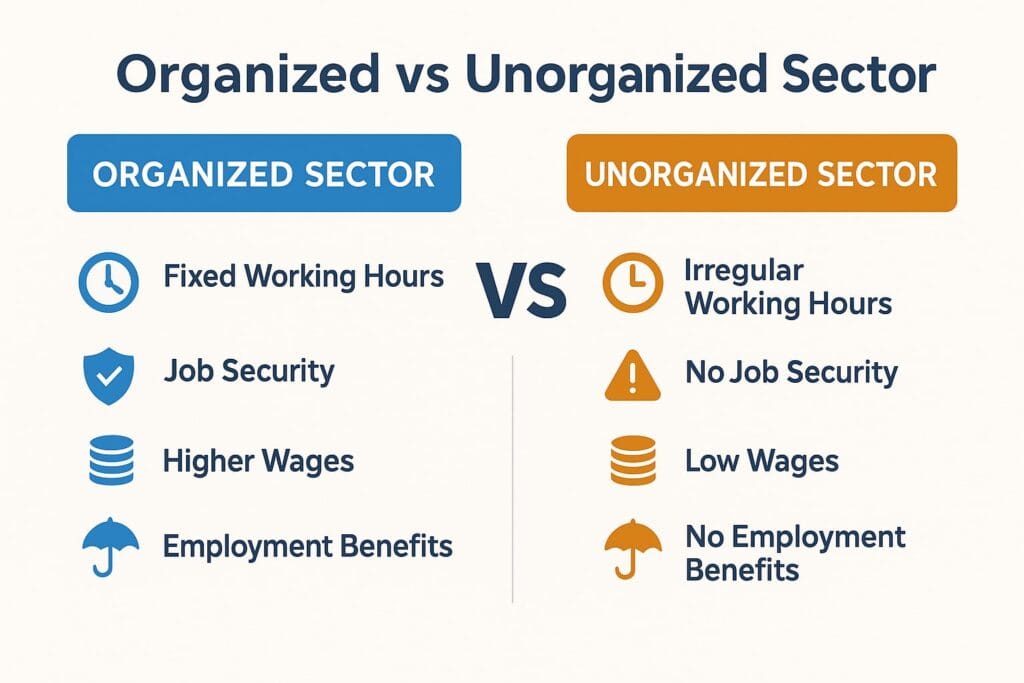
🟩 TABLE 2: Organised vs Unorganised Sector
| Feature | Organised | Unorganised |
|---|---|---|
| Hours | Fixed & regulated | Long & irregular |
| Salary | Regular monthly salary | Daily / weekly wages |
| Security | High | None |
| Benefits | PF, pension, insurance | No benefits |
| Rules | Government regulated | No formal rules |
6. Sectors Based on Ownership
Ownership determines who controls economic activity: Government or Private individuals.
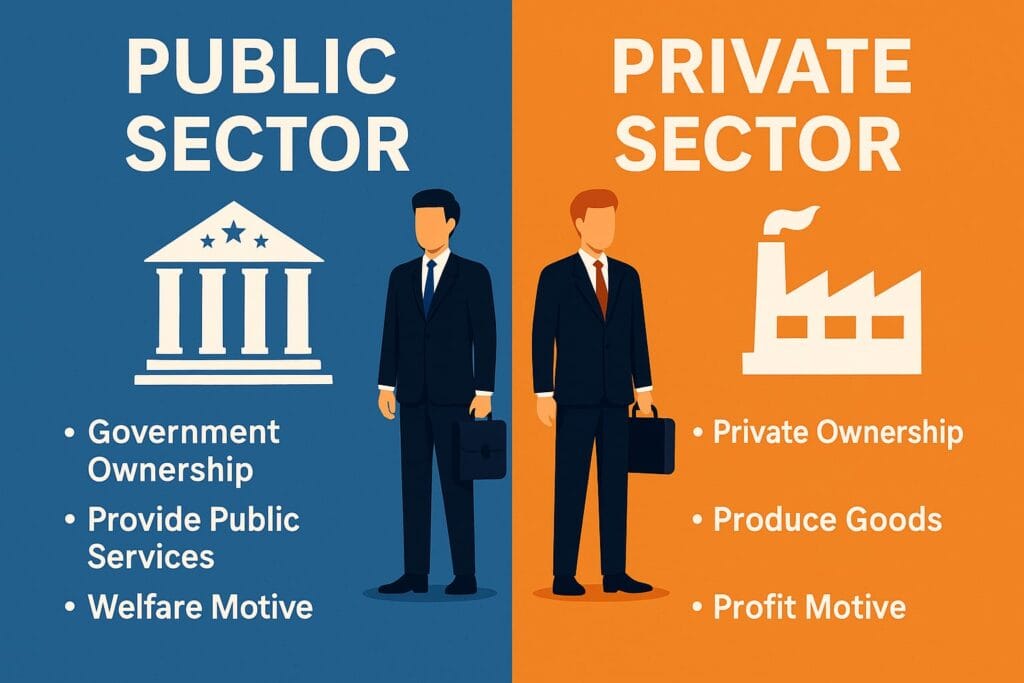
A. Public Sector
Owned and operated by the government for welfare, fairness and development.
Role of Public Sector
Provides essential services like railways, banking and water supply
Ensures welfare for poor people
Reduces inequality through subsidies and support programs
Controls heavy industries requiring huge investment
Examples
Indian Railways, LIC, ONGC, Post Office, BSNL.
Public sector focuses on service delivery rather than profit.
B. Private Sector
Owned by individuals or private companies aiming to earn profit.
Examples
Reliance, TCS, Infosys, Tata Motors, private banks.
Role
Encourages competition and innovation
Creates jobs and supports industrial growth
Contributes to national income
Private sector focuses on efficiency and innovation.
🟩 TABLE 3: Public vs Private Sector
| Feature | Public Sector | Private Sector |
|---|---|---|
| Ownership | Government-owned | Individually or company-owned |
| Objective | Welfare | Profit |
| Examples | Railways, LIC | TCS, Reliance |
| Focus | Equality and service | Innovation and efficiency |
7. Role of the Government in the Economy
The government plays a crucial part in balancing economic growth and social welfare.
Why Government is Important
Provides essential public goods like education, healthcare, electricity and roads
Protects poor workers from exploitation through labour laws
Ensures fair distribution of income through welfare schemes
Regulates economy to prevent monopolies
Undertakes large development projects like dams, bridges, highways
Government intervention ensures balanced and fair development for all.
8. Rising Importance of the Tertiary Sector
The tertiary sector has grown rapidly in recent decades.
Reasons
Growth of basic services like education, health, banking and communication.
Growth of IT and digital services making India a global technology hub.
Growth of primary and secondary sectors, which need transport, banking, marketing, warehousing and communication support.
Globalisation, increasing demand for tourism, trade, export services and BPO industry.
Today, the tertiary sector contributes the largest share of India’s GDP.
9. Employment Generation in All Sectors
To reduce unemployment, India must generate jobs across all sectors.
Primary Sector
Modern farming methods
Better irrigation and water conservation
Dairy, fisheries and poultry growth
Agro-based industries in villages
Secondary Sector
Development of small and medium industries
Government credit support for entrepreneurs
More industrial zones and manufacturing hubs
Skill development programs
Tertiary Sector
Expansion of education and healthcare services
Tourism development and digital services
Banking, finance and retail sector expansion
Balanced growth ensures that opportunities reach both rural and urban areas.
10. How to Protect Workers in the Unorganised Sector
Workers in the unorganised sector face exploitation and need strong government support.
Measures
Fix minimum wages to prevent underpayment
Provide legal rights and ensure job security
Social security schemes like PF, insurance and pensions
Regulate working hours to avoid overwork
Provide credit facilities to reduce dependence on moneylenders
Skill training and development programs
Implementation of schemes like MGNREGA for 100 days of guaranteed rural employment
11. Important Terms
Primary sector: Activities using natural resources
Secondary sector: Manufacturing and industrial activities
Tertiary sector: Service-based activities
Organised sector: Jobs with formal rules and protection
Unorganised sector: Informal jobs without security
Public sector: Government-owned services
Private sector: Companies owned by individuals
Disguised unemployment: Extra workers without decrease in output
Seasonal unemployment: Jobs available only during certain seasons
12. Summary
Indian economy is divided into primary, secondary and tertiary sectors.
Tertiary sector contributes most to GDP, primary employs most workers.
Organised sector provides secure jobs; unorganised sector lacks safety and wages.
Public sector works for welfare, private sector focuses on profit.
Growth in all sectors ensures balanced development.
Sectors of the Indian Economy Class 10 Notes
FAQs
1: Why are sectors classified in the economy?
Sectors are classified to help understand how different economic activities function, how people earn their livelihoods and how the economy grows. In Sectors of the Indian Economy Class 10 Notes, classification makes it easier for governments to plan policies, distribute resources, identify employment challenges and study the contribution of each sector to GDP. It also shows which sectors need support, which are expanding fast and which sectors require reforms to ensure balanced development across the country.
2: What is disguised unemployment and why is it common in India?
Disguised unemployment occurs when more people work in a job than are actually needed. Even if some workers leave, output does not decrease. In Sectors of the Indian Economy Class 10 Notes, it is common in agriculture because families often work together on small farms with limited work. Due to lack of alternative jobs, extra workers remain engaged even if their contribution is minimal. This leads to low productivity, hidden unemployment and long-term rural poverty unless new opportunities are created.
3: What is the difference between public and private sectors?
Public sector is owned by the government and focuses on welfare, equality and essential services like railways, post offices and public healthcare. Private sector is owned by individuals or companies and focuses on profit, efficiency and innovation. In Sectors of the Indian Economy Class 10 Notes, both sectors are necessary because public sector ensures fairness and stability while private sector drives growth and job creation. Together, they form a balanced and sustainable economy.
4: Why is the tertiary sector becoming more important in India?
The tertiary sector is growing because modern economies depend heavily on services like banking, transport, IT, communication and healthcare. In Sectors of the Indian Economy Class 10 Notes, the rise of digital services, globalisation, international trade and the IT revolution has made the service sector the largest contributor to India’s GDP. As primary and secondary sectors grow, they also require more support services such as marketing, finance, logistics and insurance, further boosting the importance of the tertiary sector.
5: Why does the unorganised sector require more protection?
The unorganised sector has poor working conditions, low wages, no job security, no paid leave and unsafe environments. Workers often face exploitation because labour laws do not apply strictly. In Sectors of the Indian Economy Class 10 Notes, a large part of India’s workforce belongs to this sector, especially small farmers, vendors and daily-wage workers. They need protection through minimum wages, social security schemes, training, skill development and legal rights to ensure fair and dignified employment opportunities.
6: What is the role of the government in providing public goods?
Government provides essential public goods such as education, healthcare, water supply, sanitation, electricity and transport because private companies may not find them profitable. In Sectors of the Indian Economy Class 10 Notes, these services are important for social welfare, economic development and equality. Public goods improve quality of life, reduce poverty and ensure opportunity for all. Without government involvement, poor people may get excluded from essential services, creating inequality and hindering national development.
7: Why is there a mismatch between GDP contribution and employment in India?
In India, the tertiary sector contributes the most to GDP, but the primary sector employs most workers. According to Sectors of the Indian Economy Class 10 Notes, this mismatch occurs because agriculture uses outdated methods and low technology, requiring more labour but giving low output. Meanwhile, services use modern technology and skilled labour, producing high value with fewer workers. This imbalance shows the need for better farming practices and growth in industrial and service jobs.
MCQs
Q1. In Sectors of the Indian Economy Class 10 Notes, which sector uses natural resources directly?
A. Secondary sector
B. Tertiary sector
C. Primary sector
D. Private sector
Answer: C
Q2. According to Sectors of the Indian Economy Class 10 Notes, which activity belongs to the secondary sector?
A. Farming
B. Dairy
C. Iron and steel production
D. Fishing
Answer: C
Q3. Which sector provides essential services like banking, transport and communication?
A. Primary
B. Secondary
C. Tertiary
D. Public
Answer: C
Q4. Disguised unemployment is commonly found in which sector?
A. Tertiary
B. Secondary
C. Primary
D. Organised
Answer: C
Q5. Which of the following is NOT included in the organised sector?
A. Banks
B. Hospitals
C. Street vendors
D. Schools
Answer: C
Q6. In Sectors of the Indian Economy Class 10 Notes, which feature belongs to unorganised sector?
A. Regular salary
B. Job security
C. Paid leave
D. No fixed working hours
Answer: D
Q7. Which of the following is an example of the public sector?
A. Reliance
B. Infosys
C. Indian Railways
D. Tata Motors
Answer: C
Q8. Which of the following is a private sector company?
A. LIC
B. ONGC
C. TCS
D. BSNL
Answer: C
Q9. Seasonal unemployment is mainly found in:
A. Banking
B. Agriculture
C. IT sector
D. Manufacturing
Answer: B
Q10. Which sector contributes the highest to India’s GDP today?
A. Primary
B. Secondary
C. Tertiary
D. Public
Answer: C
Q11. Which statement is correct according to Sectors of the Indian Economy Class 10 Notes?
A. Secondary sector employs most workers
B. Tertiary sector contributes most to GDP
C. Primary sector is the most profitable
D. Unorganised sector gives job security
Answer: B
Q12. Construction is part of which sector?
A. Primary
B. Secondary
C. Public
D. Tertiary
Answer: B
Q13. The government owns and controls which sector?
A. Private
B. Unorganised
C. Public
D. Service
Answer: C
Q14. Which sector provides raw materials to industries?
A. Primary
B. Secondary
C. Public
D. Private
Answer: A
Q15. IT and software services belong to:
A. Secondary sector
B. Tertiary sector
C. Primary sector
D. Public sector
Answer: B
Q16. Unorganised sector workers often face:
A. High salaries
B. Paid leave
C. No job security
D. Retirement benefits
Answer: C
Q17. Which industry belongs to the secondary sector?
A. Mining
B. Transport
C. Cement manufacturing
D. Education
Answer: C
Q18. Public sector aims at:
A. Maximising profits
B. Welfare of society
C. Reducing services
D. Avoiding employment
Answer: B
Q19. Which of these is a service activity?
A. Fishing
B. Mining
C. Banking
D. Agriculture
Answer: C
Q20. Disguised unemployment means:
A. No one is employed
B. More people working than required
C. Only skilled workers hired
D. Workers get high salaries
Answer: B
Q21. India’s largest employer is the:
A. Tertiary sector
B. Secondary sector
C. Primary sector
D. Public sector
Answer: C
Q22. Organised sector workers get:
A. No leaves
B. Legal protection
C. Very low wages
D. No defined hours
Answer: B
Q23. Services like postal communication belong to:
A. Private sector
B. Tertiary sector
C. Primary sector
D. Unorganised sector
Answer: B
Q24. Manufacturing industries are part of:
A. Primary sector
B. Secondary sector
C. Public sector
D. Unorganised sector
Answer: B
Q25. The fastest growing sector in India is the:
A. Primary
B. Secondary
C. Tertiary
D. Public
Answer: C
Q26. Which one is NOT a feature of organised sector?
A. Regular wages
B. Pension benefits
C. PF facilities
D. No fixed working hours
Answer: D
Q27. Fishing comes under:
A. Primary sector
B. Secondary sector
C. Public sector
D. Organised sector
Answer: A
Q28. Which sector benefits most from globalisation?
A. Primary
B. Secondary
C. Tertiary
D. Unorganised
Answer: C
Q29. A private bank like HDFC belongs to:
A. Primary sector
B. Secondary sector
C. Public sector
D. Private sector
Answer: D
Q30. A major problem in primary sector is:
A. High salaries
B. Lack of raw materials
C. Disguised unemployment
D. Too much technology
Answer: C
Daily Update: Quizzes, Flashcards, Tests, Worksheets etc are shared .
5-Marker Questions
Q1. Explain the differences between primary, secondary and tertiary sectors with examples and importance
Primary sector includes activities based on natural resources such as agriculture, fishing, forestry and mining. It forms the base of the economy by providing raw materials. Secondary sector includes manufacturing and industrial activities like food processing, textiles, steel production and construction. It adds value to raw materials and promotes industrial growth. Tertiary sector provides services like banking, transport, IT, trade and communication. It supports both primary and secondary sectors and contributes the highest to India’s GDP. Together, all three sectors ensure balanced economic development and employment generation, which is highlighted clearly in Sectors of the Indian Economy Class 10 Notes.
Q2. What are the features of organised and unorganised sectors? Why does the unorganised sector need protection?
Organised sector includes jobs with fixed working hours, regular salaries, paid leave, job security and government-regulated conditions. Workers enjoy PF, pensions and safe environments. Unorganised sector includes small units with irregular work, low wages, long hours, no security and no benefits. According to Sectors of the Indian Economy Class 10 Notes, the unorganised sector needs protection because workers face exploitation, instability and poverty. Government must ensure minimum wages, social security, training, legal rights and schemes like MGNREGA to improve working conditions.
Q3. Why is the tertiary sector growing so rapidly in India? Explain with reasons.
The tertiary sector is growing due to expanding services like banking, healthcare, retail, communication and education. Digitalisation, IT growth and global outsourcing have created millions of high-skilled jobs. In Sectors of the Indian Economy Class 10 Notes, the growth of primary and secondary sectors also increases demand for services such as transport, marketing and insurance. Globalisation has expanded international trade, tourism and export services. As the economy modernises, people demand better healthcare, education and entertainment, making the tertiary sector the largest contributor to India’s GDP.
Q4. What were the impacts of the Green Revolution?
The Green Revolution increased food production using HYV seeds, fertilizers, and irrigation. It helped India achieve self-sufficiency, especially in wheat. However, it caused soil damage, regional inequality, and overuse of chemicals. Students learn both positives and negatives in agriculture class 10 notes.
Impacts:
Increased production
Use of HYV seeds
Regional imbalance
Soil degradation
Higher income gap
Q5. What challenges do Indian farmers face today?
Farmers face monsoon dependence, rising input costs, small landholdings, and market exploitation. These problems make farming risky. Understanding these challenges is important in agriculture class 10 notes, as they explain why support systems like MSP and PDS are necessary.
Challenges:
Lack of irrigation
High cost of seeds
Credit issues
Soil degradation
Market instability
Supportive Study Material Class 10 Science
- Class 10 Science Quiz
- Class 10 Science tests
- Class 10 Science Worksheets
- Class 10 Science PYQs
- Class 10 Science NCERT Solution