
Complete CBSE Error-Proof Resources and Development Class 10 Notes
(Score Higher)
Introduction
These Resources and Development Class 10 Notes explain how resources are classified, why planning is essential, how land and soil are used in India, and what measures are needed for sustainable development.
Students often struggle with definitions and classifications, so these Resources and Development Class 10 Notes are written in teacher-style bullet points for perfect understanding and high retention.
1. RESOURCES — MEANING & TYPES
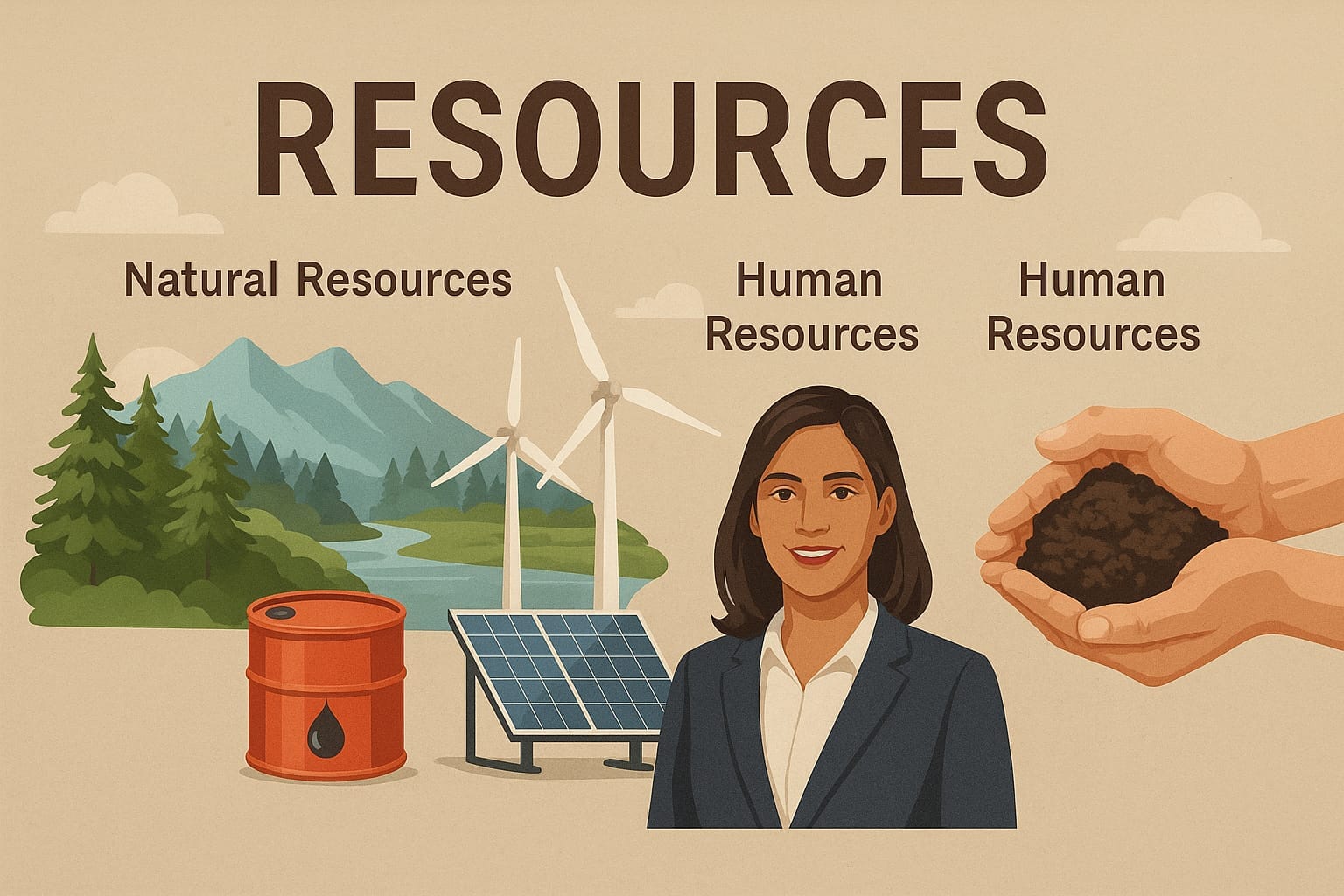
A resource is anything that can satisfy human needs and is technologically accessible. To score full marks, learn these classifications exactly as explained in these Resources and Development Class 10 Notes.
1.1 Types of Resources
A. Based on Origin
| Type | Meaning | Examples |
|---|---|---|
| Biotic | Living resources | Plants, animals, forests, humans, fisheries |
| Abiotic | Non-living resources | Rock, minerals, metals, land, water |
B. Based on Exhaustibility
| Type | Meaning | Examples |
|---|---|---|
| Renewable | Replenished naturally | Wind, water, solar, forests |
| Non-Renewable | Limited, exhaustible | Coal, petroleum, minerals |
C. Based on Ownership
| Type | Description | Examples |
|---|---|---|
| Individual | Private ownership | Plots, farms, wells |
| Community | Shared by community | Grazing land, village ponds |
| National | Managed by government | Highways, rivers, forests |
| International | Beyond national control | Oceans beyond 200 nautical miles |
D. Based on Development
| Type | Meaning | Example |
|---|---|---|
| Potential | Present but unused | Wind in Rajasthan |
| Developed | Surveyed and used | Coal mines |
| Stock | Available but unusable with current tech | Hydrogen in water |
| Reserves | Usable with existing tech, saved for future | Water in dams |
2. NEED FOR RESOURCE PLANNING
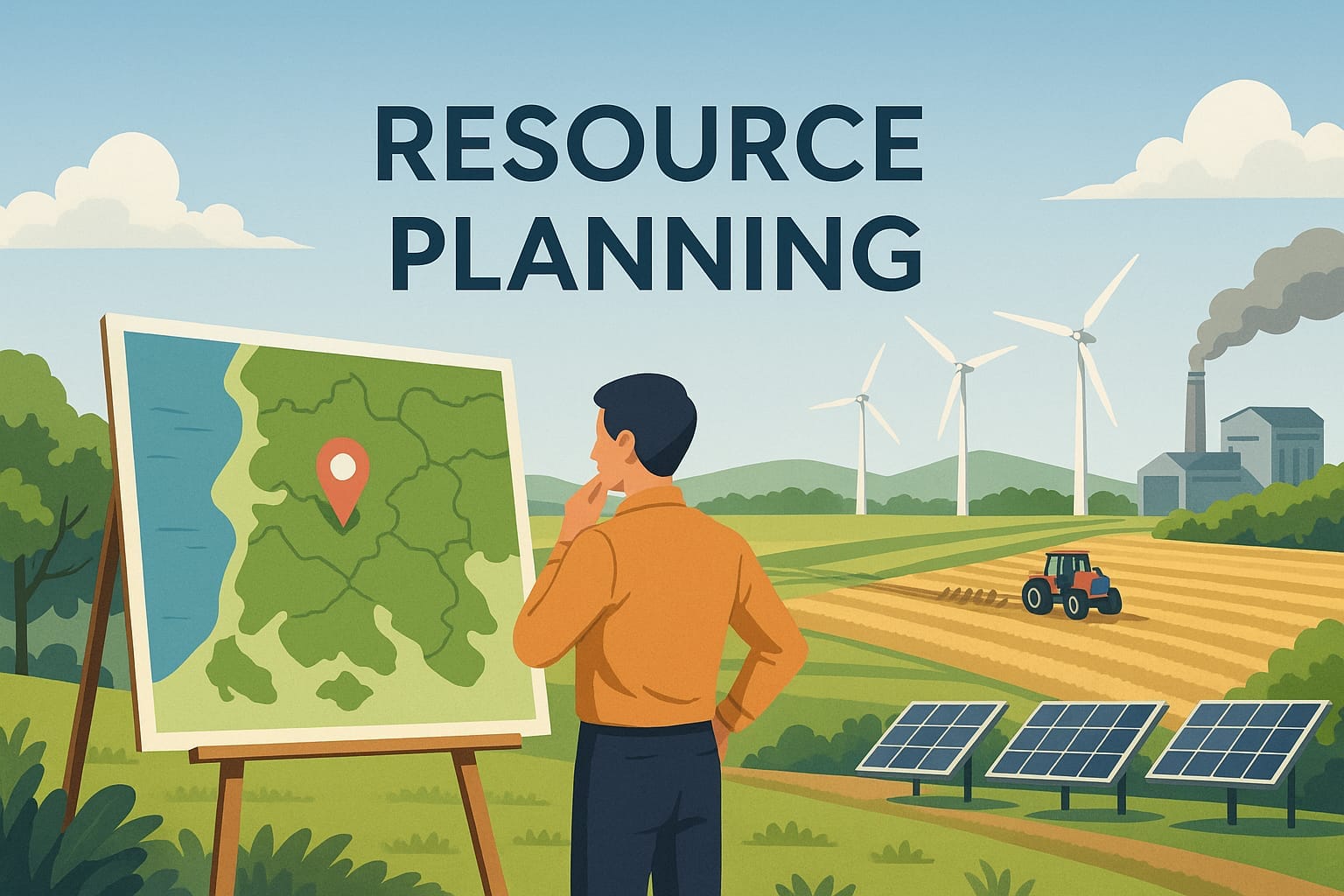
Resource planning is central to Resources and Development Class 10 Notes because India’s resources are unevenly distributed.
Why resource planning?
Avoid over-use of minerals
Reduce regional imbalance
Support sustainable development
Match population with resource availability
Example:
Jharkhand → mineral-rich
Rajasthan → resource-rich but water-poor
3. RESOURCE PLANNING IN INDIA
Stage 1 – Identification
Mapping, surveying, GIS, satellite images
Stage 2 – Planning
Plans made at national, state, district level
Balances resources with development needs
Stage 3 – Implementation
Land development programmes
Soil conservation
Water management
This cycle is a major part of Resources and Development Class 10 Notes.
4. LAND RESOURCES
India’s land is used for:
Agriculture
Forestry
Mining
Settlements
Industries
Land is finite, making its conservation a key point in Resources and Development Class 10 Notes.
4.1 Land Use Pattern in India
Influencing factors:
Topography
Climate
Soil
Human needs
Technology
Land Use Categories
Forests
Barren land
Pastures
Grazing land
Fallow land
Net sown area
Punjab & Haryana → high NSA
Northeast India → low NSA
5. LAND DEGRADATION
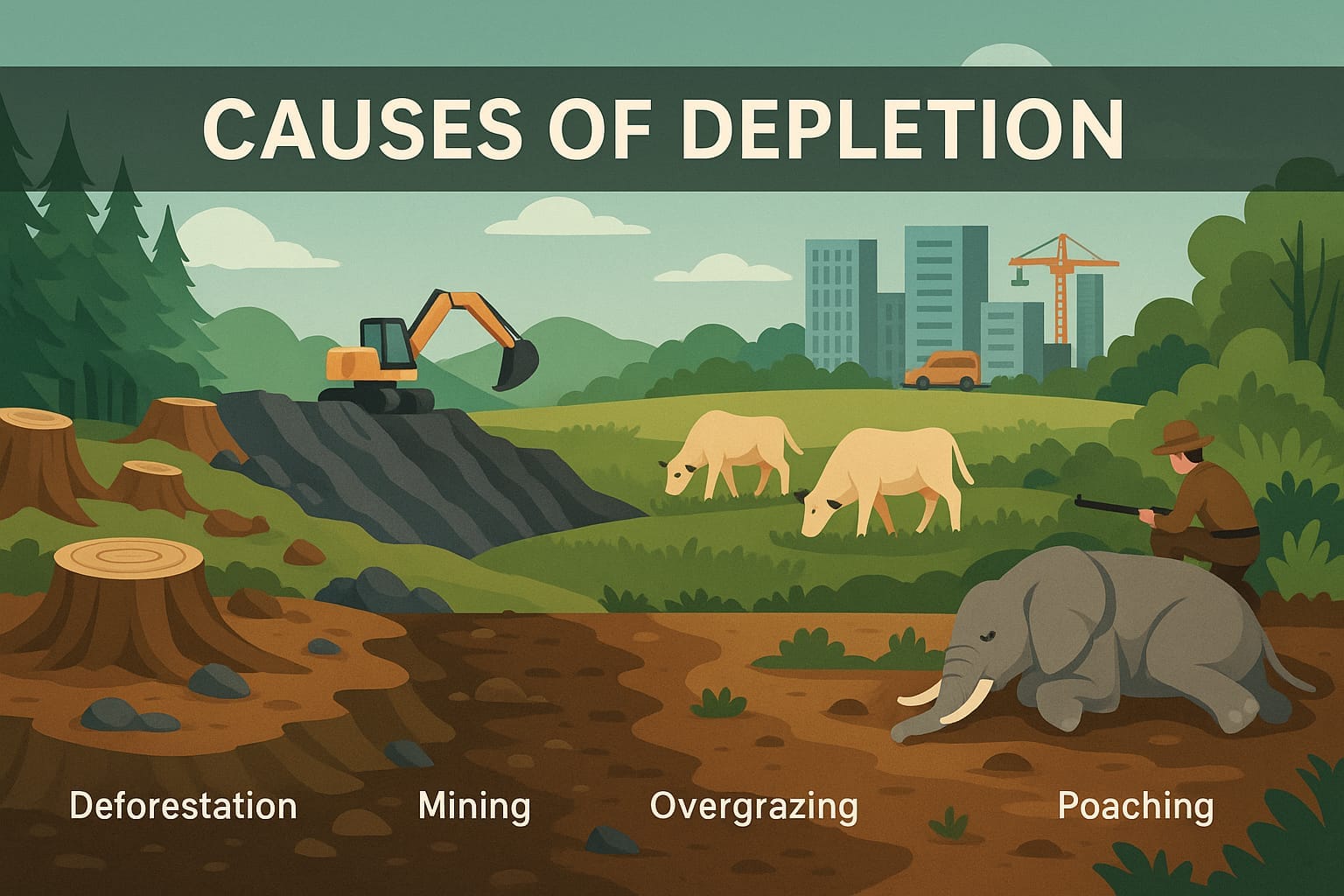
A frequently tested topic in Resources and Development Class 10 Notes.
Causes of Land Degradation
| Cause | Examples |
|---|---|
| Mining | Jharkhand, Chhattisgarh |
| Over-grazing | Gujarat, Rajasthan |
| Chemical use | Punjab, Haryana |
| Deforestation | For mining & farming |
| Industrial waste | Gujarat, Maharashtra |
5.1 Measures to Prevent Degradation
Afforestation
Controlled grazing
Reclaiming mining land
Organic farming
Waste management
Terrace farming & contour ploughing
Every exam includes a question from this part of Resources and Development Class 10 Notes.
6. SOIL AS A RESOURCE
Soil formation depends on:
Parent rock
Climate
Relief
Vegetation
Time
This explanation strengthens conceptual clarity in Resources and Development Class 10 Notes.
7. MAJOR SOIL TYPES IN INDIA
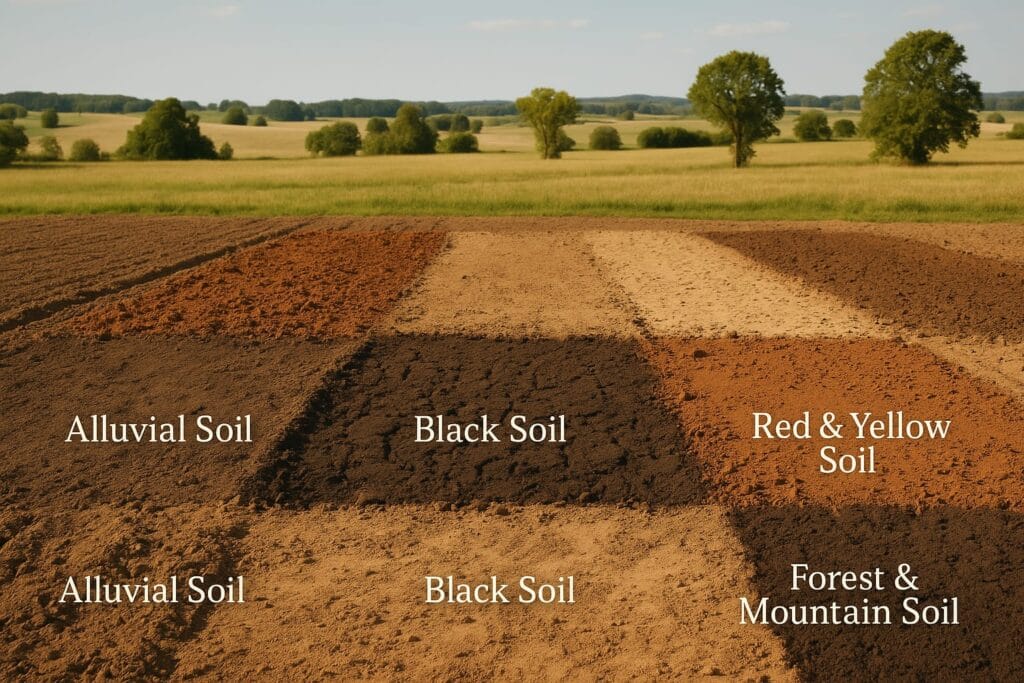
India has a wide variety of soils because of differences in climate, relief, vegetation, and geological history. These Resources and Development Class 10 Notes follow the exact NCERT pattern but explain it more clearly.
Below are the six major soil types mentioned in the NCERT:
1. Alluvial Soil
Found mainly in the Northern Plains, river valleys, and deltas of India.
Formed by river deposits of the Indus, Ganga, and Brahmaputra systems.
Very fertile soil → supports India’s major food crops.
Rich in: potash, lime, phosphoric acid
Poor in: nitrogen
Good for: rice, wheat, sugarcane, pulses, oilseeds
Divided into two types:
Khadar → newer, finer, more fertile
Bhangar → older, contains kankar nodules
NCERT notes that alluvial soil varies from clayey to sandy depending on the region.
This is the most important soil in Resources and Development Class 10 Notes because many 3- and 5-mark questions are asked from it.
2. Black Soil
According to NCERT, black soil formed from the weathering of basalt rock (Deccan Trap).
Found in: Maharashtra, Madhya Pradesh, Gujarat, Karnataka, Andhra Pradesh
Colour: deep black due to iron compounds
Texture: clayey, sticky when wet, develops large cracks when dry
Retains moisture for a long time
Ideal for cotton → that’s why it is called cotton soil (important NCERT line)
Contains: calcium carbonate, magnesium, potash
Suitable for: cotton, sugarcane, tobacco, oilseeds, millets
NCERT highlights that cracks help in aeration, which students should note.
3. Red and Yellow Soil
Formed from crystalline igneous rocks (granite and gneiss)
Found in: Odisha, Chhattisgarh, Southern Karnataka, Tamil Nadu, Jharkhand
Red colour due to iron oxide
Yellow when hydrated
Poor in humus but responds well to fertilisers
Suitable for: millets, groundnut, pulses
This soil often needs manure because it is nutrient-poor — NCERT frequently asks this point.
4. Laterite Soil
NCERT describes laterite as a soil formed under high temperature and heavy rainfall with intense leaching.
Found in: Kerala, Karnataka, Tamil Nadu, Madhya Pradesh, Assam
Low in humus, nitrogen, and minerals
Good for crops like tea, coffee, cashew, but only with fertilisers
Stony and hard when dry, soft when wet
NCERT stresses laterite = “brick-like”.
(‘Later’ means brick in Latin — an NCERT fact.)
5. Arid Soil
Found in: Rajasthan, Gujarat, Western Haryana, Punjab
Sandy texture, saline in nature
Very low humus due to harsh climate
High evaporation → salt accumulation
With irrigation (like the Indira Gandhi Canal), becomes fertile for wheat, cotton, and maize
NCERT highlights calcareous (kankar) nodules common in arid soil.
6. Forest Soil
Found in: Himalayan and forest areas
Formed by organic matter from trees
Thin, acidic, and not very fertile
Fertility varies with height:
Lower slopes → more fertile
Higher slopes → coarse, stony
Suitable for: tea, coffee, spices, apples, forest crops
NCERT notes these soils are strongly affected by climate.
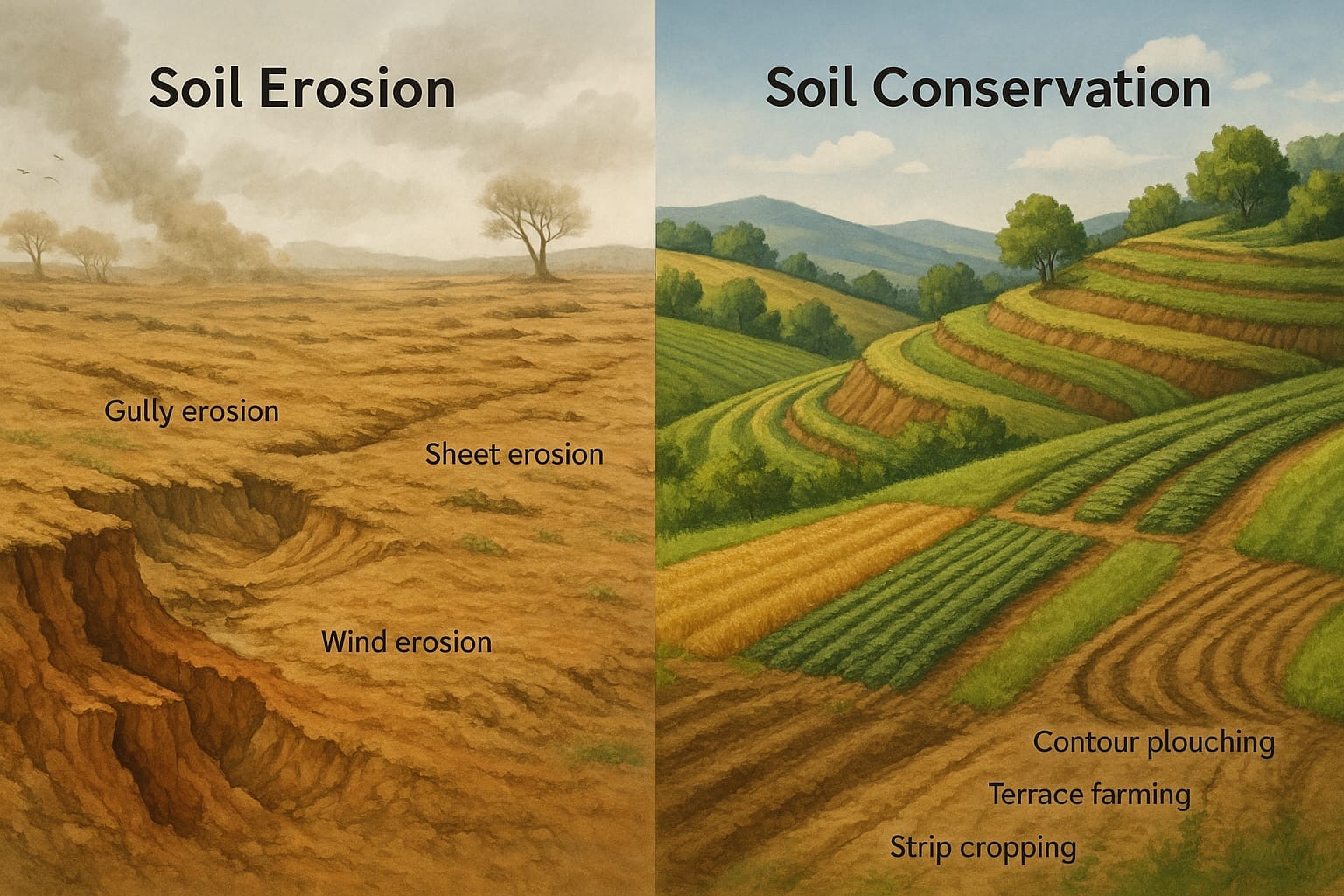
8. SOIL EROSION AND CONSERVATION
Soil erosion means removal of the upper, fertile layer of soil by wind or water.
According to NCERT, soil erosion in India is caused by both natural and human factors.
Types of Soil Erosion
1. Gully Erosion
Running water cuts deep channels into the soil
Creates badlands (ravines)
Seen in Chambal region of Madhya Pradesh
2. Sheet Erosion
Topsoil removed uniformly
Occurs on gentle slopes along surface runoff
NCERT also mentions another type:
Wind erosion → blows away loose soil in arid regions
Soil Conservation Measures
These must be in every set of Resources and Development Class 10 Notes because they carry repeated exam questions.
✔ Contour Ploughing
Ploughing along contours prevents water from flowing down slopes quickly.
✔ Terrace Farming
Steps or terraces built on hill slopes reduce erosion.
✔ Strip Cropping
Strips of crops alternated with grasses to reduce wind erosion.
✔ Shelter Belts
Rows of trees planted to reduce wind speed (used in desert regions).
✔ Crop Rotation
Growing different crops maintains soil fertility.
✔ Afforestation
Planting trees reduces soil erosion and restores soil structure.
NCERT states conservation is essential for sustainable agriculture.
9. SUSTAINABLE DEVELOPMENT
“Development that meets the needs of the present without compromising the ability of future generations to meet their own needs.”
This idea is central to Resources and Development Class 10 Notes.
Key Principles
Reduce waste
Recycle materials
Conserve water & soil
Use renewable energy
Protect biodiversity
Balance economic growth and ecological health
NCERT links sustainable development with Gandhiji’s idea:
“Nature has enough to satisfy everyone’s need but not greed.”
Resources and Development Class 10 Notes.
FAQs
1. What are resources according to the NCERT definition?
Resources are all materials, substances, and environmental components that satisfy human needs and are technologically accessible. In Resources and Development Class 10 Notes, resources are shown as both natural and created by human knowledge. A resource only becomes valuable when humans have the technology and ability to use it effectively. Examples include minerals, land, forests, water, people, and even institutions.
2. Why is resource planning essential for India?
India’s resources are unevenly distributed—some areas have minerals but lack water, while others have forests but limited infrastructure. Resource planning helps match availability with population needs, prevents overuse, reduces regional imbalance, and ensures sustainable development. Resources and Development Class 10 Notes explain that without planning, over-exploitation and environmental degradation become unavoidable.
3. What is the difference between stock and reserves?
Stock refers to resources available in the environment but which humans cannot use due to lack of technology—like hydrogen and oxygen in water for energy. Reserves are a part of stock that humans can use with existing technology but choose to conserve for the future. This difference is important in Resources and Development Class 10 Notes as it appears in exams frequently.
4. What factors influence land use in India?
Land use depends on both physical factors—like climate, soil, relief—and human factors such as population density, technology, and economic development. For example, plains support agriculture while mountains support forestry. Resources and Development Class 10 Notes highlight that cultural practices and government policies also strongly influence land use patterns.
5. How does mining cause land degradation?
Mining removes vegetation, disrupts soil layers, leaves deep pits, and increases dust pollution. States like Jharkhand, Chhattisgarh, and Madhya Pradesh face severe degradation. Waste materials from mines destroy fertility and disturb water tables. Resources and Development Class 10 Notes often mention that abandoned mining areas take decades to recover without scientific reclamation.
6. What are the major characteristics of alluvial soil?
Alluvial soil is fertile, light in texture, rich in potash, phosphoric acid, and lime. It is found in the Northern Plains and river valleys. Resources and Development Class 10 Notes emphasize the two types: Khadar (new, fertile) and Bhangar (old). This soil supports crops like rice, wheat, sugarcane, oilseeds, and pulses, making it the backbone of Indian agriculture.
7. What causes soil erosion in India?
Soil erosion occurs due to wind, water, deforestation, overgrazing, faulty farming techniques, and heavy rainfall. Human activities like mining and construction accelerate erosion. Resources and Development Class 10 Notes classify erosion as sheet erosion, gully erosion, and wind erosion. Soil erosion reduces fertility and threatens long-term agricultural productivity.
8. How can soil be conserved effectively?
Techniques include contour ploughing, terrace farming, strip cropping, shelter belts, afforestation, crop rotation, and controlled grazing. Conservation slows erosion and retains nutrients. Resources and Development Class 10 Notes stress that combining traditional methods with modern scientific practices is essential for protecting soil for future generations.
9. Why is sustainable development important?ement face limitations?
Sustainable development ensures that current needs are met without harming future generations’ ability to meet theirs. Overuse of land, soil, minerals, and water threatens environmental balance. Resources and Development Class 10 Notes highlight the need for recycling, conservation, renewable energy, and responsible consumption to protect the planet.
10. How are resources classified based on ownership?
Resources are classified as individual, community, national, and international. Individual resources are privately owned; community resources belong to all; national resources are controlled by the government; international resources are regulated by global institutions. This classification often appears in board exams and is important in Resources and Development Class 10 Notes.
MCQs
1. Which of the following is a non-renewable resource?
A. Solar energy
B. Water
C. Coal
D. Wind
Answer: C
2. Alluvial soil is found mainly in the:
A. Deccan Plateau
B. Northern Plains
C. Western Ghats
D. Thar Desert
Answer: B
3. Khadar soil is:
A. Older alluvium
B. Less fertile
C. Newer alluvium
D. Sandy in nature
Answer: C
4. Mining causes maximum land degradation in:
A. Rajasthan
B. Kerala
C. Jharkhand
D. Punjab
Answer: C
5. The most extensive soil of India is:
A. Red soil
B. Black soil
C. Alluvial soil
D. Laterite soil
Answer: C
6. Which is NOT a soil conservation method?
A. Terrace farming
B. Crop rotation
C. Overgrazing
D. Shelter belts
Answer: C
7. Arid soil is mainly found in:
A. Odisha
B. Rajasthan
C. Tamil Nadu
D. Assam
Answer: B
8. Stock resources are those:
A. Not discovered
B. Not technically usable
C. Already used up
D. Intensively used
Answer: B
9. Which soil is ideal for cotton?
A. Black soil
B. Alluvial soil
C. Laterite soil
D. Arid soil
Answer: A
10. Which factor DOES NOT influence land use?
A. Climate
B. Relief
C. Literacy rate
D. Soil type
Answer: C
5-Marker Questions
1. Explain the different types of resources based on origin, exhaustibility, ownership, and development. Give examples.
2. Describe the three stages of resource planning in India. Why is resource planning important for a country like India?
3. What are the major causes of land degradation in India? Explain any four measures to control land degradation.
4. Explain the characteristics and distribution of alluvial, black, and red soils in India.
5. What is sustainable development? Explain the steps needed to achieve sustainable development in India.
Supportive Study Material Class 10 Science
- Class 10 Science Quiz
- Class 10 Science tests
- Class 10 Science Worksheets
- Class 10 Science PYQs
- Class 10 Science NCERT Solution