Minerals And Energy Resources Class 10 Notes
Ultimate High-Scoring Guide
(No Confusion, Complete 2025 Revision)
Introduction
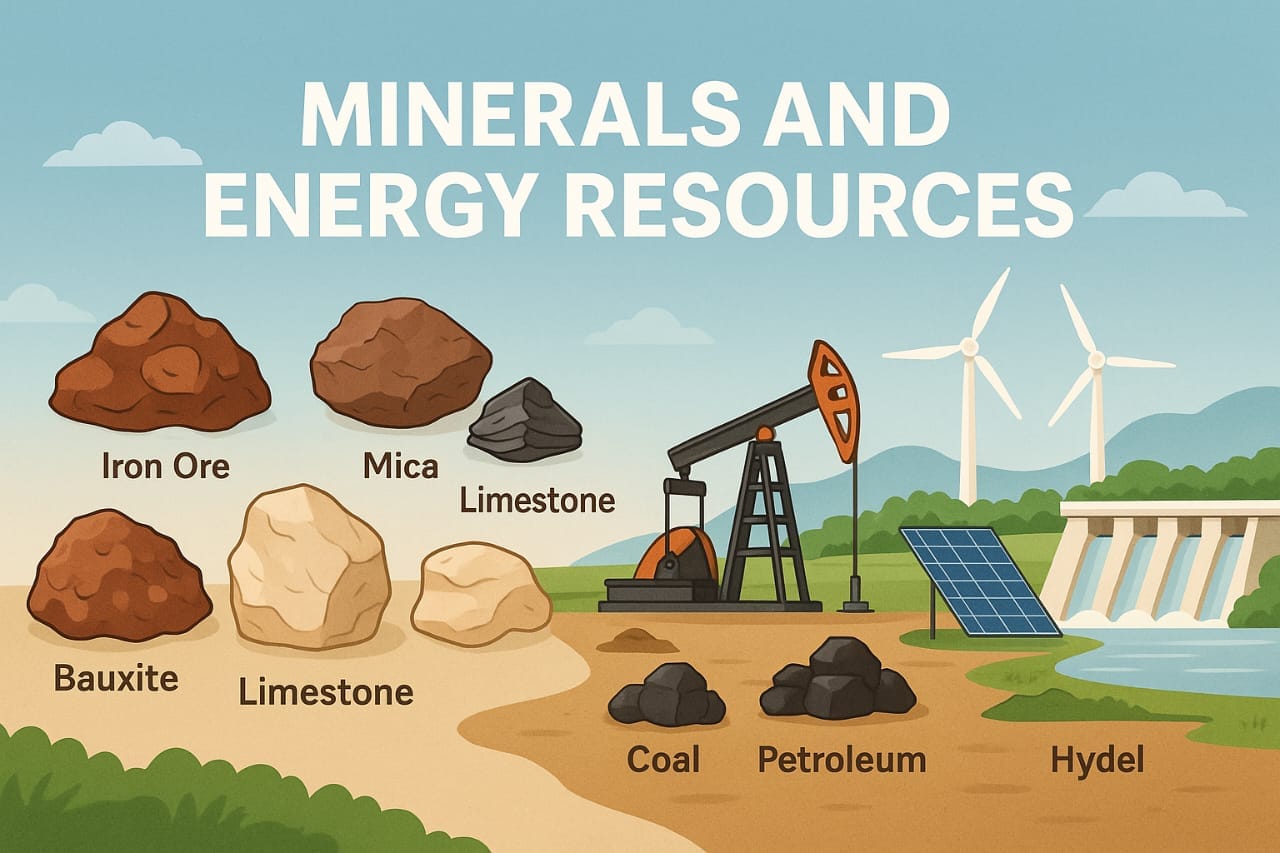
The chapter Minerals And Energy Resources Class 10 Notes helps students understand the importance of minerals and how they power our industries and everyday life. Minerals and energy together form the foundation of economic growth, industrial development, and modern lifestyle. Since minerals take millions of years to form, they must be used wisely.
1. Minerals: Meaning And Importance
Minerals are naturally occurring inorganic substances that have a definite chemical composition and physical structure. They are created through geological processes such as heat, pressure, and sedimentation. Since minerals take millions of years to form, they are non-renewable and must be conserved.
🔹 Why minerals are important?
Minerals are the backbone of industries and essential for development.
They are used in industries like steel, automobiles, cement, electronics, and construction.
Everyday items like salt, toothpaste, wires, fuels, tiles, and batteries rely on minerals.
Minerals support power generation, especially coal and uranium.
They contribute to economic development, employment, and manufacturing.
Although India is rich in mineral resources, the distribution is highly uneven, which means some states have abundant resources while others have very little.
2. Mode Of Occurrence Of Minerals
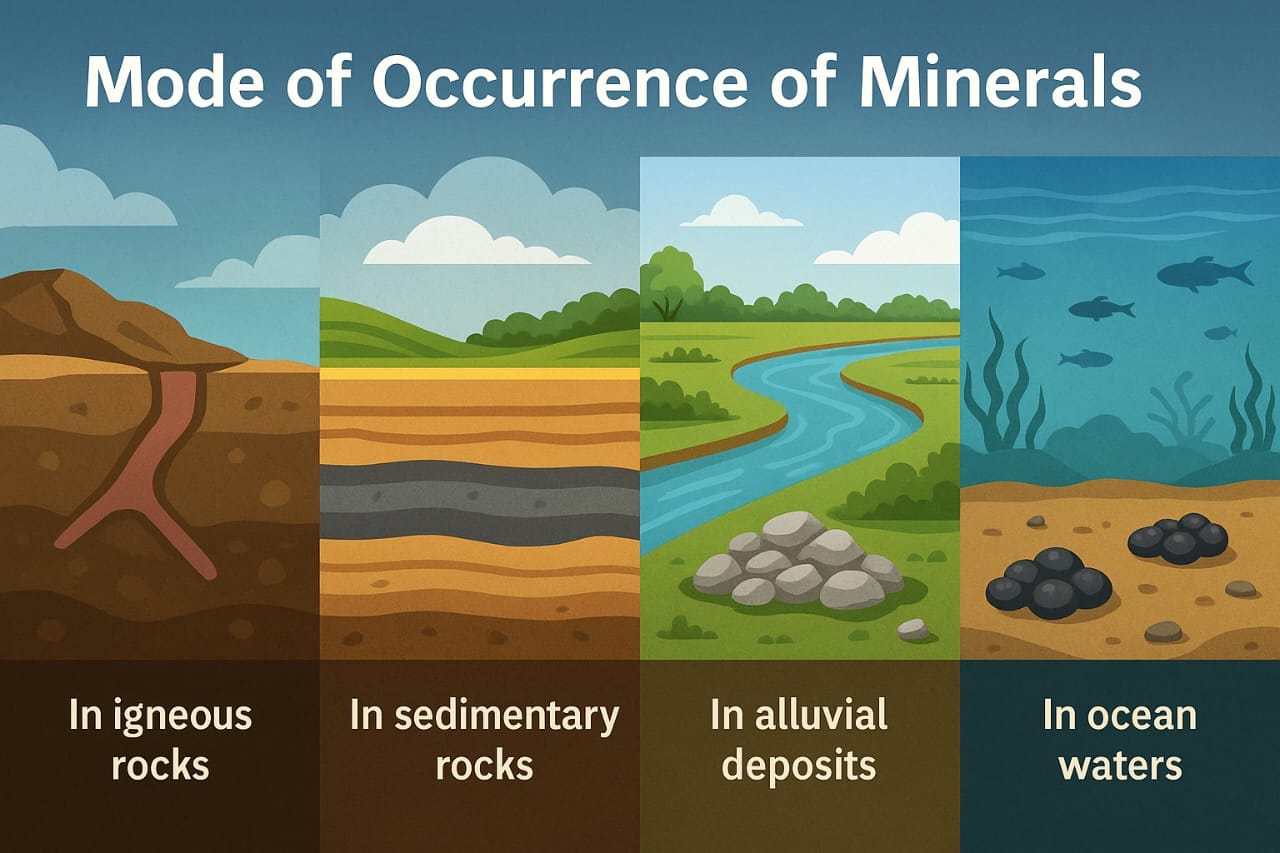
Minerals occur in different forms depending on the geological processes that formed them. Understanding the occurrence is an essential part of Minerals And Energy Resources Class 10 Notes because it explains why minerals are unevenly distributed.
2.1 Minerals in Igneous and Metamorphic Rocks
In these rocks, minerals occur in the form of:
Veins: Minerals deposited in small cracks.
Lodes: Minerals deposited in large cracks or fissures.
These formations occur when hot molten magma cools and minerals crystallize.
Examples: Tin, Copper, Zinc, Lead.
These rocks often contain high-value metallic minerals, making them important for industrial purposes.
2.2 Minerals in Sedimentary Rocks
Sedimentary rocks form due to deposition, layering, evaporation, and compression of materials over long periods.
These processes produce minerals like:
Limestone
Gypsum
Salt
Potash
Iron ore (certain regions)
Salt is formed when salty water from seas or lakes evaporates, leaving salt deposits behind.
2.3 Placer Deposits
Placer deposits are formed when heavy minerals settle at the bottom of river beds due to their higher density.
Examples: Gold, Tin, Platinum.
These minerals are extracted by washing river sands.
2.4 Ocean Deposits
Oceans contain a vast quantity of minerals, especially:
Common salt
Magnesium
Bromine
Polymetallic nodules (found on deep ocean floors)
Marine minerals are extremely important but extracting them is expensive.
3. Types of Minerals
Minerals are broadly classified into Metallic and Non-Metallic categories. This classification is often asked in exams and repeated in Minerals And Energy Resources Class 10 Notes.
TABLE 1 – DIFFERENCE BETWEEN METALLIC & NON-METALLIC MINERALS
| Feature | Metallic Minerals | Non-Metallic Minerals |
|---|---|---|
| Composition | Contain metals | Do not contain metals |
| Appearance | Shiny, lustrous | Dull appearance |
| Conductivity | Conduct heat/electricity | Poor conductors |
| Examples | Iron, Copper, Bauxite | Mica, Limestone, Salt |
| Uses | Machines, transport, buildings | Cement, fertilizers, insulation |
3.1 Metallic Minerals
These contain metal and are used widely in industrial applications.
A. Ferrous Minerals (Contain Iron)
Ferrous minerals are the backbone of the industrial sector.
Iron Ore
Iron ore is essential for steel production. India has rich iron ore reserves.
Types of Iron Ore:
- Magnetite: Finest quality, highest iron content.
- Hematite: Most widely used in industries.
Major Regions:
- Odisha–Jharkhand belt (Mayurbhanj, Keonjhar, Singhbhum)
- Chhattisgarh–MP belt (Bailadila mines)
- Karnataka (Bellary, Chitradurga)
- Maharashtra–Goa belt
Manganese
Used in steel hardening, bleaching powder, batteries.
Producing states include: Madhya Pradesh, Maharashtra, Odisha, Karnataka.
B. Non-Ferrous Minerals (Do Not Contain Iron)
Copper
A good conductor used in electrical industries.
Found in: Rajasthan (Khetri), Jharkhand (Singhbhum), Madhya Pradesh (Balaghat).
Bauxite
The raw material for aluminium, used in aircraft, utensils, cables.
Found in: Odisha (largest), Gujarat, Jharkhand, Maharashtra.
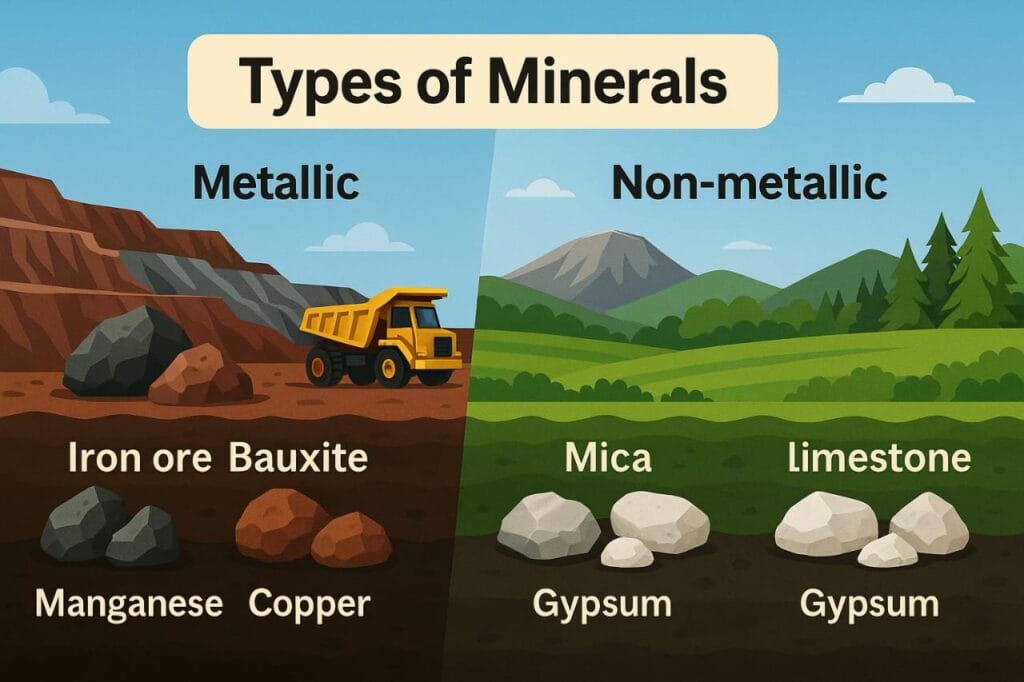
TABLE 2 – MAJOR METALLIC MINERALS & THEIR STATES
| Mineral | Main States | Uses |
|---|---|---|
| Iron Ore | Odisha, Karnataka, Chhattisgarh | Steel industry |
| Manganese | MP, Maharashtra, Odisha | Batteries, steel |
| Copper | Rajasthan, Jharkhand, MP | Electrical wiring |
| Bauxite | Odisha, Maharashtra | Aluminium production |
4. Rock Minerals
These are non-metallic minerals found in rock formations.
Mica
Excellent electrical insulator.
Found in Jharkhand, Bihar, Rajasthan.
Limestone
Used in cement industry.
Found in Rajasthan, MP, Andhra Pradesh.
Gypsum
Used in cement and fertilizer industries.
Found in Rajasthan, Jammu & Kashmir.
5. Non-Metallic Minerals
These include minerals used for domestic, industrial, and chemical purposes.
Salt
Sea salt: Produced by evaporating seawater.
Rock salt: Found in underground deposits.
Gujarat = Largest producer.
Coal
Coal is the most important fossil fuel, used for electricity and industries.
Types of Coal (highest to lowest quality):
Anthracite
Bituminous
Lignite
Peat
6. Mineral Conservation
Since minerals are non-renewable, conservation is essential.
Methods of Conservation
Reduce wastage during mining
Recycle metals
Use substitutes
Improve mining technology
Restore mined areas (plantation, soil refilling)
This is important for sustainable development and repeatedly appears in Minerals And Energy Resources Class 10 Notes.
7. Energy Resources
Energy is essential for heating, cooking, transport, industries, and daily life.
Energy resources are divided into:
Conventional resources
Non-conventional resources
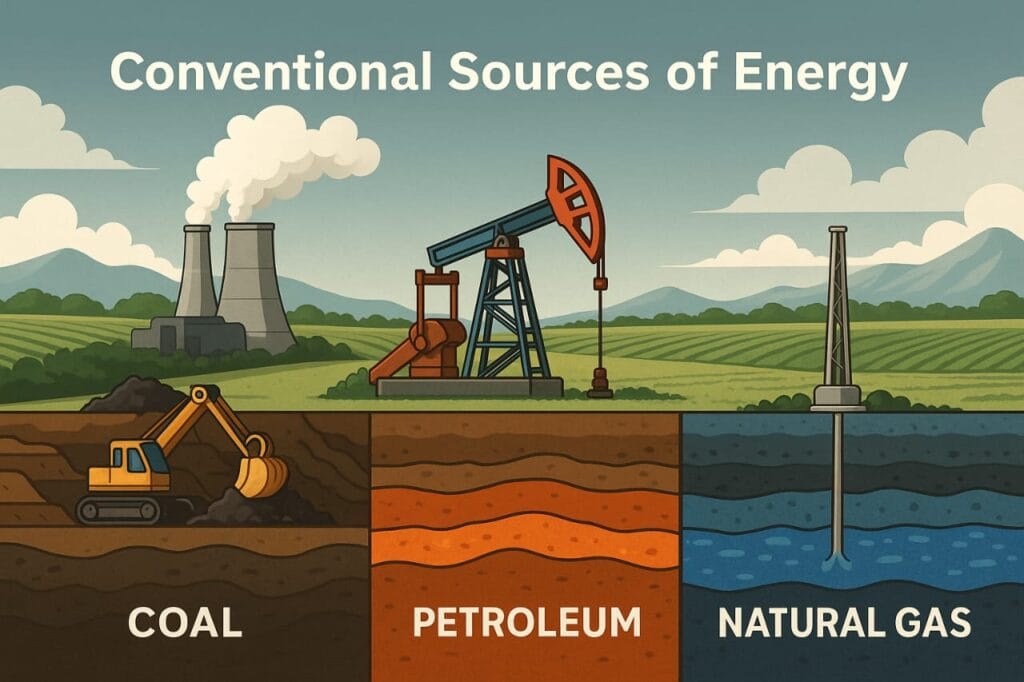
8. Conventional Energy Resources
These are commonly used and include fossil fuels.
8.1 Coal
Coal is the main energy source for industries and thermal power plants.
Types:
Anthracite (best quality)
Bituminous (most used)
Lignite (low quality)
Peat (lowest quality)
Major Coal Regions:
Jharkhand, Chhattisgarh, Odisha, West Bengal, Madhya Pradesh.
8.2 Petroleum
Petroleum is widely used in transport and industries. It is known as “black gold.”
Major Oil Fields:
Bombay High (largest)
Gujarat (Ankleshwar)
Assam (Digboi, Naharkatia)
India imports a large portion of its needs.
8.3 Natural Gas
A clean fuel used in cooking and industries.
Regions: Mumbai High, Krishna-Godavari Basin, Assam, Rajasthan.
8.4 Electricity
Thermal Power
Generated by burning coal or oil. Polluting but widely used.
Hydel Power
Generated from water falling from dams. Clean and renewable.
Major hydel stations: Bhakra Nangal, Hirakud, Nagarjuna Sagar.
TABLE 3 – COAL VS PETROLEUM VS NATURAL GAS
| Feature | Coal | Petroleum | Natural Gas |
|---|---|---|---|
| Type | Solid fossil fuel | Liquid fossil fuel | Gaseous fossil fuel |
| Main Use | Electricity, steel | Transport, chemicals | Cooking, industry |
| Cleanliness | Most polluting | Less polluting | Cleanest |
| Major Region | Jharkhand | Bombay High | KG Basin |
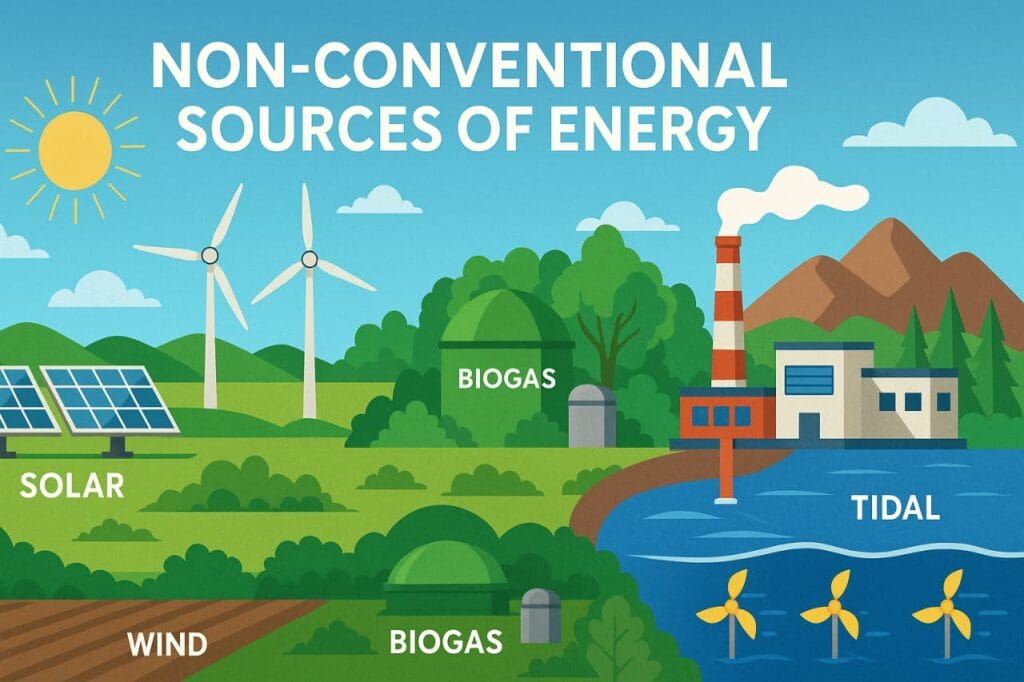
9. Non-Conventional Energy Resources
These are renewable, eco-friendly, and crucial for long-term sustainability.
Solar Energy
High potential in Rajasthan, Gujarat, Maharashtra.
Wind Energy
Wind farms in Tamil Nadu, Gujarat, Maharashtra, Karnataka.
Biogas
Produced from organic waste; ideal for rural India.
Tidal/Wave Energy
Generated from ocean tides; still experimental.
Geothermal Energy
Produced from Earth’s heat; Puga Valley (Ladakh) is a major site.
10. Energy Conservation
As resources are limited, saving energy is vital.
Methods:
Use energy-efficient appliances
Reduce wastage
Shift to renewables
Promote public transport
Efficient electricity use
This ensures sustainability for future generations.
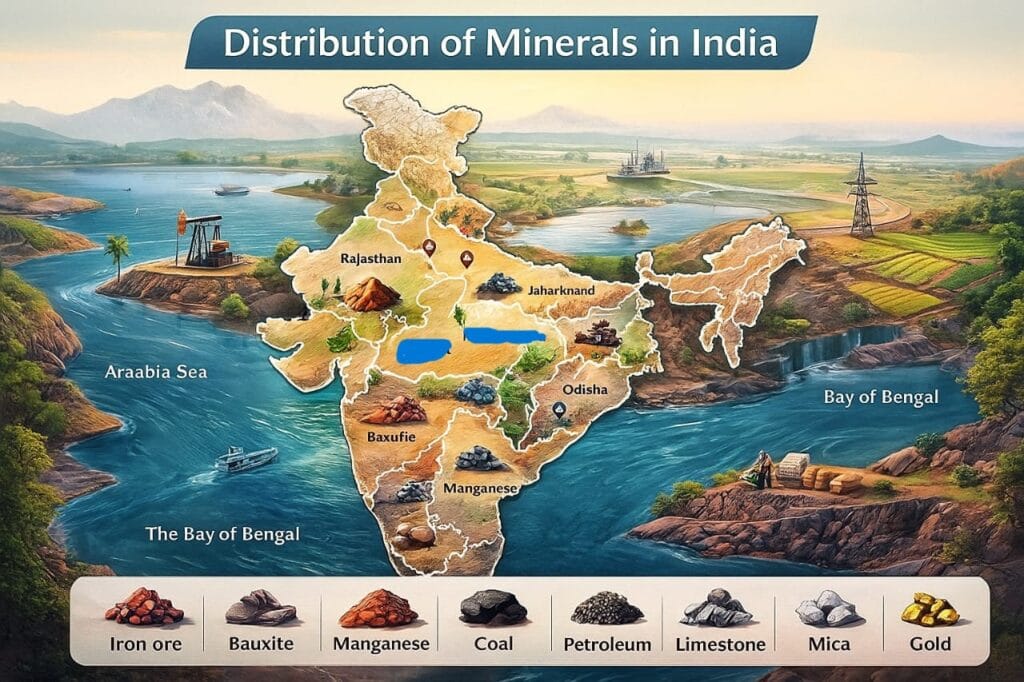
11. Distribution of Minerals in India (State-Wise)
Odisha-Jharkhand Belt
Iron ore, manganese, bauxite, mica.
Chhattisgarh-MP Belt
Coal, iron ore, bauxite.
Karnataka
Iron ore and manganese.
Rajasthan
Copper, limestone, gypsum.
Maharashtra-Goa Belt
Iron ore, bauxite.
Northeast India
Coal, limestone.
12. Environmental Impact of Mining
Mining has severe environmental consequences.
A. Land Degradation
Removal of topsoil, abandoned pits.
B. Water Pollution
Chemical runoff and mine drainage.
C. Air Pollution
Dust from drilling and blasting.
D. Deforestation
Clearing forests for mining reduces biodiversity.
E. Health Issues
Respiratory diseases among miners and locals.
13. Mining in India
Mining is of three types:
Open-cast mining – surface mining
Shaft mining – underground mining
Drilling – for oil and gas extraction
India’s mining sector requires modernization and environmental safety.
14. Biodiversity and Mineral Resources
Mining destroys natural habitats and affects plants and animals. Proper environmental management reduces ecological damage.
Measures:
Plantation in mined areas
Recycling metals
Environmental Impact Assessments (EIA)
Pollution control
15. Important Terms
Ferrous minerals: Contain iron
Non-ferrous minerals: Do not contain iron
Open-cast mining: Surface mining
Hydel power: Electricity from water
Non-conventional energy: Renewable sources
Placer deposits: Heavy minerals in river beds
Conservation: Careful use of resources
16. Important Questions (With Answers)
Q1. Distinguish between conventional and non-conventional energy.
Conventional energy: Coal, petroleum, gas → limited, polluting.
Non-conventional: Solar, wind, biogas → renewable, clean.
Q2. Name two ferrous and two non-ferrous minerals.
Ferrous: Iron ore, manganese.
Non-ferrous: Copper, bauxite.
Q3. Major iron ore belts?
Odisha-Jharkhand, Chhattisgarh-MP, Karnataka, Maharashtra-Goa.
Q4. Importance of bauxite?
Raw material for aluminium; used in aircraft, utensils, cables.
Q5. Why energy conservation?
Limited resources, rising demand, pollution, sustainability.
Minerals And Energy Resources Class 10 Notes
FAQs
1: Why are minerals considered non-renewable resources?
Minerals are non-renewable because they take millions of years to form inside the Earth through slow geological processes such as heat, pressure and sedimentation. Once extracted and used, they cannot be replenished within a human timescale. This makes careful usage and conservation essential in Minerals And Energy Resources Class 10 Notes, especially because industries, construction and daily life depend heavily on minerals.
Key Points:
Form over millions of years
Cannot be regenerated quickly
Limited reserves on Earth
High industrial dependence
Conservation is necessary
2: What are the major differences between ferrous and non-ferrous minerals?
Ferrous minerals contain iron and are essential for industries like steel manufacturing and machinery production. Non-ferrous minerals do not contain iron; they are resistant to corrosion, easy to shape and used in electrical and aerospace industries. This difference forms a core concept in Minerals And Energy Resources Class 10 Notes, as both categories serve different industrial needs.
Key Points:
Ferrous = contains iron; Non-ferrous = no iron
Ferrous → magnetic, heavy industries
Non-ferrous → electrical, aircraft, utensils
Examples: Iron, manganese vs. copper, bauxite
3: What is the environmental impact of mining?
Mining causes significant environmental damage because it removes large areas of land, destroys habitats, and releases harmful dust and chemicals. It leads to deforestation, air pollution, water contamination and health problems among workers. This topic is heavily emphasised in Minerals And Energy Resources Class 10 Notes due to its impact on ecosystems and climate.
Key Points:
Land degradation from excavation
Water pollution from mine drainage
Dust leading to air pollution
Loss of biodiversity
Respiratory diseases in miners
4: Why is energy conservation important in India?
Energy conservation is crucial because India’s population and industries are expanding rapidly, increasing the demand for electricity and fuels. At the same time, fossil fuels like coal and petroleum are limited and cause pollution. Conservation ensures sustainable development and reduces environmental damage, making it a repeated theme in Minerals And Energy Resources Class 10 Notes.
Key Points:
Rising energy demand
Limited fossil fuel reserves
Reduces pollution
Supports sustainability
Encourages renewables
5: What is the difference between conventional and non-conventional energy sources?
Conventional energy sources such as coal, petroleum and natural gas are exhaustible and cause pollution. They have been used for decades and dominate India’s energy mix. Non-conventional sources like solar, wind and biogas are renewable, eco-friendly and cost-effective in the long run. This comparison is essential in Minerals And Energy Resources Class 10 Notes to understand future energy trends.
Key Points:
Conventional → fossil fuels, polluting, limited
Non-conventional → renewable, clean, modern
Used for reducing carbon emissions
Essential for sustainable development
MCQs
Q1: India’s mineral distribution is highly uneven due to differences in geological structures and rock formations across regions. Which region is known for its largest deposits of iron ore?
A. Rajasthan
B. Odisha–Jharkhand belt
C. Andhra–Telangana belt
D. Himachal belt
Answer: B
Q2: Magnetite and hematite are two important types of iron ore found in India. Magnetite contains the highest iron content, making it the finest quality. Which statement is true about hematite?
A. It has the lowest quality
B. It is the most widely used
C. It forms only through ocean deposits
D. It is found only in Rajasthan
Answer: B
Q3: Manganese is essential for toughening steel and is used in making bleaching powder and batteries. Which state is the leading producer of manganese?
A. Punjab
B. Madhya Pradesh
C. Bihar
D. Kerala
Answer: B
Q4: Copper is highly valued for its excellent electrical conductivity. In India, which region is famous for copper mining?
A. Khetri in Rajasthan
B. Nellore in Andhra Pradesh
C. Coimbatore in Tamil Nadu
D. Alwar in Haryana
Answer: A
Q5: Bauxite is the raw material for aluminium production. Which of the following states is India’s largest bauxite producer?
A. Jharkhand
B. Odisha
C. Gujarat
D. Tamil Nadu
Answer: B
Q6: Mica is an important non-metallic mineral used in electrical appliances because of its excellent insulating properties. In which of the following states is mica found?
A. Goa
B. Bihar
C. Uttar Pradesh
D. Punjab
Answer: B
Q7: Coal is graded based on carbon content. Which type of coal is considered the highest quality with maximum carbon?
A. Peat
B. Lignite
C. Bituminous
D. Anthracite
Answer: D
Q8: Petroleum is known as “black gold” because of its immense economic importance. Which of the following oil fields is India’s largest?
A. Digboi
B. Bombay High
C. Naharkatia
D. Ankleshwar
Answer: B
Q9: Natural gas is used as a clean fuel for cooking and industry. Which region is rich in natural gas reserves?
A. Kerala coast
B. Krishna-Godavari Basin
C. Jammu hills
D. Sikkim
Answer: B
Q10: Hydel power is produced by using water stored in dams. Which of the following is a major hydel power station in India?
A. Digboi
B. Hirakud
C. Trombay
D. Ankleshwar
Answer: B
Q11: Which type of mineral deposit is formed when high-density minerals like gold settle at the bottom of river beds?
A. Veins
B. Lodes
C. Placer deposits
D. Polymetallic nodules
Answer: C
Q12: Which mineral is formed in sedimentary rocks due to the evaporation of salty water?
A. Copper
B. Iron ore
C. Mica
D. Salt
Answer: D
Q13: Which non-metallic mineral is used extensively in the cement industry?
A. Limestone
B. Coal
C. Manganese
D. Bauxite
Answer: A
Q14: India’s mining industry requires modernization due to outdated technology and environmental challenges. Which mining method is used for extracting coal from deep underground?
A. Shaft mining
B. Open-cast mining
C. Drilling
D. Hydraulic mining
Answer: A
Q15: Which of the following is NOT a conventional source of energy?
A. Coal
B. Petroleum
C. Solar energy
D. Natural gas
Answer: C
Q16: Which state is the largest producer of salt in India?
A. Tamil Nadu
B. Gujarat
C. Rajasthan
D. Karnataka
Answer: B
Q17: Gypsum is widely used in the fertilizer and cement industries. Which of the following states produces gypsum?
A. Assam
B. Rajasthan
C. Odisha
D. Bihar
Answer: B
Q18: Which region is known for its high-quality bauxite deposits essential for aluminium extraction?
A. Puga Valley
B. Bellary
C. Mayurbhanj
D. Koraput
Answer: D
Q19: Which of the following is the cleanest fuel among the ones listed?
A. Coal
B. Petroleum
C. Natural gas
D. Diesel
Answer: C
Q20: Coal is mainly used in which of the following sectors?
A. Textile industry
B. Thermal power generation
C. Dairy industry
D. Fishing
Answer: B
Q21: Which non-conventional energy resource has the highest potential in states like Rajasthan and Gujarat?
A. Wind energy
B. Solar energy
C. Tidal energy
D. Geothermal energy
Answer: B
Q22: Which of the following is a major disadvantage of thermal power?
A. Renewable
B. Eco-friendly
C. Highly polluting
D. Low cost
Answer: C
Q23: Which mineral is found in ocean water in huge quantities and produced by evaporation?
A. Gypsum
B. Salt
C. Copper
D. Bauxite
Answer: B
Q24: Which of the following is a renewable source of energy ideal for rural households?
A. Coal
B. Bituminous
C. Biogas
D. Diesel
Answer: C
Q25: Which metal is obtained from bauxite?
A. Iron
B. Aluminium
C. Copper
D. Lead
Answer: B
Q26: Which of the following belts is famous for iron ore and manganese?
A. Maharashtra–Goa belt
B. Rajasthan belt
C. Odisha–Jharkhand belt
D. Northeast belt
Answer: C
Q27: Which type of power generation uses falling water stored behind dams?
A. Thermal
B. Nuclear
C. Hydel
D. Solar
Answer: C
Q28: What is the main use of mica in industries?
A. Making utensils
B. Electrical insulation
C. Steel manufacturing
D. Fertilizer production
Answer: B
Q29: Which energy resource is still in the experimental stage in India?
A. Solar
B. Wind
C. Tidal
D. Biogas
Answer: C
Q30: Which sector is MOST affected by the shortage of petroleum in India?
A. Transport sector
B. Agriculture
C. Food industry
D. Education
Answer: A
Daily Update: Quizzes, Flashcards, Tests, Worksheets etc are shared .
5-Marker Questions
1: Explain the different modes of occurrence of minerals with examples.
Minerals are formed through various geological processes, and their mode of occurrence determines how they are mined. In Minerals And Energy Resources Class 10 Notes, minerals are classified into four major occurrence forms.
Igneous & metamorphic rocks: Minerals occur in veins and lodes where molten magma cools and fills cracks. Example: tin, copper, zinc, lead.
Sedimentary rocks: Formed through deposition and evaporation. Minerals like limestone, gypsum, potash and salt originate here.
Placer deposits: Heavy minerals settle at the bottom of rivers. Example: gold, tin.
Ocean deposits: Oceans contain salt, magnesium, bromine and polymetallic nodules.
2: Describe the distribution of major minerals in India.
India has uneven mineral distribution due to geological diversity.
Odisha–Jharkhand belt: Leading in iron ore, manganese, bauxite and mica. Important mines include Mayurbhanj and Keonjhar.
Chhattisgarh–MP belt: Rich in coal, bauxite and quality iron ore. Bailadila mines are globally recognised.
Karnataka belt: Known for Bellary and Chitradurga iron ore and high-quality manganese.
Rajasthan: Produces limestone, gypsum and copper from Khetri mines.
Maharashtra–Goa belt: Important for iron ore and bauxite.
Northeast India: Deposits of coal and limestone.
3: What are the major differences between conventional and non-conventional energy resources? Why are non-conventional sources important?
Conventional fuels like coal, petroleum and natural gas are exhaustible, polluting and expensive to extract. They have been used for decades and dominate India’s energy mix. Non-conventional sources such as solar, wind, biogas and tidal energy are renewable, eco-friendly and ideal for long-term sustainability.
These sources are emphasised in Minerals And Energy Resources Class 10 Notes because they:
Reduce pollution
Lower dependence on fossil fuels
Support sustainable development
Are abundant in India (especially solar and wind)
Provide energy security for the future
Supportive Study Material Class 10 Science
- Class 10 Science Quiz
- Class 10 Science tests
- Class 10 Science Worksheets
- Class 10 Science PYQs
- Class 10 Science NCERT Solution