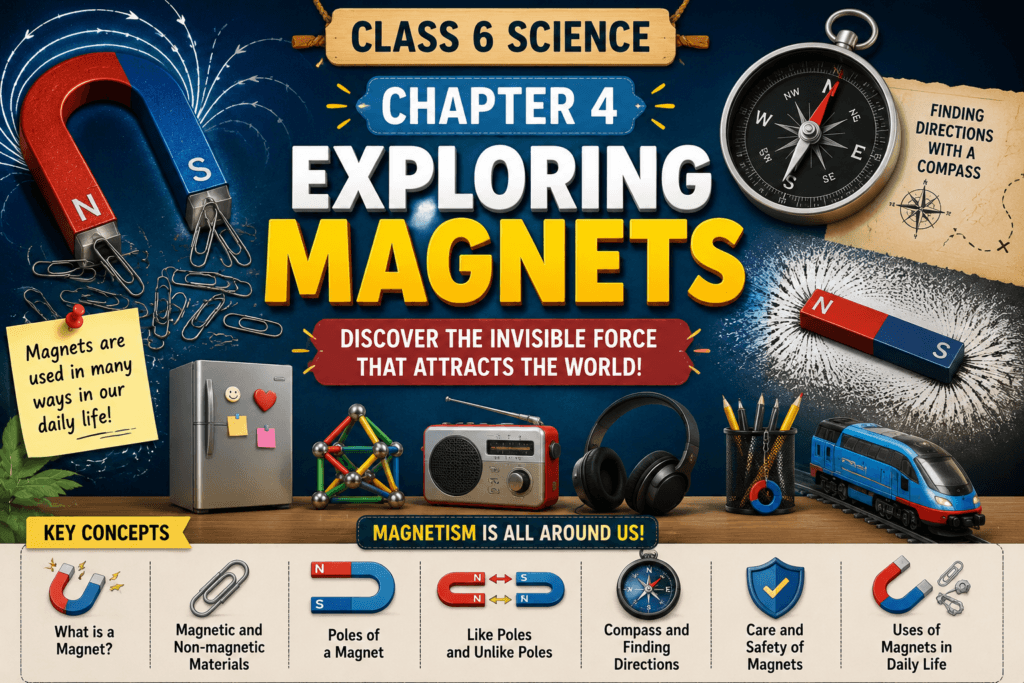
Exploring Magnets Class 6 Worksheet
This Exploring Magnets Class 6 Worksheet provides complete practice based on NCERT Chapter 4. It covers natural and artificial magnets, magnetic and non-magnetic materials, poles of magnets, attraction and repulsion, and practical uses of magnets.
Section A: Multiple Choice Questions (20 Questions)
1. Which natural magnet was known in ancient times?
A. Copper
B. Lodestone
C. Aluminium
D. Plastic
2. Which of the following is attracted by a magnet?
A. Iron nail
B. Rubber band
C. Wood piece
D. Glass marble
3. Which of the following is a non-magnetic material?
A. Steel pin
B. Iron clip
C. Plastic ruler
D. Nickel coin
4. The two ends of a magnet are called:
A. Tips
B. Poles
C. Corners
D. Faces
5. Which part of a magnet attracts most strongly?
A. Middle
B. Poles
C. Flat surface
D. Center line
6. Like poles of two magnets:
A. Attract each other
B. Repel each other
C. Melt together
D. Lose magnetism
7. Unlike poles of two magnets:
A. Repel each other
B. Attract each other
C. Break apart
D. Rotate randomly
8. Which instrument uses a magnet to show direction?
A. Thermometer
B. Compass
C. Microscope
D. Barometer
9. A freely suspended magnet always points in the:
A. East-West direction
B. North-South direction
C. Up-Down direction
D. Circular direction
10. The pole that points north is called the:
A. South pole
B. Magnetic center
C. North pole
D. Neutral pole
11. Which of the following is an artificial magnet?
A. Lodestone
B. Bar magnet
C. Iron ore
D. Rock
12. Which shape of magnet is commonly used in classrooms?
A. Spiral magnet
B. Bar magnet
C. Cone magnet
D. Cube magnet
13. Which device in a school bag may use magnets?
A. Pencil
B. Compass box clasp
C. Notebook paper
D. Eraser dust
14. Which property helps us separate iron filings from sand?
A. Solubility
B. Magnetism
C. Density
D. Color
15. Which material can be magnetized easily?
A. Iron
B. Wood
C. Cotton
D. Rubber
16. Which of the following is a magnetic material?
A. Copper wire
B. Iron screw
C. Glass bead
D. Chalk piece
17. Earth behaves like a:
A. Giant magnet
B. Huge battery
C. Water tank
D. Mirror
18. What happens if a magnet is heated strongly or hammered repeatedly?
A. It may lose magnetism
B. It becomes heavier
C. It changes color
D. It dissolves
19. Which of the following demonstrates repulsion?
A. North pole and south pole brought together
B. North pole and north pole brought together
C. Magnet attracting pins
D. Compass needle aligning north-south
20. Which statement is correct?
A. All metals are magnetic.
B. Magnets attract only iron-like materials.
C. Magnets attract plastic.
D. A magnet has only one pole.
Section B: True or False (10 Questions)
- Lodestone is a natural magnet.
- Magnets attract all kinds of materials.
- The poles of a magnet are the strongest parts.
- Like poles attract each other.
- Unlike poles repel each other.
- A compass contains a small magnet.
- A freely suspended magnet points north-south.
- Earth acts like a giant magnet.
- Heating a magnet can reduce its magnetism.
- Iron filings can be separated from sand using a magnet.
Section C: Fill in the Blanks (10 Questions)
- A natural magnet is called __________.
- The two ends of a magnet are called __________.
- Like poles __________ each other.
- Unlike poles __________ each other.
- A freely suspended magnet points in the __________ direction.
- The instrument used to find direction is a __________.
- The pole that points north is the __________ pole.
- Earth behaves like a giant __________.
- Materials attracted by magnets are called __________ materials.
- Lodestone is a naturally occurring magnetic __________.
Section D: Give Reasons (10 Questions)
- Give reason: Magnets attract iron objects.
- Give reason: The poles of a magnet are more effective than the middle.
- Give reason: Like poles repel each other.
- Give reason: A compass can show directions.
- Give reason: Earth is called a giant magnet.
- Give reason: Iron filings can be separated from sand.
- Give reason: Magnets are useful in refrigerator doors.
- Give reason: Heating a magnet can weaken it.
- Give reason: Not all metals are magnetic.
- Give reason: A suspended magnet always aligns north-south.
Section E: Long Answer Questions (5 Questions)
1. What is a magnet? Explain natural and artificial magnets with examples.
2. Describe magnetic and non-magnetic materials with suitable examples.
3. Explain the properties of magnets, including attraction, repulsion, and directional property.
4. What is a compass and how does it work?
5. Describe five practical uses of magnets in daily life.
Section F: HOTS (Higher Order Thinking Skills) Questions (5 Questions)
1. Why is repulsion considered a sure test for magnetism?
2. If Earth had no magnetic field, how would navigation be affected?
3. Why are magnets used in recycling plants to separate metals?
4. What would happen if a compass were placed near a strong magnet?
5. Why are magnetic door seals useful in refrigerators?
Real Assignment Activity
Investigate Magnetic and Non-Magnetic Materials
Collect 15 small objects from your home or classroom such as a coin, key, pencil sharpener, paper clip, eraser, spoon, button, and rubber band.
Create a table with three columns:
- Object Name
- Prediction (Magnetic or Non-Magnetic)
- Actual Result
Test each object using a magnet and compare your prediction with the result. Write a short conclusion about which materials were attracted and what common property they shared.
Bonus Challenge Questions
- Why do magnets always have two poles?
- Can a broken magnet have only one pole? Explain.
- Research and write about how birds may use Earth’s magnetic field for navigation.
Conclusion
This Exploring Magnets Class 6 Worksheet provides thorough practice on all important concepts of magnetism. By solving these questions and completing the real assignment, students will understand how magnets work and how they are used in everyday life and modern technology.
Additional Resources
- NCERT Science Textbook: https://ncert.nic.in/textbook.php
- NCERT Official Website: https://ncert.nic.in
- FlashCards of this Chapter : Click Here
Recommended Book for Extra Practice
It is especially useful for students who want to go beyond the textbook and build a stronger conceptual foundation.
 Buy Now: https://amzn.to/4uAnwFu
Oswaal CBSE Class-6 One for All Science (Curiosity) for 2026–27 Exam | As Per Latest NCERT & CBSE Syllabus | Chapter-Wise Question Bank, Revision Notes, Theory, Diagrams & Competency-Based Questions
This is a highly recommended resource for students, parents, and teachers looking for a complete practice and revision book for Class 6 Science.