Methods of Separation in Everyday Life Class 6 Worksheet
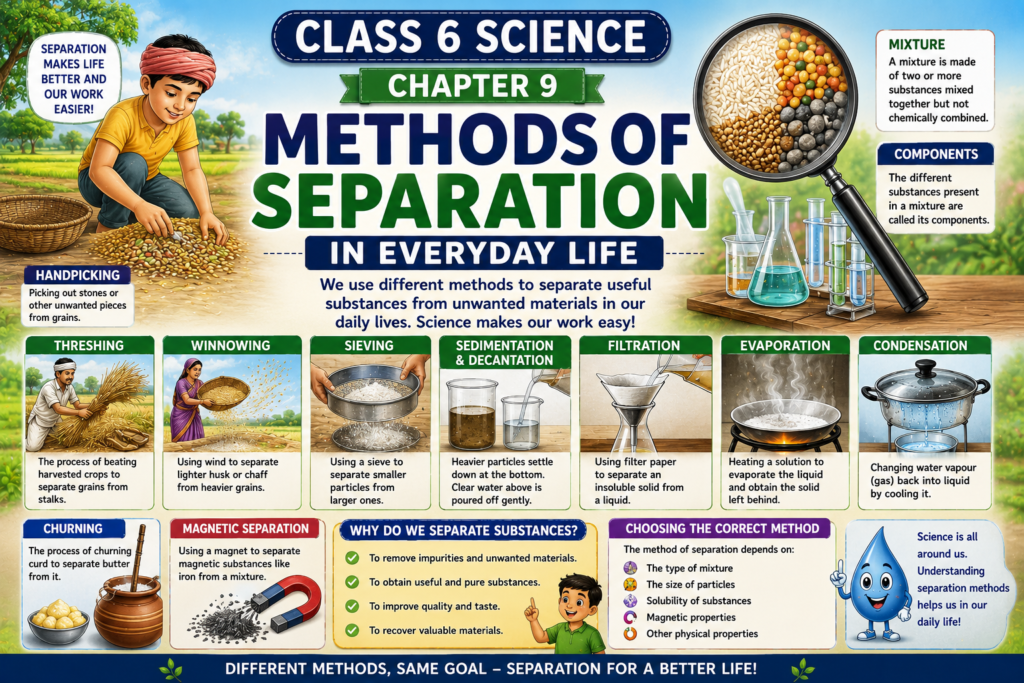
This Methods of Separation in Everyday Life Class 6 Worksheet provides complete practice based on NCERT Chapter 9. It covers mixtures, components, and methods such as handpicking, threshing, winnowing, sieving, sedimentation, decantation, filtration, evaporation, condensation, churning, and magnetic separation.
Section A: Multiple Choice Questions (20 Questions)
1. A combination of two or more substances is called a:
A. Compound
B. Mixture
C. Element
D. Solution
2. Which method is used to remove stones from rice?
A. Filtration
B. Handpicking
C. Evaporation
D. Churning
3. Which method separates grain from stalks?
A. Threshing
B. Winnowing
C. Sieving
D. Loading
4. Which method separates husk from grains?
A. Handpicking
B. Winnowing
C. Filtration
D. Churning
5. Which method separates particles of different sizes?
A. Sedimentation
B. Sieving
C. Decantation
D. Evaporation
6. The settling of heavy particles at the bottom is called:
A. Condensation
B. Sedimentation
C. Churning
D. Loading
7. Carefully pouring off the clear liquid is called:
A. Filtration
B. Decantation
C. Evaporation
D. Winnowing
8. Alum is added to muddy water to speed up:
A. Boiling
B. Loading
C. Dissolving
D. Melting
9. Which method is used to separate tea leaves from tea?
A. Filtration
B. Winnowing
C. Sieving
D. Churning
10. The liquid that passes through a filter is called:
A. Residue
B. Sediment
C. Filtrate
D. Supernatant
11. The solid left on the filter paper is called:
A. Filtrate
B. Residue
C. Vapour
D. Sediment only
12. Which method is used to obtain salt from seawater?
A. Filtration
B. Evaporation
C. Handpicking
D. Churning
13. Conversion of vapour into liquid is called:
A. Evaporation
B. Condensation
C. Freezing
D. Melting
14. Which method is used to obtain butter from curd?
A. Winnowing
B. Churning
C. Sieving
D. Decantation
15. Which method can separate iron filings from sand?
A. Filtration
B. Magnetic separation
C. Sedimentation
D. Evaporation
16. The clear liquid above the sediment is called the:
A. Residue
B. Supernatant
C. Filtrate
D. Vapour
17. Which property is used in winnowing?
A. Solubility
B. Difference in weight
C. Magnetism
D. Colour
18. Which property is used in magnetic separation?
A. Density
B. Magnetism
C. Size
D. Taste
19. Which process combines evaporation and condensation?
A. Distillation
B. Sedimentation
C. Sieving
D. Loading
20. Separation is important because it:
A. Removes impurities
B. Obtains useful substances
C. Improves quality
D. All of these
Section B: True or False (10 Questions)
- A mixture contains two or more substances.
- Handpicking is suitable for removing visible impurities.
- Winnowing uses moving air.
- Sieving separates particles of different sizes.
- Sedimentation occurs when heavy particles settle.
- Filtration can separate insoluble solids from liquids.
- Evaporation can recover dissolved solids.
- Churning separates butter from curd.
- Magnets can separate iron filings from sand.
- Separation methods are useful in daily life.
Section C: Fill in the Blanks (10 Questions)
- A combination of two or more substances is called a __________.
- Removing stones from rice by hand is called __________.
- Separating husk from grains is called __________.
- The settling of heavier particles is called __________.
- The clear liquid above the sediment is the __________.
- The liquid obtained after filtration is the __________.
- The solid left on the filter is the __________.
- Salt is obtained from seawater by __________.
- Butter is separated from curd by __________.
- Iron filings can be separated using a __________.
Section D: Give Reasons (10 Questions)
- Give reason: Stones are removed from rice before cooking.
- Give reason: Winnowing is used after threshing.
- Give reason: Alum is added to muddy water.
- Give reason: Tea is filtered before drinking.
- Give reason: Salt can be obtained from seawater.
- Give reason: Churning separates butter from curd.
- Give reason: Iron filings can be separated with a magnet.
- Give reason: Separation improves the quality of substances.
- Give reason: Different mixtures need different separation methods.
- Give reason: Filtration is widely used in daily life.
Section E: Long Answer Questions (5 Questions)
1. What is a mixture? Why do we separate mixtures?
2. Explain handpicking, threshing, and winnowing with examples.
3. Describe sedimentation, decantation, and filtration.
4. Explain evaporation and condensation with suitable examples.
5. Describe five methods of separation used in everyday life.
Section F: HOTS (Higher Order Thinking Skills) Questions (5 Questions)
1. Why is it important to choose the correct separation method for a mixture?
2. How would you separate a mixture of sand, salt, and iron filings?
3. Why is distillation useful when both components of a mixture are valuable?
4. How are separation methods used in water purification plants?
5. What problems would arise if we had no methods to separate substances?
Real Assignment Activity
Separation at Home Project
Perform any three of the following activities:
- Remove stones from rice.
- Filter tea.
- Churn curd to obtain butter.
- Evaporate salt water.
- Use a magnet to separate iron objects.
Create a table with:
- Mixture Used
- Separation Method
- Property Used
- Final Result
Write a short conclusion about how separation methods make daily life easier.
Bonus Challenge Questions
- Can more than one separation method be used for the same mixture? Explain.
- Why is filtration not suitable for separating dissolved salt from water?
- Research how large industries separate useful substances from crude mixtures.
Conclusion
This Methods of Separation in Everyday Life Class 6 Worksheet provides complete practice on mixtures and separation methods. By solving these questions and performing the assignment, students will understand how scientific techniques help us obtain clean and useful substances in everyday life.
Additional Resources
Recommended Book for Extra Practice
It is especially useful for students who want to go beyond the textbook and build a stronger conceptual foundation.
 Buy Now: https://amzn.to/4uAnwFu
Oswaal CBSE Class-6 One for All Science (Curiosity) for 2026–27 Exam | As Per Latest NCERT & CBSE Syllabus | Chapter-Wise Question Bank, Revision Notes, Theory, Diagrams & Competency-Based Questions
This is a highly recommended resource for students, parents, and teachers looking for a complete practice and revision book for Class 6 Science.
 Buy Now: https://amzn.to/4uAnwFu