Complete CBSE-Ready Globalisation and the Indian Economy Class 10 Notes
(Avoid Common Mistakes)
Daily Update: Quizzes, Flashcards, Tests, Worksheets etc are shared .
1. WHAT IS GLOBALISATION?
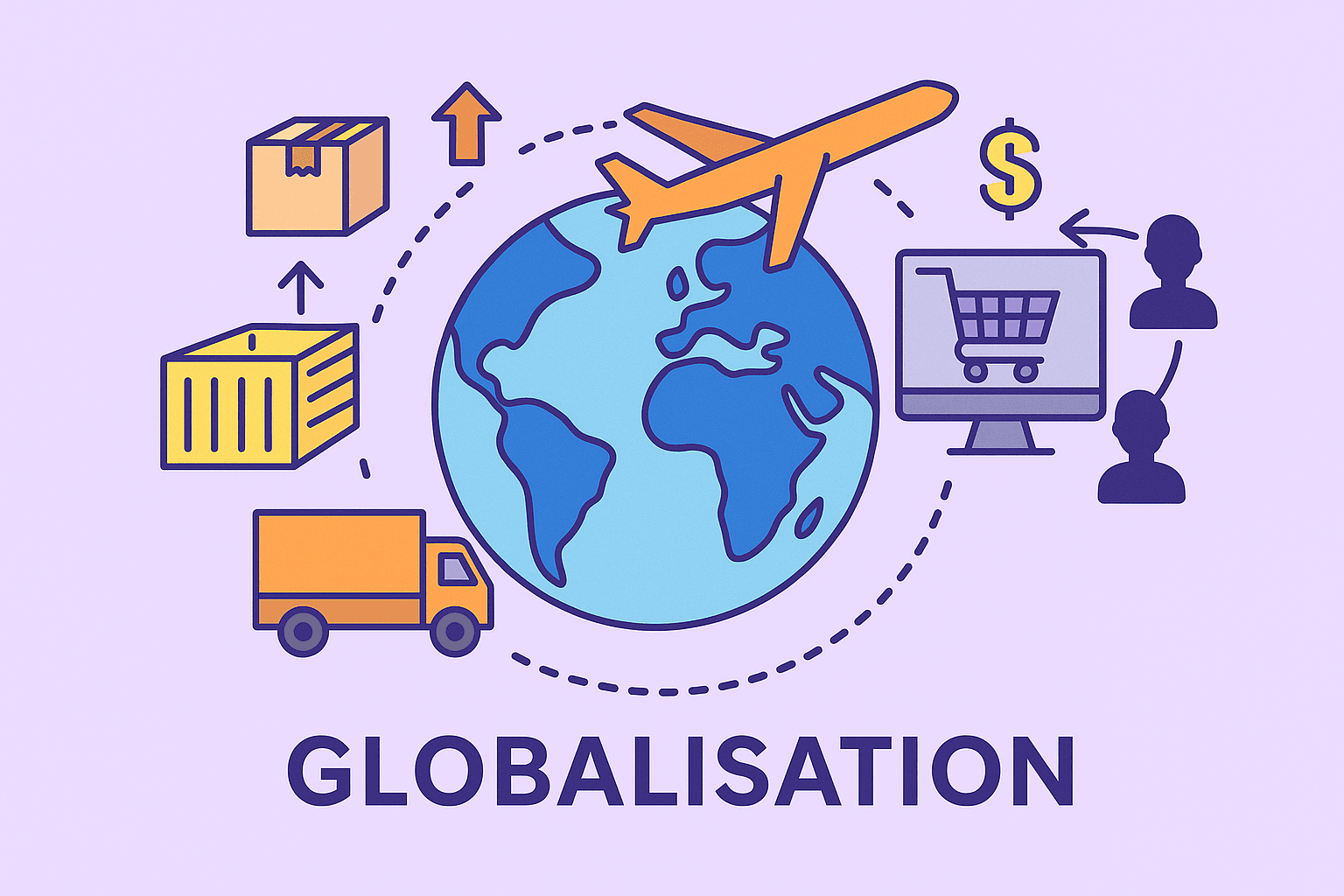
Globalisation refers to the growing connection between different countries through trade, investment, technology, culture, and production. It turns the world into one large marketplace where goods, services, and money can move across borders more freely. In simple words, globalisation means countries becoming more linked and dependent on one another.
Why Globalisation Is Important
It increases trade between nations and creates new business opportunities.
Consumers get more choices and better quality goods.
Companies can sell their products worldwide, increasing profits.
Technology spreads faster, improving communication and productivity.
Globalisation encourages cooperation among nations and supports economic growth.
Globalisation does not benefit everyone equally; therefore, understanding its impact is important for exams and real-life awareness.
2. FACTORS THAT ENABLED GLOBALISATION
Globalisation became possible due to several major changes in technology, trade rules, communication networks, and government policies.
A. Improved Technology
Technological development is the biggest driving force behind globalisation because it brings the world closer.
1. Faster and Cheaper Transport
Cargo ships and containers transport large amounts of goods quickly across oceans.
Airplanes move people and products within hours instead of weeks.
Railways and highways ensure smooth domestic transport and reduce shipping time.
These improvements reduce cost and time, helping companies produce goods in one country and sell them easily in another.
2. Revolution in Communication
Mobile phones, internet, email, and video calls help companies communicate instantly regardless of distance.
Businesses can manage international teams and production processes in real time.
Consumers can buy products online from anywhere in the world.
These changes pushed globalisation to grow faster than ever before.
B. Liberalisation of Trade and Investment Policies
Before 1991, India followed strict trade rules. Importing goods from outside was very difficult. This slowed down growth.
What Happened After 1991?
India introduced economic reforms called Liberalisation.
Major Steps in Liberalisation
Reduced import duties to make foreign goods cheaper.
Removed restrictions on foreign trade.
Allowed Foreign Direct Investment (FDI) so foreign companies could invest in India.
Simplified rules for starting and running businesses.
These changes opened India’s markets and supported globalisation.
3. PRODUCTION ACROSS COUNTRIES
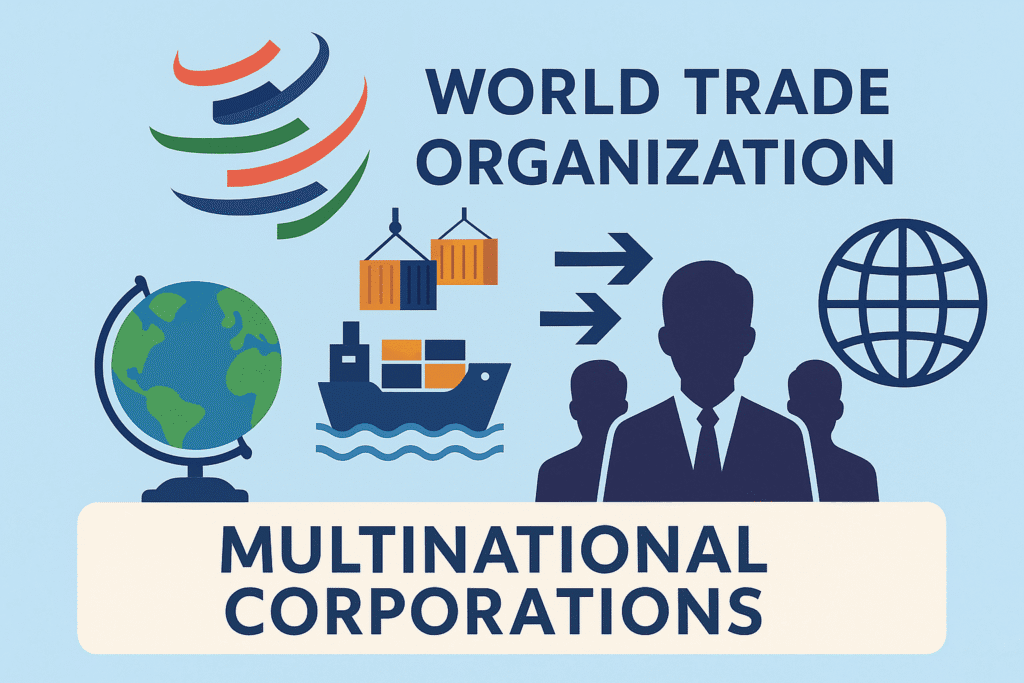
A Multinational Corporation (MNC) is a company that owns or controls production activities in more than one country. Examples include Apple, Samsung, Coca-Cola, Nike, and Honda.
Why MNCs Spread Production Across Nations
To access cheaper labour and reduce production cost.
To get raw materials easily for manufacturing.
To enter new markets for selling products.
To use skilled workers, technology, and global resources effectively.
How MNCs Set Up Production
Starting new factories: They build manufacturing units in countries with low costs.
Forming partnerships / joint ventures: They link with local businesses for quick entry.
Buying local companies: Fastest method to start production using local brand value.
Outsourcing: Small producers supply parts or services to MNCs at lower costs.
This flexibility helps MNCs grow rapidly across continents.
4. INTERLINKING OF PRODUCTION (GLOBAL PRODUCTION NETWORK)
MNCs divide different stages of production across different countries to reduce cost and increase efficiency.
How Production Gets Interlinked
Design may be done in Country A.
Raw materials may come from Country B.
Parts may be manufactured in Country C.
Final assembly may take place in Country D.
Products are sold globally.
This creates a production network spread across multiple nations, where countries depend on one another.
Table 1: Example of Global Production Network
| Stage | Country |
|---|---|
| Design & Technology | USA |
| Raw Materials | Brazil / Australia |
| Component Manufacturing | China / Malaysia |
| Assembly | India / Vietnam |
| Global Sales | Worldwide |
5. FOREIGN TRADE & GLOBAL MARKET INTEGRATION
Foreign trade involves importing, exporting, and connecting global producers with consumers.
Effects of Foreign Trade
Wider choice for consumers: People get access to international brands.
Increase in competition: Domestic producers improve quality and reduce prices.
Opportunities for producers: Indian companies sell goods abroad and expand business.
Market integration: Prices and production in one country influence others.
Foreign trade is one of the strongest forces pushing globalisation in India.
Daily Update: Quizzes, Flashcards, Tests, Worksheets etc are shared .
6. WORLD TRADE ORGANIZATION (WTO)
The WTO is an international organisation that supervises trade rules among countries.
Goals of WTO
Promotes free and fair trade across nations.
Encourages removal of trade barriers.
Ensures transparency in global trading systems.
Provides a platform for countries to negotiate deals.
Criticisms of WTO
Rich countries influence decisions.
Poor nations struggle to protect small producers.
Developed countries maintain hidden trade barriers.
India is a member but demands a more balanced system that supports developing countries.
7. STRUGGLE FOR FAIR GLOBALISATION
Globalisation benefits large companies the most, while small producers and workers often face difficulties.
Challenges Faced by Small Producers
Loss of jobs due to cheaper imports.
Competition from powerful MNCs.
Unstable incomes and lack of government support.
Forced to reduce prices, lowering profit margins.
How to Make Globalisation Fair
Provide training and technology to small businesses.
Implement labour laws to ensure fair wages.
Protect domestic producers through supportive policies.
Strengthen cooperatives and Self-Help Groups.
Negotiate fair trade rules at WTO.
Ensure companies follow safety and labour standards.
Worker unions and social groups also pressure governments to protect poor workers from exploitation.
8. IMPACT OF GLOBALISATION ON INDIA
Positive Impacts
Availability of international brands improves consumer choices.
New job opportunities in IT, BPO, telecom, automobiles, and electronics.
Improved technology and better-quality products.
Growth of export industries like textiles, leather, engineering goods.
Indian companies like Infosys, TCS, Tata Motors operate globally.
Negative Impacts
Small-scale industries struggle to compete with MNCs.
Fear of job insecurity due to contract-based work.
Unequal benefits — skilled workers gain more than unskilled.
Farmers face unstable prices due to global market fluctuations.
Cultural influence may reduce traditional values.
Globalisation creates opportunities but also challenges that need balanced government policies.
📊Table 2: Positive vs Negative Impact of Globalisation in India
| Positive | Negative |
|---|---|
| More consumer choices | Small producers lose market |
| More jobs in IT/BPO | Job insecurity increases |
| Improved technology | MNC dominance |
| Export growth | Farmers face price fluctuations |
| Indian companies go global | Workers face poor conditions |
9. ROLE OF GOVERNMENT IN GLOBALISATION
Government plays a crucial role in ensuring fair benefits for everyone.
Government Should:
Provide subsidies to small industries.
Regulate MNCs to prevent exploitation.
Invest in skill development training.
Protect farmers from price fluctuations.
Improve infrastructure (roads, power, internet).
Encourage innovation and local manufacturing.
Strong policies protect vulnerable sections from global competition.
10. KEY TERMS (EXAM-ORIENTED DEFINITIONS)
Globalisation: Integration of economies through trade, investment, and technology.
Liberalisation: Removal of restrictions on trade and business.
Privatisation: Shifting control from government to private companies.
FDI (Foreign Direct Investment): Investment by foreign companies in India.
MNC: A company operating in more than one country.
Trade Barrier: Any restriction on import/export.
WTO: Organisation regulating global trade.
11. IMPORTANT QUESTIONS (WITH ANSWERS)
Q1. What is globalisation? Explain with an example.
Globalisation refers to the process where countries become interconnected through trade, investment, and technology. For example, a mobile phone designed in the USA, assembled in China, and sold in India shows how globalisation links production and markets across nations.
Q2. How do MNCs spread production across countries?
By setting up factories where labour is cheap.
By forming partnerships with local companies.
By buying existing domestic companies.
By outsourcing some activities to small producers.
This helps reduce cost and increase profit.
Q3. How has globalisation affected Indian producers?
Positive effects include access to global markets and better technology. Negative effects include tough competition, job loss for small businesses, and unstable incomes for farmers.
Globalisation and the Indian Economy Class 10 Notes
FAQs
1. What is the meaning of globalisation in simple words?
Globalisation means increasing connection between countries through trade, technology, communication, and investment. It allows goods, services, and people to move more easily across borders. For example, clothes designed in Europe, made in Bangladesh, and sold in India show globalisation. It gives consumers more choices, improves product quality, and supports economic growth. However, globalisation also creates competition and challenges for small producers, which is why government regulation is important.
2. How do MNCs benefit developing countries like India?
MNCs benefit India by bringing foreign investment, advanced technology, and better management practices. They create jobs in manufacturing, automobiles, IT, electronics, and retail sectors. Local companies supply parts to MNCs, increasing business opportunities. Foreign brands increase product variety and quality. Export industries grow because MNCs help Indian products reach global markets. However, MNCs also create competition for small industries, so the government must ensure fair rules.
3. Why does globalisation increase competition?
Globalisation increases competition because foreign companies enter domestic markets with better technology, higher quality, and lower prices. This forces Indian producers to improve standards, reduce cost, and innovate to survive. Consumers benefit because they get better products at cheaper prices. While competition is healthy for the economy, it becomes challenging for small-scale industries that cannot match the scale or price of MNC products. Hence, support for small producers is needed.
4. What is the role of WTO in globalisation?
WTO (World Trade Organization) creates rules for international trade and ensures countries follow these rules. It promotes free trade by encouraging nations to reduce taxes and barriers on imports and exports. WTO also settles trade disputes between countries. However, many developing countries argue that WTO favours rich nations, allowing them to protect their own industries while forcing poor countries to open their markets. India demands fair and balanced trade policies.
5. What steps can make globalisation fair for all?
Fair globalisation means everyone benefits equally, not just large companies. To achieve this, the government must protect small farmers and producers through subsidies, low-interest loans, and training. Workers should get fair wages, safe working environments, and job security. MNCs must follow labour laws and environmental rules. Trade agreements should support developing countries. Strengthening SHGs, MSMEs, and local industries ensures globalisation becomes more inclusive and just.
MCQs
Q1. Globalisation mainly refers to—
a) Isolation of markets b) Connecting world markets c) No exports d) Only domestic trade
Answer: b) Connecting world markets
Q2. MNC stands for—
a) Multi National Corporation b) Massive National Company c) Multi Network Corporation d) Managed National Chain
Answer: a) Multi National Corporation
Q3. India liberalised its economy in—
a) 1970 b) 1991 c) 2000 d) 1985
Answer: b) 1991
Q4. WTO promotes—
a) Free trade b) High taxes c) Ban on imports d) Government monopoly
Answer: a) Free trade
Q5. Outsourcing means—
a) Producing everything inside country
b) Giving work to small producers
c) Stopping foreign trade
d) Increasing import tax
Answer: b) Giving work to small producers
Q6. A major negative impact of globalisation on small producers is—
a) More exports b) Loss of market c) Better technology d) Higher profits
Answer: b) Loss of market
Q7. Which of the following is NOT an MNC?
a) Honda b) Nike c) Reliance Digital d) Coca-Cola
Answer: c) Reliance Digital
Q8. Foreign trade results in—
a) Fewer choices b) Price rise c) Market integration d) Less competition
Answer: c) Market integration
Q9. Which sector received most globalisation benefit in India?
a) Fisheries b) IT & BPO c) Handloom d) Mining
Answer: b) IT & BPO
Q10. Cheapest labour is one reason MNCs locate in—
a) USA b) Germany c) India d) Japan
Answer: c) India
Q11. Globalisation leads to—
a) More competition b) Less trade c) No investment d) Decrease in technology
Answer: a) More competition
Q12. WTO is criticised because—
a) Supports poor nations b) Favours rich nations c) Reduces taxes d) Gives loans
Answer: b) Favours rich nations
Q13. Production across countries is controlled by—
a) MNCs b) Farmers c) SHGs d) Students
Answer: a) MNCs
Q14. Example of foreign investment—
a) Local shop investing in school
b) Samsung opening factory in India
c) Farmer buying seeds
d) Government building road
Answer: b) Samsung opening factory in India
Q15. Globalisation increases—
a) Domestic isolation b) World competition c) Only local production d) Only agriculture
Answer: b) World competition
Q16. What helps globalisation grow?
a) Slow internet b) Expensive transport c) Better technology d) Fewer communication tools
Answer: c) Better technology
Q17. Trade barrier example—
a) Import tax b) Discount offers c) More exports d) Free shipping
Answer: a) Import tax
Q18. Which industry got outsourcing benefits?
a) Iron & Steel b) IT Services c) Food grains d) Agriculture
Answer: b) IT Services
Q19. Fair globalisation aims to protect—
a) MNCs b) Small producers c) Only rich d) Only government
Answer: b) Small producers
Q20. Globalisation links—
a) Separate markets b) National & international markets c) Only villages d) Only towns
Answer: b) National & international markets
Daily Update: Quizzes, Flashcards, Tests, Worksheets etc are shared .
5-Marker Questions
Q1. Explain how globalisation has affected Indian producers and workers. Give both positive and negative impacts.
Globalisation has created a wide range of opportunities for Indian producers and workers, but it also introduced challenges because of global competition. Understanding both sides is crucial for exams.
Positive Impacts on Producers
Access to global markets: Indian companies sell products worldwide, increasing profit and production.
Improved technology: MNCs introduced advanced technology, increasing productivity and efficiency.
Growth in export industries: Textiles, leather, chemical, automobile and service industries expanded rapidly.
Better quality standards: Competition motivated Indian producers to improve quality and reduce production cost.
Positive Impacts on Workers
New jobs: IT, BPO, telecommunications, automobile, electronics and retail sectors created lakhs of jobs.
Skill development: Training programs increased demand for skilled labour and improved wages in some sectors.
Negative Impacts on Producers
Competition from MNCs: Small industries struggle to compete with cheap imported goods.
Many local producers forced to shut down: Low-cost imports reduce profits of small units.
Dependence on global prices: Producers face losses when international prices fluctuate.
Negative Impacts on Workers
Job insecurity: Contract-based work increased, reducing stability.
Low wages in small industries: Many workers are hired temporarily with minimal benefits.
Poor working conditions: Pressure to reduce costs leads to long working hours and safety issues.
Overall, globalisation gives benefits but increases inequalities, which is why government support is needed.
Q2. What are Multinational Corporations (MNCs)? How do they interlink production across countries?
MNCs are companies that operate in multiple countries at the same time. They control production, marketing, and distribution across different regions.
How MNCs Interlink Production
Cost optimisation: MNCs locate each stage of production where it is cheapest (materials, labour, electricity).
Example of division:
Design in USA
Raw materials from Brazil
Components from China
Assembly in India
Sales worldwide
Partnerships: They collaborate with local manufacturers for supply of parts and services.
Outsourcing: Customer support, IT services and small-scale manufacturing are outsourced to countries like India.
This interlinking connects the world economy and forms a global production network.
Q3. Why is fair globalisation necessary? Suggest ways to achieve it.
Globalisation benefits big corporations more than small producers and workers. Therefore, fair globalisation ensures that everyone — especially poor and developing nations — gains equally.
Why Fair Globalisation Is Necessary
To prevent exploitation of small workers and farmers
To protect local industries from collapse
To ensure equal wages and safe working conditions
To reduce inequality between rich and poor countries
To support sustainable growth
Ways to Ensure Fair Globalisation
Government support: Provide subsidies, training, and technology to small producers.
Strong labour laws: Ensure fair wages, safe workplaces, and job security.
Fair trade negotiations: Push for trade rules that help developing countries, not just rich nations.
Regulate MNCs: Check that they follow safety standards and environmental rules.
Support local industries: Promote Make in India, MSMEs, and cooperatives.
Strengthen SHGs: Women and small entrepreneurs should get easy loans and training.
Fair globalisation ensures growth with justice.
Supportive Study Material Class 10 Science
- Class 10 Science Quiz
- Class 10 Science tests
- Class 10 Science Worksheets
- Class 10 Science PYQs
- Class 10 Science NCERT Solution